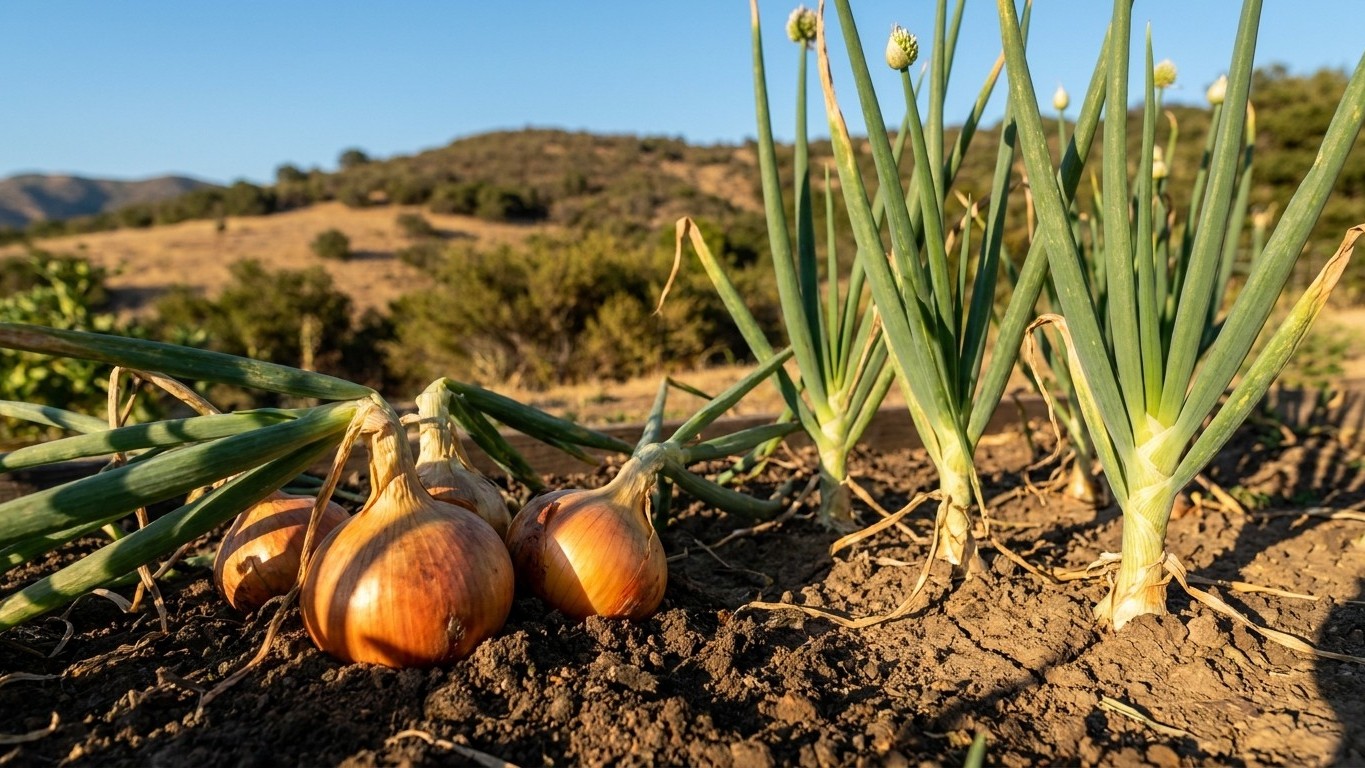

In Saskatchewan, onions are ready to lift once most of the tops have fallen over and started to yellow, usually in late summer and before a hard freeze. Dig them on a dry day. Cure them in a warm, airy, sheltered spot until the necks are tight and the skins papery. Only then do they go into storage. Cured bulbs keep best in cool, dry air, which rules out the refrigerator and most of the garage.
When should you lift onions in Saskatchewan?
The calendar matters less than the daylight the plants have already received. Bulbing is triggered by day length. At Saskatoon, 52.17 degrees north (the station at Saskatoon Diefenbaker International Airport, according to Environment and Climate Change Canada), the longest day of the year brings 16 h 31 of daylight. That is long enough to satisfy a long-day onion, which waits for 14 to 16 hours before it starts swelling. A short-day variety starts bulbing at about 12 hours, according to Clemson Cooperative Extension, so it bulbs early and stays small this far north. The variety you planted sets the pace of the whole season. Our guide to The Best Onion Varieties for Saskatchewan covers which ones suit the province.
Gardeners near the edges of the province should check their own latitude. A garden in the far north of the territory sees longer summer days than one in the south, and that difference matters when bulbs size up.
Once bulbing is under way, the plant tells you when it is finished. The necks soften, the tops flop over, and the leaves turn yellow from the tips down. When most of the row looks like that, stop watering and let the soil dry for a few days. Then lift the bulbs with a garden fork, working a few inches out from the row so the tines do not spear them. Slow plants in the same row can stay in the ground a little longer, but don’t wait for a hard freeze to decide for you.
Handle them gently. A bruised or nicked bulb is where rot starts in storage, and bulbs chewed by maggots rarely keep. If you saw damage during the season, What Eats Onion in Saskatchewan, and When explains what was likely responsible. Set those bulbs aside to eat first. Do not wash any onion you plan to store, and brush off loose dirt only after it dries.
How do you cure onions after lifting?
Curing dries the outer skins and seals the neck, where rot organisms get in. Bulbs go into storage only after curing, never straight from the ground.
Where to spread them out
Lay the bulbs in a single layer, tops still attached, in a place that is warm, dry and well ventilated, but out of direct sun and out of the rain. A covered porch, an open shed, a garage with the door cracked, or a table in a breezy carport all work. Racks, window screens or slatted crates let air reach every side. Prairie late summers are often dry, but a rainy spell is common enough that you should always have a covered spot ready. A small fan helps when the air is damp.
How to tell they are done
Curing time depends on the weather, the size of the bulbs and how thick the necks are. Use the bulb itself as the clock. Cured onions show all of these signs:
- The neck is dry, tight and no longer squeezes when pinched.
- The outer skins are papery and rustle when you rub them.
- The roots are shriveled and wiry.
- The tops are fully brown and dry.
When the bulbs pass, trim the roots close and cut the tops above the bulb. Keep any bulb with a thick, green neck out of storage. It still holds moisture and will rot first.
Keeping them, and for how long
Cured onions want it cool and dry. Clemson Cooperative Extension’s Home & Garden Information Center puts it this way: “Ideal conditions are between 45 °F and 55 °F, and 50 to 60 percent humidity.” The number to write down is 45 °F to 55 °F with 50 to 60 percent humidity, and it is worth taping to the wall where you store the crop.
The humidity is the part gardeners most often get wrong. Onions want dry air, which is the opposite of what carrots, beets and other roots need. Roots do best in cold, damp storage, and a single cellar cannot hold both groups well. If you grow both, give the onions their own shelf in the driest, warmest corner and put the roots somewhere damper.
How long they last is a separate question, and the answer is always a ceiling. A length of storage quoted for a variety applies to perfect conditions and perfect bulbs. Most home spaces fall short of that. Pungent, thick-skinned varieties generally keep much longer than sweet, mild ones, which are best eaten first. A sweet onion that has been in storage for a few months has probably already done what it is going to do.
Store them in mesh bags, open baskets or slatted crates so air moves around the bulbs. Do not seal them in plastic, and do not pile them deep. Keep them away from potatoes, which give off moisture, and check the batch for damp or rot. One soft bulb can spoil the ones beside it, so remove it as soon as you find it. Sprouting is the other warning sign. A bulb that starts to green at the neck is telling you the space is too warm or too damp, and that bulb should go to the front of the line for cooking.
If you want more background on growing the crop from planting onward, start with Onions in Saskatchewan.
Where in the house that actually is
Few homes have a spot that holds 45 °F to 55 °F and 50 to 60 percent humidity all winter. Here is how the usual places compare.
| Location | Temperature | Humidity | Verdict |
|---|---|---|---|
| Refrigerator | Colder than the range | Often damp in the crisper | Too cold; bulbs soften and sprout |
| Heated living space or kitchen | Warmer than the range | Varies | Too warm; short life |
| Attached garage | Swings with the weather | Swings with the weather | Risky; freezing ruins bulbs |
| Cool interior basement room or closet | Closest to the range | Check it; can run damp | Best bet |
A domestic fridge runs colder than onions like, and the crisper drawer tends to be humid. A heated room is too warm, and bulbs sprout or shrivel there. A garage follows the weather, so on a Saskatchewan prairie winter it can drop well below freezing, and a frozen bulb turns to mush when it thaws. In fall it can be too warm for storage.
The closest match in most houses is an unheated or lightly heated interior room, such as a cool basement room, a closet against an inside wall, or a cold cellar that stays dry. Keep the bulbs off the floor and away from the furnace, the water heater and any exterior wall that gets cold. Basements often run damp in spring and early summer, so watch for that.
Put a thermometer and a hygrometer where the onions will sit before you move the crop in. Read them in the morning and again in the evening. If the temperature stays between 45 °F and 55 °F and the humidity stays between 50 and 60 percent, you have a good spot. If the space runs damp, a small fan or a dehumidifier can pull the numbers back. If it runs warm, try a lower shelf or a different room.
Common questions
Can I leave onions in the ground until frost?
A light frost will not hurt them, but a hard freeze can damage the bulbs and shorten storage life. Lift them once the tops have fallen over and before hard freezing weather is forecast.
What if it rains while the onions are curing?
Move them under cover straight away and give them airflow with a fan. Wet bulbs left outside can rot at the neck before they are cured. Spread them out again once the surfaces are dry.
What should I do with onions that have thick necks?
Eat them first. A thick neck stays moist, and moisture lets rot in. Use these bulbs in the kitchen within a few weeks and save the tight-necked bulbs for storage.
Can I store onions with carrots or potatoes?
It is best to keep them apart. Onions need dry air at 50 to 60 percent humidity, while carrots want cold, damp storage. Potatoes release moisture that can speed up onion rot. Use separate shelves or separate rooms.