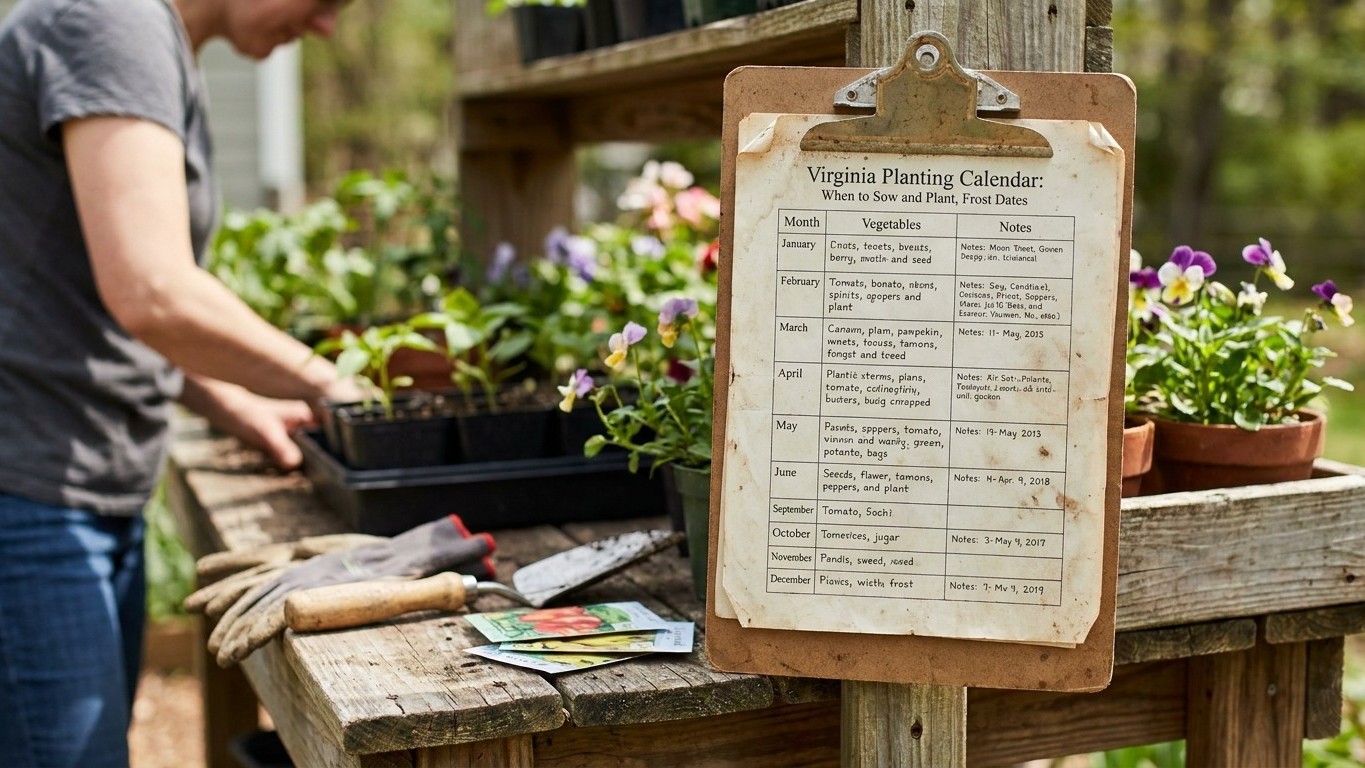

Virginia’s growing season runs from the last spring frost to the first fall frost. NOAA’s National Centers for Environmental Information puts the last spring frost at March 20 to April 3 and the first fall frost at November 10 to November 24, using 1991-2020 climate normals recorded at the NAS Oceana station near Virginia Beach. Those dates mark the mild, coastal edge of the state. Before you commit to a planting day, check your own county’s frost data through Virginia guides or the state extension service, since inland and mountain counties run weeks behind the coast.
The frost window in Virginia

Your last spring frost decides almost everything you plant this year, and near the Virginia coast it usually lands somewhere between late March and early April. Farther inland or up in the mountains, that date arrives weeks later, so the same calendar page doesn’t apply to your yard. Before you sow anything, look up the frost record for your own county rather than going by a statewide guess — it’s the one number that actually governs when your peas, lettuce, and tomatoes belong in the ground.
How the growing season length works out
Counting from the earliest possible last frost to the earliest possible first frost gives a season of roughly 221 days. Counting from the latest last frost to the latest first frost gives close to 249 days. In practice, most years near Virginia Beach land somewhere in that band, call it roughly 220 to 250 frost-free days. That is a long window by East Coast standards, long enough for two full plantings of many crops if you time the second one off the fall frost date rather than the calendar.
Move away from the coast and the math changes. The Blue Ridge counties and the far southwest of the state see their last spring frost weeks later than Virginia Beach and their first fall frost weeks earlier, which shortens the growing season from both ends at once. A gardener in those higher counties should treat the coastal dates as a floor, not a target, and lean on locally recorded frost data rather than a statewide average. That same shortened window also matters throughout the year, so it’s worth checking What to Plant in Virginia in January before the season even begins, What to Plant in Virginia in February while you’re still planning ahead, What to Plant in Virginia in March as the frost window narrows, What to Plant in Virginia in April as the season gets underway, What to Plant in Virginia in May be, and What to Plant in Virginia in June as the season hits its stride, What to Plant in Virginia in July once the heat of summer sets infore your spring crops go in, What to Plant in Virginia in August as summer crops peak, What to Plant in Virginia in September as you plan your second planting, What to Plant in Virginia in October as the season starts to turn, and What to Plant in Virginia in November before the first fall frost closes out your cool-season crops, or What to Plant in Virginia in December if you’re pushing into the last stretch. Gardeners just across the mountains in West Virginia deal with an even more compressed window, and the West Virginia planting calendar lays out how much further that pushes spring sowing back.
Cool-season crops
Cool-season vegetables go in the ground before the last frost date because their germination and early growth tolerate cold soil and a light freeze better than warm-season crops do. Peas, spinach, lettuce, the brassica family (broccoli, cabbage, kale), and root crops like carrots and beets all fall into this group. The trigger for sowing them is the frost date itself, not a fixed date on the calendar, which matters because that date shifts by two weeks even within the coastal band NOAA reports.
Timing relative to the frost date
Peas and spinach can go into the ground several weeks before the last spring frost, since their seed germinates in cold soil and the seedlings shrug off a light freeze. Lettuce and the brassicas are usually started a few weeks earlier still if you are transplanting indoor-started seedlings, or direct-sown a bit closer to the frost date if you are seeding straight into the garden. Root crops like carrots, beets, and radishes are almost always direct-sown, timed to go in a few weeks ahead of the last frost so they have cool soil to germinate in.
- Peas: sow as soon as the soil can be worked, well ahead of the last frost
- Spinach: direct-sow several weeks before the last frost
- Lettuce: transplant or direct-sow a few weeks before the last frost
- Brassicas (broccoli, cabbage, kale): transplant a few weeks before the last frost
- Carrots and beets: direct-sow a few weeks before the last frost, into cool soil
The risk with cool-season crops isn’t cold, it’s heat. Lettuce and spinach bolt and turn bitter once the days warm up, so the practical limit on how late you can start them in spring is the arrival of consistent heat, not the last frost date. Near Virginia Beach that heat tends to arrive earlier than it does in the mountains, which is one more reason a single statewide sowing date doesn’t serve every gardener equally well.
Warm-season crops

Tomatoes, peppers, squash, beans, and corn all need warm soil to germinate and grow, and a warm-season transplant set out too early just sits and sulks even if the air temperature is technically above freezing. That’s why soil temperature, not the frost date alone, is the real gate for these crops. The frost date tells you when the risk of a killing freeze has dropped off. Soil warming tells you when the plant will actually grow once it’s in the ground, and the two don’t always line up on the same week.
Counting back for indoor starts
Tomato and pepper transplants are usually started indoors and set into the garden a few weeks after the last frost date, once the soil has had time to warm. Working backward from a planting-out date in the window after March 20 to April 3, most tomato and pepper seedlings need roughly six to eight weeks of indoor growing time before they are ready to go out, which puts the seed-starting window in early to mid February for a setting-out date in early to mid April. Squash, beans, and corn are usually direct-sown instead, and go into the ground after the soil has warmed rather than on a fixed date.
Catalogue days-to-maturity figures are counted from the transplant date, not the seed-starting date, and they shift by a week or two depending on the season’s weather. Setting transplants out in the early April to mid April window near Virginia Beach, and counting forward using each variety’s published days to maturity, gives a workable estimate of first harvest and how much margin remains before the first fall frost arrives in the November 10 to November 24 window.
| Variety | Type | Days from transplant | Notable resistance | Estimated first ripe | Margin before fall frost |
|---|---|---|---|---|---|
| Sakura | Indeterminate | 55 | Nematodes, ToMV, Fusarium 1&2 | Mid June | 152 days |
| Edox | Indeterminate | 55 | Nematodes, ToMV, Fusarium 1&2 | Mid June | 152 days |
| Valentine | Indeterminate | 55 | Early Blight | Mid June | 152 days |
| Glacier | Determinate | 55 | None listed | Mid June | 152 days |
| Sun Gold | Indeterminate | 57 | TMV, Fusarium 1 | Mid June | 150 days |
| Supersweet 100 | Indeterminate | 60 | Verticillium, Fusarium 1 | Mid June | 147 days |
| Juliet | Indeterminate | 60 | Late Blight, Early Blight | Mid June | 147 days |
| Amalfi | Determinate | 68 | Nematodes, Late Blight, Early Blight | Late June | 139 days |
| Cherokee Purple | Indeterminate | 72 | None listed | Late June | 135 days |
| Big Beef Plus | Indeterminate | 72 | Nematodes, Gray Leaf Spot, ToMV | Late June | 135 days |
| Tiren | Indeterminate | 75 | Verticillium, ToMV, Fusarium 1 | Early July | 132 days |
| Granadero | Indeterminate | 75 | Nematodes, Verticillium, ToMV | Early July | 132 days |
| San Marzano II | Indeterminate | 78 | None listed | Early July | 129 days |
| Celebrity Plus | Determinate | 78 | Nematodes, Gray Leaf Spot, ToMV | Early July | 129 days |
Every variety on this list, even the 78-day San Marzano II and Celebrity Plus, finishes with well over four months of margin before the earliest possible fall frost near Virginia Beach. That margin shrinks fast, though, if you’re gardening at higher elevation or further inland, where the fall frost date arrives earlier and the spring soil warms later.
The fall planting window
Fall planting works backward from the first frost instead of forward from the last one. Take a crop’s days to maturity, add roughly two to three weeks of margin for the slower growth that comes with shortening daylight in September and October, and count back from NOAA’s first fall frost window of November 10 to November 24 near Virginia Beach. That gives a sowing window, not a single day, and it moves earlier the further you are from the coast.
Crops that finish after a light frost
Many of the same cool-season crops planted in spring go back into the ground in mid to late summer for a fall harvest, and several of them actually improve after a light freeze. Kale and Brussels sprouts sweeten once cold weather converts some of their starches to sugars. Carrots and parsnips left in the ground through a light frost do the same, and spinach often tastes better after a cold snap than it did in the heat of early fall. None of these crops need protection from the first frost. What they need protection from is a hard freeze deep enough to damage the roots or collapse the leaves outright, which is a different threshold than the 32°F freeze that defines NOAA’s frost date.
Fast crops like radishes, spinach, and lettuce can often be sown into late summer and still mature well ahead of the first fall frost, even in the November 10 window. Slower fall crops such as broccoli and cabbage need to go in earlier, usually as transplants rather than direct-sown seed, so that most of their growing is done before the daylight and temperature drop off in October. A gardener planning a fall garden should look at a crop’s days to maturity, add the frost-slowdown margin, and count backward from whichever end of the November 10 to November 24 range applies to their location, using the earlier date if they are inland or at elevation.
Reading a planting calendar properly
A statewide planting calendar, this one included, is built from a single weather station’s data and applied across a state with mountains, coastline, and everything in between. NOAA’s frost normals for this page come from the NAS Oceana station near Virginia Beach, and that station’s readings do not describe conditions in Roanoke, Wytheville, or the Shenandoah Valley. Treat every date on this page as a starting estimate to test against your own garden, not a fixed instruction.
Microclimates that shift the dates
Elevation is the biggest factor. Every rise in elevation delays spring warming and speeds up fall cooling, which is why the mountain counties see a shorter season from both directions at once. Urban and suburban areas run warmer than surrounding open country because pavement and buildings hold heat overnight, so a city garden can sometimes push a week or two past a rural frost date without damage. Low spots in a yard collect cold air on a still night and frost first, while a slope or a spot near a south-facing wall often stays frost-free later into spring and earlier into fall than the rest of the property.
The only way to know your own numbers is to keep a record: note the date of your last damaging frost each spring and your first each fall, for a few years running, right where you garden. That local log will tell you more than any statewide average, and it’s the same principle behind the county-level advice available through the extension service. Gardeners in New Jersey deal with the same problem of a single coastal station standing in for a climatically varied state, and the fix is identical: local observation over time beats a single published date.
Local help
County-level frost dates, soil testing, and variety recommendations specific to your part of the state are available through the Virginia Cooperative Extension, the state’s land-grant extension service. Their local offices can also tell you whether your county runs closer to the coastal dates cited here or several weeks behind them, which matters more than anything printed on a seed packet. A soil test through the same office will tell you whether your ground is ready for the crops in this calendar regardless of what the thermometer says.
Common questions
What zone is Virginia for planting?
Virginia spans several USDA hardiness zones from the coast to the mountains, and hardiness zone is about winter cold survival for perennials, not about when to plant vegetables in spring. For vegetable timing, the frost dates in this guide matter far more than the zone number.
Can I plant tomatoes before the last frost date if I cover them?
You can protect a tomato plant from air temperature with a cover, but covering it does nothing for cold soil, and a transplant set into ground that hasn’t warmed will simply stall until conditions catch up. Waiting until soil has warmed, even a week or two after the last frost date, usually beats an early planting under cover.
Why do my neighbors in another county plant weeks earlier than me?
They’re likely closer to the coast or at lower elevation, both of which push the last spring frost earlier and the first fall frost later. NOAA’s coastal data for Virginia Beach does not apply evenly across the state, and a county 100 miles inland or a few hundred feet higher can run two or three weeks behind on the same crop.
Is it too late to plant a fall garden if I missed the summer sowing window?
It depends on the crop. Fast growers like radishes and lettuce can still be sown quite late relative to the first fall frost and finish in time, while slower crops like broccoli or cabbage need to have gone in as transplants much earlier to mature before growth slows in October.
Do frost dates mean it can’t freeze before or after that window?
No. NOAA’s frost dates represent a probability band, not a guarantee, so a freeze earlier than the stated fall window or later than the stated spring window is possible in any given year. Keep row cover or another frost protection method on hand near both ends of the season rather than treating the date as a hard cutoff.
Related guides
- Maryland Planting Calendar: When to Sow and Plant, Frost Dates Included
- West Virginia Planting Calendar: When to Sow and Plant, Frost Dates Included
- Arizona Planting Calendar: When to Sow and Plant, Frost Dates Included