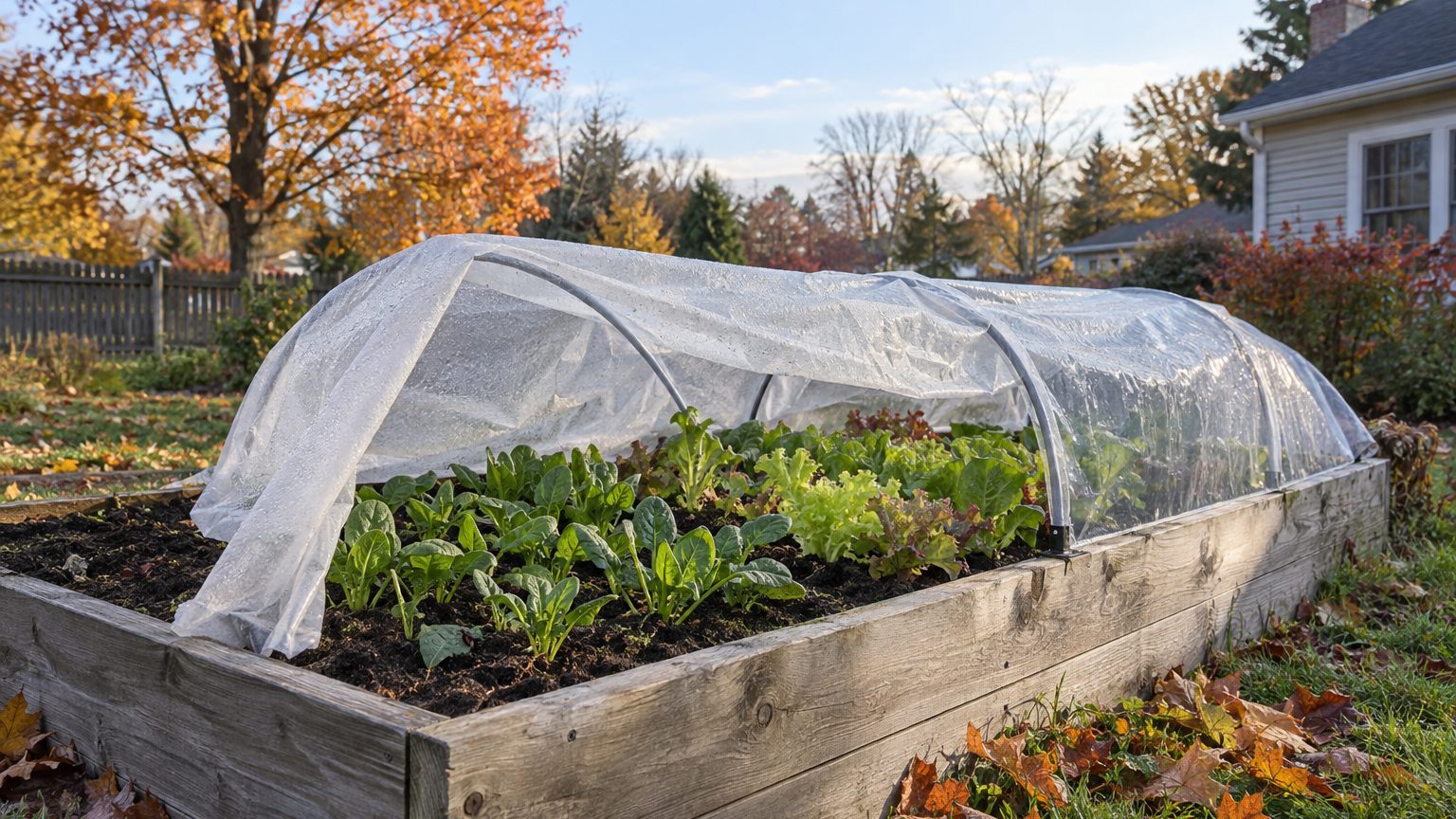

Coastal Virginia’s last spring freeze falls between March 20 and April 3, but that date marks the end of frost risk, not the start of good planting. Season extension in Virginia works best when it waits for warm soil and then stretches a long window at both ends with passive covers. The figures here come from one coastal station, so readers in the mountains should shift everything later in spring and earlier in fall.
When the soil is warm enough in Virginia
The date most gardeners ask about is the last spring frost. For Virginia Beach, the NOAA NCEI 1991-2020 Climate Normals (station USW00013769, NAS Oceana) put it between March 20 and April 3, based on the 30-70% band of 32°F freeze probabilities. Treat it as a probability, not a promise. Some springs will freeze after April 3, and some will have stopped freezing before March 20.
The frost date is also a proxy, and a sloppy one. Season extension waits for warm soil, and soil warms after the frost risk ends, not with it. Air can climb above freezing in a day. A bed holding winter’s cold takes weeks to catch up, because wet soil absorbs a great deal of heat before its own temperature moves.
Station USW00013769 sits at the mild end of the state. The Blue Ridge and southwest Virginia run weeks later in spring and earlier in fall, so a gardener in Roanoke, Abingdon or the Shenandoah Valley should not borrow these dates. Treat them as the coastal baseline.
Why the calendar runs ahead of the ground
Seed sown into cold, saturated soil mostly sits. Some rots, some germinates unevenly, and transplants stall with their roots barely working even when the leaves look fine. A cheap soil thermometer pushed a few inches deep in the morning tells you more than the date does. Your state extension office publishes the soil temperature each crop needs, and those thresholds vary by crop, so look them up instead of guessing.
What a cover does, and what it does not
A cover can warm the ground ahead of planting. Laid over a bed for a couple of weeks, fabric or plastic traps heat that the soil radiates and keeps the air still, so the surface warms faster than bare ground would. At night, that same trapped warmth slows the drop in temperature. A second layer, such as fabric draped inside a hoop structure, adds another pocket of still air.
The gain is real but variable. It depends on the material, the night, the wind, and whether the ground was warm to begin with. A cover shifts the limit; it does not remove it. A clear, windless night with a hard freeze can still kill a covered crop, and the person who believed the bed was frost-proof is the one who loses it.
Closed structures bring a second risk in the opposite direction. A cold frame with its lid shut in spring sun can cook its contents within an hour, even on a cool day. Venting is not optional: prop the lid open in the morning and close it again as the afternoon cools. Everything on this page is passive. Do not put a heater, lamp or candle inside any covered structure, because the fire and carbon monoxide risks are real.
How long the season lasts here
The same station gives the first fall frost as November 10 to November 24, again from the 30-70% band of 32°F freeze probabilities. Set that against the spring dates and the frost-free window runs from about 221 days (April 3 to November 10) to about 249 days (March 20 to November 24). That is roughly seven and a half to eight months at the coast.
| Case | Last spring frost | First fall frost | Window |
|---|---|---|---|
| Shortest | April 3 | November 10 | About 221 days |
| Longest | March 20 | November 24 | About 249 days |
A gap of 28 days between the two cases is bigger than most gardeners expect. A single cool spring or a late first freeze moves your whole schedule by about a month.
What does a window that long allow? A second sowing, for a start. A gardener who plants a cool-season crop in March can pull it in early summer and sow again for a fall harvest, with weeks of margin before November. Our succession sowing guide covers how to space those plantings. The long window also lowers the value of transplanting. Moving a seedling costs it a root check, a few days of stalled growth, so where the season is long, direct sowing often catches up and sometimes passes it.
The picture changes in the mountains. I have no verified frost dates for the Blue Ridge or southwest Virginia on this page, so I will not guess at a window. The state’s own warning is clear enough: spring comes weeks later and fall weeks earlier there. If your window is shorter, the first sowing may be your only one, and a transplant started indoors becomes worth the root check because it spends the cold weeks somewhere else. Gardeners who want a colder contrast can compare the Extending the Growing Season in Minnesota page, or look next door at Extending the Growing Season in Tennessee.
Heat and water in Virginia
This is where a Virginia page should be candid. The verified figures behind this page do not include a count of days above 90°F or a summer rainfall total, so I will not put numbers on them. Any count would be a reading at a single reference station anyway, not a description of the whole state. Get your own county’s figures from your local extension office or the National Weather Service. What can be said is qualitative: summers here are warm and humid, which favors foliar disease and tends to stress cool-season crops, and that matters when you decide how long to stretch a spring crop.
For season extension, though, heat is rarely the governing fact. Light and cold together are. Virginia Beach sits at 36.82 degrees north (the coordinates of station USW00013769, read in August 2026), and that figure belongs to the city, not the state. A gardener near the northern edge, in Winchester or Arlington, or at the southwestern tip, should check their own latitude. Latitude sets day length, and day length is what tells an onion to stop making leaves and start making a bulb. It also sets the date in fall when daylight drops below the level plants need to grow. After that date, a cover holds a crop alive rather than growing it. Spinach under fabric in December is waiting, not gaining.
At this latitude, that date comes late in the fall and the dark stretch is short compared with the northern states. That is why winter harvesting from a protected bed is realistic here in a way it is not in Minnesota.
The coldest month then decides what kind of cover you need. The mean daily minimum in Virginia Beach’s coldest month is 31.6°F (NOAA NCEI Climate Normals 1991-2020). That is the average low, not the record low, so some nights run well below it. At the coast, a light fabric is often enough for hardy greens, with a bit more insulation for the coldest stretches. Inland and uphill, where winters bite harder, a framed structure is the safer choice. The USDA Plant Hardiness Zone Map 2023 spans zones 5a to 8b across Virginia, which tells you how much the state varies. That zone system rests on one variable, the average annual extreme minimum, and it describes survival, not growing weather. Use your own location rather than the statewide range.
Which season extension suit Virginia
The choice comes down to type, not cultivar, and Virginia’s facts point in several directions at once.
- Where the window is short (mountains, high valleys), favor the earliest-maturing types, so the crop finishes before the first fall freeze.
- Where summers run hot, favor types that tolerate heat, and give them airflow and shade at the root so the bed does not bake.
- Where humidity is high, which is most of the state, make disease resistance the first criterion. A variety that ripens well but molds in damp weather is a poor trade.
- For bulb crops, match the day-length class to your latitude instead of choosing by flavor.
On the cover itself, a light fabric laid over a bed suits the coast and the milder months. A hoop frame with a second layer inside suits colder inland sites and deeper winter. Remember the mechanism: both work by trapping heat from the soil and holding still air, and the gain is real but varies with the night. Neither makes a crop frost-proof. A cold frame, whatever its size, needs venting every sunny day.
This page does not name a single cultivar, and that is deliberate. The only recommendation worth following is a variety trialed in your region, and trial results from the coast do not transfer to the Blue Ridge. Virginia Cooperative Extension publishes those local recommendations, along with soil temperature thresholds and county agents who know your microclimate. Start there for the variety list, then use this page to time it. The overall logic of what a cover can and cannot do is laid out in Extending the Season: What a Cover Buys, and What It Cannot.
Common questions
When can I plant outside in coastal Virginia?
The last spring freeze falls between March 20 and April 3 at NAS Oceana, but soil warms later. Use a soil thermometer and your crop’s own threshold from extension, not the calendar alone. A cover can bring the planting date forward.
Is a row cover enough for a Virginia winter?
At the coast, where the coldest month’s mean minimum is 31.6°F, light fabric often protects hardy greens, though colder nights can still get through. Inland and in the mountains, a framed structure with a second layer is the safer choice. Nothing is frost-proof.
Do these frost dates apply in the Blue Ridge?
No. They come from a coastal station at the mild end of the state. The Blue Ridge and southwest Virginia run weeks later in spring and earlier in fall, so check your own county’s dates before you plant.
Can I put a heater or lamp in a cold frame?
No. Heaters, lamps and candles inside a covered structure carry fire and carbon monoxide risks, and this site does not recommend them. Use passive methods only, and vent the frame on sunny days so the crop does not overheat.