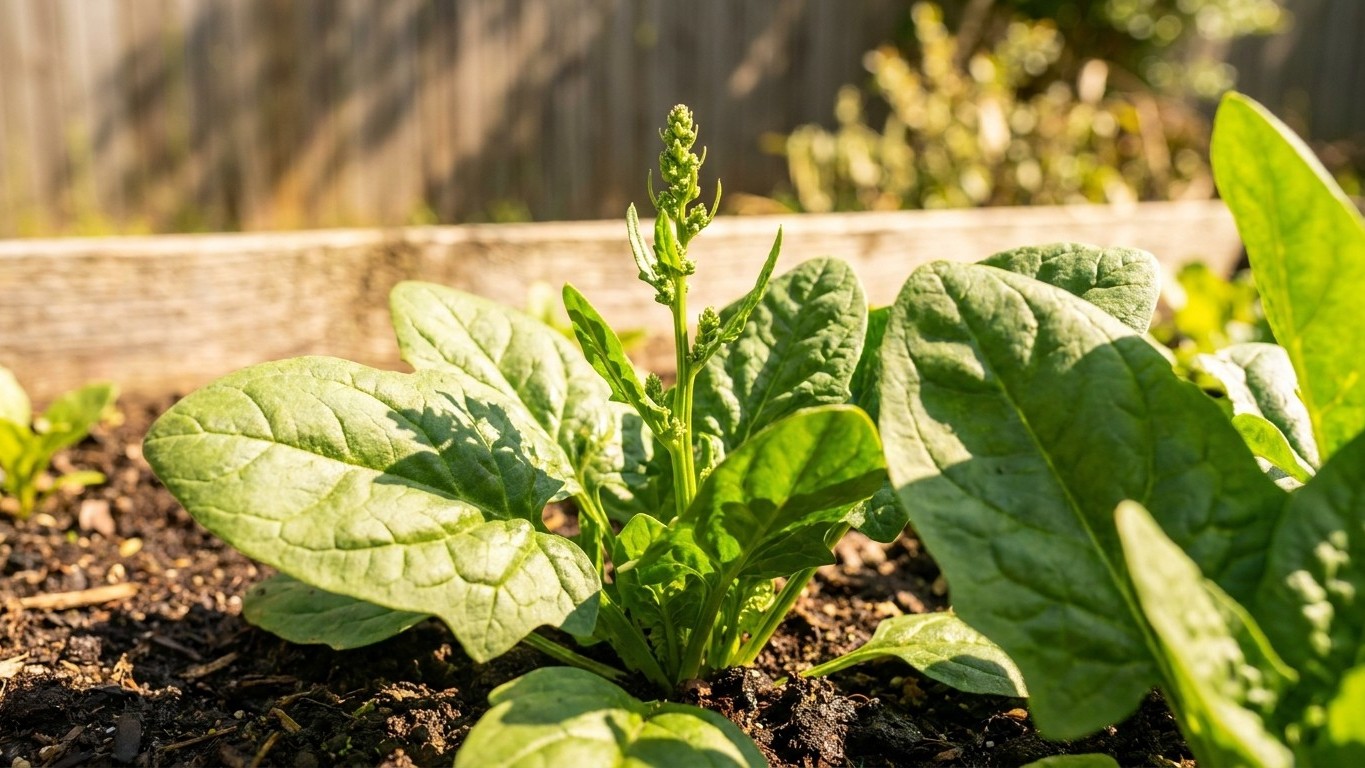

Nothing in a Virginia garden eats into spinach as thoroughly as the calendar. Long days push the plant to flower, air above 75 F stops good growth, and warm soil in late summer keeps autumn seed from sprouting. Each one closes a window at a predictable time. The figures below are for coastal Virginia, with notes on how the Blue Ridge and southwest Virginia shift them. Insect pests are a separate subject, and the sourced facts here do not cover them.
The short answer
On the longest day of the year, coastal Virginia gets 14 h 32 of daylight. That figure is calculated for the reference city from its latitude, counting the geometric horizon only. Atmospheric refraction adds roughly seven minutes of real daylight that the number leaves out.
For spinach, those hours matter because of what Utah State University Extension says: spinach bolts during long days and warm temperatures. Read that sentence twice. Long days alone can trigger flowering, so a cool summer does not buy extra weeks. A gardener who gets a mild June and expects the bed to hold on is counting on the wrong variable. The plant is reading the sky, not only the thermometer. (Onions work the opposite way, since long days help them form bulbs. Spinach gets nothing from them.)
So the limit in Virginia is both day length and heat, and they stack. Day length is fixed by latitude. It starts stretching in late winter and peaks at the solstice, no matter how the weather behaves. Heat is the part that varies from year to year. The coastal reference station averages 26.0 days a year that reach 90 F or more, a good measure of how heavy the summer load is. Spinach grows best where temperatures do not exceed 75 F, and that one number carries two consequences. Above it, growth stops being good, and the leaves turn bitter. It is a temperature, not a date, and it arrives on a different week in Virginia Beach than in Abingdon.
The sources used here publish no hour count at which spinach flips from leaves to flower stalk, so there is no magic number to compare against 14 h 32. What you can say is that the solstice day is long enough to be a problem, and every spring sowing is racing toward it. The mountains soften the heat half of the problem with cooler air. They do nothing for the day-length half, because daylight does not care about elevation. For the full picture of how bolting plays out, see Will Spinach Bolt Early in Virginia?
Utah State’s list of varieties includes Bloomsdale, Melody, Teton and Olympia. It gives no data on any of them, and neither does this page, so claims about which one holds out longest cannot be checked here. For the broader growing basics, start with Growing Spinach in Virginia.
How long the spring window really is
Spring spinach is sown two to three weeks before the last frost, and growth stops being good above 75 F. Those two rules bracket the season. Here is how to work out what is left between them, using the coastal numbers.
- Start with the last spring frost. At the reference station (NOAA NCEI 1991-2020 normals, NAS Oceana), the 32 F freeze probabilities put it between March 20 and April 3. That is the mild end of the state. The Blue Ridge and southwest Virginia run weeks later.
- Subtract two to three weeks. Three weeks before March 20 lands at about February 27. Two weeks before April 3 lands at about March 20. On the coast, sowing runs from the last days of February to roughly the third week of March.
- Add the weeks it takes to grow a crop. This step cannot be filled in with a published number. The source gives no days to maturity for spinach, and borrowing one from another crop would be a guess. Check your seed packet instead.
- Watch for the week highs stop dipping below 75 F. That is where growth stops being good and bitterness starts. No date for it is published here, so use your own local forecast and record. Longer days are stacking on top by then, which makes the end of the window less forgiving than the temperature alone suggests.
- Count the weeks between step 2 and step 4. That is your usable spring.
The honest answer for the coast is a span measured in weeks, not months. A March sowing gets cool air for a stretch, then meets a summer with 26.0 days at 90 F or above in an average year. The window also behaves like a ratchet. Every week you lose at the front, by waiting for the soil to feel right or the weekend to open up, comes off the back, because the back end is set by temperature and daylight rather than by when you started.
Inland Virginia plays the same game on a shifted calendar. Later last frosts push the sowing dates later, and cooler air can stretch the days before 75 F takes over. The mountains buy you a few weeks of heat relief. They cannot buy you a shorter solstice day.
The autumn crop, and when the soil lets you sow
Autumn is the better spinach season in most of Virginia, because the sky and the thermometer are both on the way down instead of up. It has its own two obstacles, and neither is cold. The first is warm soil. The second is the frost that ends the season. The full sowing calendar lives in When to Sow Autumn Spinach in Virginia, and this page covers the mechanics.
Warm soil blocks germination
Seed germination is reduced above 80 F soil, and late-summer Virginia soil can stay there well after the first cool-feeling morning. Air and soil are different things. The ground holds heat the way a cast-iron pan does, so a week of pleasant evenings can leave the top few inches still too warm for seed to sprout reliably. A cheap soil thermometer at seed depth beats the calendar here. In a hot region the window opens when the soil falls, not when the date says so.
Watering the row can help cool the surface, but the source gives no guidance on that trick, so treat it as a gardener’s habit rather than a researched fix. The only authority this page leans on for the 80 F figure is Utah State University Extension.
Frost ends the season
The first fall frost at the coastal reference station falls between November 10 and November 24 (same NOAA NCEI normals and station). Utah State’s guidance for a fall crop is to plant 50 to 75 days before the date you want to harvest. Treat the frost window as the end of the line and count back.
If you want to be picking by November 10, sow between about August 27 (75 days back) and September 21 (50 days back). If you can stretch to November 24, the range slides to roughly September 10 through October 5. Those are arithmetic, not promises, because the source publishes no days to maturity for spinach, only the planting rule above.
Put the two obstacles together and the dates tell a story. The early end of those ranges, late August, is exactly when the soil is most likely to still be above 80 F, so it is the part of the window you may have to skip. The later end comes with cooler soil but less time before frost. Inland, where frost arrives weeks sooner, the count-back lands earlier on the calendar, while the soil cools sooner too. In the Blue Ridge and southwest Virginia, run the same subtraction from your own frost date rather than the coastal one.
Common questions
Does a cool summer let spinach last longer in Virginia?
No. Long days alone can trigger flowering, and the longest day on the coast delivers 14 h 32 of daylight no matter how mild the weather is. Cool air helps with the heat half of the problem only.
Which variety should I plant?
Utah State University Extension names Bloomsdale, Melody, Teton and Olympia. It publishes no data about any of them, so this page cannot rank them or describe how they differ.
How long does harvested spinach keep?
UC Davis Postharvest gives an optimum of 32 F and 95 to 98 percent relative humidity, and says spinach will not maintain good quality for more than 2 weeks. That is a ceiling, not a plan. At the 41 to 50 F a home fridge door actually holds, yellowing and decay come faster. The coldest spot is the back of the bottom shelf, not the door.
Can I sow in late summer if the soil is above 80 F?
You can, but germination is reduced above 80 F, so expect patchy stands. Waiting for the soil to cool costs a little time and saves a lot of seed.