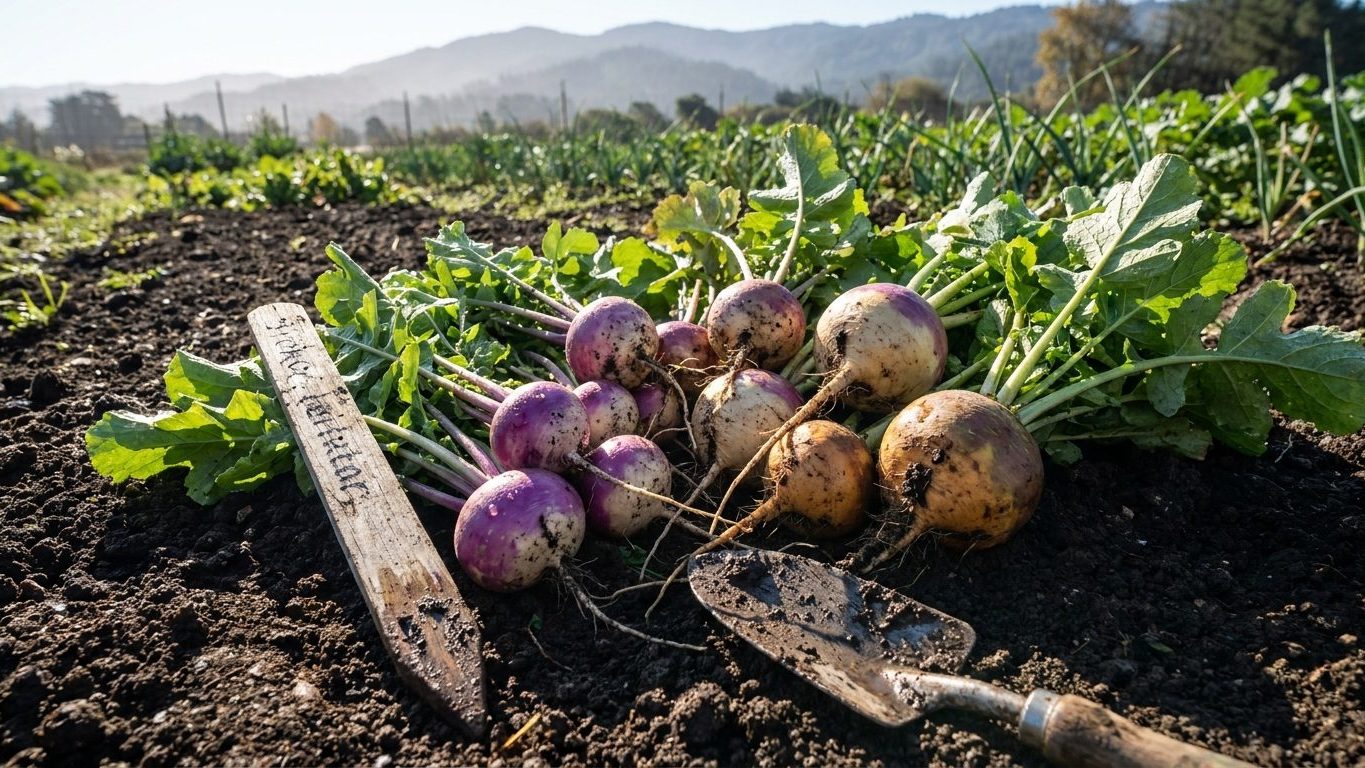

Fall-sown turnips are the best bet in Virginia. Rutabaga works only as a fall crop that goes in early. Spring is a short race against warming soil, and the frost dates, a coldest-month minimum of 31.6°F at the Virginia Beach reference station, and a hardiness range of 5a to 8b all point the same way. Varieties below are sorted by type rather than brand, because type is what Virginia’s weather decides.
The short answer for Virginia
Quick salad-style white turnips and greens-type turnips are the safest choice for both spring and fall. A purple-top globe type is the pick for fall roots you want to store, and rutabaga belongs only in the fall, started as early as the season allows. The frost numbers show why. At the Virginia Beach reference station (NAS Oceana), the last spring frost falls between March 20 and April 3, and the first fall frost between November 10 and November 24. Those are the 30-70% probability bands for a 32°F freeze in the NOAA 1991-2020 Climate Normals. They are odds, not promises, and a late freeze can still land outside them.
Frost is not the limiting factor for turnips here. All of these crops shrug off light frost, and the gap between the two bands is wide. The trouble comes from the warm stretch in the middle, which cooks spring plantings and strains midsummer sowings. The mean daily minimum of the coldest month at Virginia Beach is 31.6°F, just under freezing, so fall roots there can sit in the ground well into winter. Inland and uphill, that margin shrinks fast.
| Type | Best season in Virginia | Why it fits | Main risk |
|---|---|---|---|
| Salad-style white turnip | Early spring and fall | Matures fast enough to beat the heat or the first hard freeze | Turns woody or strong-flavored if it sits in warm weather |
| Purple-top globe turnip | Fall | Bulks up as days shorten and soil cools, and holds well in the ground | Sown too late, it makes leaves and little root |
| Greens-type turnip | Spring and fall | You harvest leaves, so the root’s timing hardly matters | Flea beetles on young leaves |
| Rutabaga | Fall only, sown early | Slowest of the group, and cool weather finishes it | Too little time before hard cold, especially in the mountains |
For exact sowing windows to pair with these types, see When to Sow Turnips in Virginia. The broader crop guide is Growing Turnips and Rutabaga in Virginia.
What will not work here
Spring rutabaga is the clearest failure. It is the slowest root in the garden, and a spring planting runs out of cool weather before it finishes. The roots come out small, tough and rank. Treat rutabaga as a late-summer sowing for a fall and early-winter harvest, or skip it.
Waiting until the weather “feels like fall” to sow comes next. With the first fall frost band not starting until November 10 on the coast and arriving earlier inland, an October sowing gives a turnip too little time to size up. Expect more greens than roots. A sowing that goes in while days are still warm gets the weeks of growth it needs, and the cooling nights do the rest.
Close spacing is the quiet killer. Virginia’s warm, humid air keeps crowded foliage wet for hours after rain or dew, and that invites leaf disease and slugs. This page has no humidity figure to quote, but anyone who has watched a coastal or Piedmont garden after a week of thunderstorms knows the pattern. Thin seedlings to the spacing on the seed packet. It feels wasteful, and it works.
Watering by the calendar also fails. Turnips want even moisture, and Virginia’s summer and fall rain arrives in bursts, not on a schedule. A dry spell followed by a downpour splits roots and makes them bitter. Check the soil a few inches down instead of watering every Saturday, and mulch lightly to even out the swings.
Finally, there is the mistake of pulling everything before the first frost band. A 32°F night will not hurt these crops, and a few light frosts often sweeten the roots. That holds for the coast, where winter nights hover near freezing. It does not hold in the mountains, where a hard freeze arrives weeks earlier and can lock up a late planting.
What changes across Virginia
The USDA Plant Hardiness Zone Map puts Virginia anywhere from 5a to 8b, eight half-zone steps in one state. So there is no single answer for the Commonwealth. The zone system is built on one variable, the average annual extreme minimum temperature, which says how cold winter gets but nothing about how long the cool growing windows last. It still works as a rough guide to which end of the state you garden in.
Every date above comes from a coastal station, the mild end of the state. The Blue Ridge and southwest Virginia run weeks later in spring and earlier in fall. A gardener in the north or at altitude should shift in both directions: start spring sowings later, once the ground is workable, and start fall sowings earlier, so roots size up before the first hard freeze. Rutabaga is where that squeeze hurts most. It needs the longest run of cool weather, and mountain gardens may reward a midsummer sowing, since summers there are cooler, but they have less time left in the fall.
In the southern Tidewater and parts of the Southside, the opposite applies. Fall sowings can go in later, and roots can stay in the ground through much of winter. Spring sowings need to go in early, because the warm weather arrives sooner and hits harder.
Which zone you are in is not something this page can tell you. Look up your own location on the USDA Plant Hardiness Zone Map and use it to place yourself between the coast and the mountains. Then adjust the dates above accordingly.
Where to check this for your own county
Your state extension service is the next stop. Virginia Cooperative Extension runs offices across the state, and its local agents and Master Gardeners know which turnips and rutabagas have actually done well in your county’s soil. Look for two things there. The first is a planting calendar written for your area, with spring and fall sowing windows. The second is any list of varieties trialled locally, which tells you what has been grown, not just what a catalog claims.
This page does not have a Virginia Cooperative Extension turnip calendar to quote, so the dates here come from the NOAA frost data for one coastal station. That is a state-level view. A county recommendation beats it every time, because a county office sees your elevation, your soil and the pests that show up in your area. Where the two disagree, trust the county.
When you contact an office, bring a few specifics: your town or ZIP code, whether you want roots or greens, and whether you plan to store the harvest. Those details let an agent steer you to a spring salad type or a fall storage type. Ask which of the four types in the table above has done best locally, and when people in your area actually sow it.
Checking this against your own garden
Your own observations outrank every date on this page. Three are worth watching, and none needs equipment beyond your hands and eyes.
- Soil warmth by feel. Push your hand a few inches into the bed in the morning. In spring, soil that still feels cold and clammy means seeds will sit slowly. In late summer, soil that stays warm after dark means fall seeds will sprout quickly, and it tells you which beds hold heat.
- The first true leaves. After the seed leaves, the first rough, shaped leaves show a seedling is established. That is your cue to thin. How quickly they appear, compared with a neighbor’s bed, shows how warm your site runs.
- Where frost lands first. On the first frosty morning, walk the yard. Whitened grass in a low corner and bare ground by the south wall mark your frost pockets and your protected spots.
Write down what you see and the date. After one season, you will have a calendar for your own yard that is more accurate than any state average.
Common questions
Can I grow rutabaga in the spring in Virginia?
You can plant it, but it rarely pays off. Rutabaga is the slowest root of the group, and warm weather arrives before it finishes. Sow it in late summer for a fall and early-winter harvest instead.
Which type should a first-time Virginia grower pick?
A greens-type turnip, or a quick salad-style white turnip. Both forgive timing mistakes, since you can harvest leaves or small roots whenever the weather turns.
Do turnips survive winter in Virginia?
It depends on where you are. At the Virginia Beach reference station, the mean daily minimum of the coldest month is 31.6°F, so winters are mild near the coast. In the Blue Ridge and southwest Virginia, winters are colder and the first fall frost comes earlier, so plan to harvest sooner.
Do the frost dates here apply to my garden?
Only roughly. The last spring frost band (March 20 to April 3) and the first fall frost band (November 10 to November 24) come from one coastal station. Gardens inland and at elevation run weeks later in spring and earlier in fall, so confirm local dates with your county extension office.