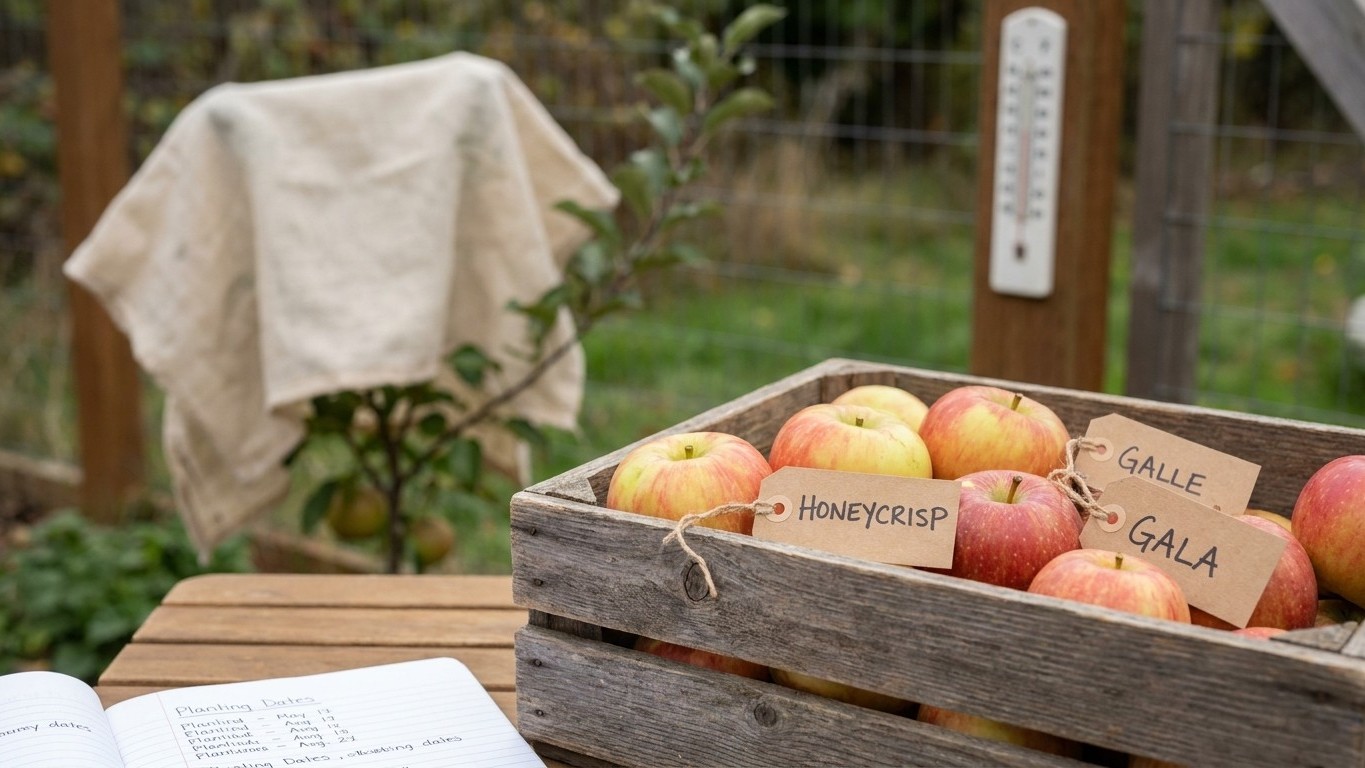

Two different climates share the name “Washington,” and that split decides which apple tree actually thrives in your yard. A gardener near Puget Sound is working with mild, wet winters and low freeze risk; a gardener east of the Cascades is managing something closer to Alberta’s cold, dry winters with a longer summer stacked on top. Before picking a variety, name which side of the state you’re on — that single fact, more than any nursery tag, tells you whether Honeycrisp or Liberty is the tree that crops every year instead of merely surviving one.
Can you grow apples in Washington
Apples are one of the most dependable fruit trees for Washington gardeners, and the state also grows more of them commercially than anywhere else in the country. USDA’s 2023 Plant Hardiness Zone Map puts Washington across zones 4a to 9a, a range wide enough to cover a mountain valley and a mild coastal yard on the same state list. That range is the first reason a single “best apple for Washington” answer doesn’t exist. The tree that thrives in a Seattle backyard isn’t automatically the one to plant in a cold pocket east of the Cascades — see this guide to Washington apple Best varieties for a breakdown by region.
At the mild end, NOAA’s 1991-2020 climate normals put the coldest month’s average daily minimum at Seattle at 35.6°F, barely below freezing even in the depth of winter. That’s a maritime climate apples handle well: cool, wet, without the deep hard freezes that split bark or kill buds outright. Gardeners near Puget Sound are working with this kind of gentle winter, and the biggest risk to their crop is rarely the cold itself.
Move east of the Cascades and the picture changes. Washington’s biggest commercial apple orchards sit in the dry interior, a high-desert climate with colder winters, hotter summers and far less rainfall than the coast. The figures available for this piece are anchored at Seattle, so anyone gardening in that eastern, high-desert part of the state should treat the Seattle-based numbers here as a coastal reference point, not a local forecast, and confirm their own zone and frost pattern with a source close to home.
Even within the mild western side, elevation and distance from water shift conditions by a full zone or more. A hillside opening a few miles from the Sound can run colder at night than a low yard near the water, because cold air drains downhill and pools in low ground. Apples tolerate a light frost at the wrong stage far worse than a hard freeze in the depth of winter, a distinction laid out in The Washington Apple Calendar, Stage by Stage.
The practical takeaway is that “grown in Washington” covers two different growing conditions under one name. A gardener close to Puget Sound is managing a mild, wet, low-freeze-risk climate. A gardener east of the mountains is managing something closer to the cold, dry climate that growers in Alberta deal with, just with a longer, hotter summer layered on top. Naming which side of the state you’re on before picking a variety saves a wasted year.
Which varieties suit this climate

Start with hardiness, then check chill. Apples bred for USDA zones 4 through 8 line up comfortably with most of Washington’s 4a-9a range, and several widely sold cultivars carry published hardiness that reaches into it. Honeycrisp is rated hardy to about zone 3, so it covers the coldest pockets of the state as well as the mild coast. Liberty and Enterprise, both bred for scab resistance, are rated to roughly zone 4, and Zestar! carries a similar rating with an early harvest that beats fall weather in short-season spots. Further down the hardiness scale, Gala, Jonagold and Golden Delicious are usually listed to about zone 5, which still covers the milder parts of the state but leaves out its coldest corners.
Hardiness and chill are different questions
Hardiness only tells you whether the tree survives winter. The separate question is winter chill: the number of cold hours below roughly 45°F a tree needs before it will break dormancy and flower evenly in spring. A variety bred for a short, mild winter in the Deep South can sit through a Washington winter and still bloom thin and ragged, because it never gets the cold exposure it expects. A variety bred for a brutal northern winter, at the other extreme, wants more sustained cold than a mild coastal yard reliably delivers in a warm year.
Washington’s winters, coastal or interior, run toward the high-chill end of the national range rather than the low end. That favors the northern and mid-latitude cultivars named above over anything bred for a short-winter climate. A gardener comparing notes with someone gardening in Texas, where low-chill varieties are the rule, is choosing from a different list entirely, and swapping the two won’t work in either direction.
No Washington-specific extension list of recommended cultivars appears in the sources for this piece, so treat the varieties named here as catalogue-hardy options to check against your own site conditions, not a locally endorsed shortlist.
| Variety | Published hardiness | Chill need | Bloom timing | Notes |
|---|---|---|---|---|
| Honeycrisp | Zone 3-8 | Moderate to high | Mid-season | Widely available, needs a pollinizer with overlapping bloom |
| Liberty | Zone 4-8 | Moderate to high | Mid-season | Scab-resistant, reliable pollen donor |
| Enterprise | Zone 4-8 | Moderate to high | Late mid-season | Scab-resistant, stores well |
| Zestar! | Zone 3-7 | Moderate to high | Early to mid-season | Ripens early, useful where fall turns wet |
| Gala | Zone 5-8 | Moderate | Mid-season | Reliable cropper on the milder coast |
Planting a pair that works here
Apples need cross-pollination from a genetically different variety blooming at the same time, and at least one of the two needs pollen that actually works. Some well-known cultivars, including Jonagold and older heirlooms like Gravenstein, carry sterile pollen. They still need a pollinizer themselves, but they can’t serve as one for a neighboring tree, so pairing two of them, or pairing one with only a crabapple that blooms at the wrong time, leaves both trees flowering for nothing.
From the varieties that suit Washington’s hardiness and chill profile, a few pairings are straightforward. Liberty and Enterprise bloom in the same mid-to-late window and both carry fertile pollen, making them a solid pair for a scab-prone wet climate. Honeycrisp blooms mid-season and sets well against either of those two, or against Gala where the site is mild enough for Gala to ripen fully. Zestar! blooms slightly earlier and pairs best with another early-to-mid bloomer rather than a late one like Enterprise, since a bloom window that barely overlaps gives pollinators too little time to move pollen between the two trees.
A crabapple with a long, heavy bloom is a common backup pollinizer where space allows only one full-size second tree, and it works for most of the varieties above as long as its own bloom period overlaps. Where space allows only one tree total, some nurseries sell a single trunk grafted with two or three compatible varieties specifically to solve this problem, though the smaller limbs still need watching so one variety doesn’t shade out the other over time.
Bloom windows aren’t fixed to the calendar. A cool, wet spring, common close to Puget Sound, can push bloom later and compress the window during which both trees are open at once, while a warm, dry spring pulls it earlier. Planting two varieties rated for roughly the same bloom timing gives a buffer against a season that runs a week or two off from average, rather than gambling on a single narrow overlap.
The frost that costs a crop here

NOAA’s 1991-2020 climate normals put the last spring freeze near Seattle in the window of February 27 to March 18, based on the 30-70% probability band for a 32°F freeze at station USW00024233. That’s a wide window, and it’s specific to the mild, maritime station near Seattle. Gardens east of the Cascades run on a colder, later schedule that this data doesn’t cover, so treat this range as a coastal reference, not a statewide one.
Why the stage matters more than the date
The date itself is less important than what stage the tree is at when a frost lands. Apple trees survive real cold every winter while fully dormant. The danger window opens once buds swell and show color, at the pink stage, just before bloom, and it stays open through open bloom itself. A freeze at that point doesn’t usually kill the tree. It kills the flowers. The wood, the leaves and next year’s buds can look completely fine while the current year’s crop is simply gone, because the delicate reproductive parts inside the blossom are far more frost-sensitive than the bark and buds around them.
There’s no way to move a mature apple tree indoors when a late cold snap is forecast, so the practical defenses are limited. Covering small trees overnight with row cover or a sheet during a forecast freeze at pink or bloom stage buys a few degrees. Running sprinklers through the night, the method commercial orchards use, relies on the latent heat released as water freezes, and it isn’t practical for a home planting. Siting the tree away from a low spot where cold air pools helps every year, not just the risky ones.
The more durable fix sits at the variety level. A cultivar that blooms later in the spring, after the risk window from NOAA’s Seattle normals has mostly closed, sidesteps the problem instead of fighting it season after season. Where a garden sits in a known cold pocket, a late-blooming variety matters more than any frost-night scrambling once the tree is already in bloom.
The apple year in Washington
Apple timing in Washington runs off the tree’s stage, not a date on the calendar, because a stage arrives whenever accumulated warmth gets it there, and that varies by several weeks from one spring to the next.
- Dormancy, winter: the safe season for pruning and for planting a new bare-root tree, since the wood tolerates cold and handling that would damage active growth.
- Green tip: the first sign buds are breaking after winter, often while the last-frost window near Seattle, February 27 to March 18 per NOAA’s normals, is still open. This is the last easy chance to finish dormant pruning.
- Pink stage: buds show color just before bloom. Frost risk to the crop starts here, not before.
- Bloom: the pollination window covered above. Watch the forecast closely if this stage lands inside or just after the local frost window.
- Petal fall: bloom is over and pollinated flowers begin swelling into fruit. Frost risk to the crop drops sharply once petals are down.
- Fruit set: the tree sheds some of its own fruit naturally in early summer. A home thinning pass now, removing the smallest fruit from each cluster, improves the size of what’s left.
- Harvest: timing depends entirely on variety, from early cultivars like Zestar! to late-season keepers, and it runs well ahead of the first fall frost for every variety grown here.
Fall works the same way in reverse. Trees need to harden off before the first freeze rather than being caught mid-growth, and near Seattle that first 32°F freeze arrives, per NOAA’s 1991-2020 normals, between November 13 and November 30. A late-summer nitrogen feed that pushes soft new growth into that window leaves the tree more vulnerable than one left to slow down on its own.
The gap between a mild coastal spring and a colder inland one means these stages arrive at different points on the calendar depending on where the tree is planted, even though the sequence itself never changes. A gardener tracking bud stage in person, rather than going by a date that worked last year, catches a risky frost before it costs the crop.
Local help
For a variety list actually checked against Washington conditions, and for current spray timing on scab, coddling moth and other regional pests, contact Washington State University Extension. County offices differ in what they publish, and orchard advice tuned to the interior valleys won’t match advice tuned to the wet coastal side, so ask specifically for guidance matched to your county.
Common questions
Do I need to spray apple trees in western Washington’s wet climate?
Expect to, at least for scab, if you’re on the wet coastal side. Washington’s western climate stays damp during bloom and leaf-out, which is exactly when apple scab spreads, and unlike the interior valleys the coast rarely gets a dry stretch to slow it down. Picking a scab-resistant variety such as Liberty or Enterprise cuts the spray schedule down but doesn’t always eliminate it, and WSU Extension is the source to check for current product recommendations, since pest pressure and legal products both change.
Should I plant a dwarf or a standard rootstock apple tree?
Dwarf rootstock, if you want an easier tree to manage. Dwarfing rootstocks such as M9 or M26 keep a tree small enough to prune and pick from the ground, and they bear fruit sooner, but they need a permanent stake because their roots anchor poorly. Semi-dwarf rootstocks like MM111 or a standard seedling rootstock grow into a much larger, self-supporting tree that takes longer to bear but tolerates poor soil and neglect better.
My apple tree bloomed heavily but set almost no fruit. What went wrong?
Usually a pollination failure rather than frost damage, if the flowers looked fine going into and coming out of bloom. Cool, wet weather during bloom keeps bees from flying, and without bee activity even two compatible varieties blooming at the same time won’t set much fruit. A single tree with no fertile pollen partner nearby produces the same result: a full bloom and almost no apples.
Can a self-fertile apple variety skip the second tree entirely?
A handful of apple varieties are labeled partially self-fertile, but they still set a heavier, more reliable crop with a second variety nearby. Treat a self-fertile label as a fallback for a small yard with room for only one tree, not as a reason to skip pollination planning when a second tree is possible.
When should I plant a new bare-root apple tree in Washington?
Plant while the tree is fully dormant and the ground is workable, not frozen or waterlogged, which in practice means sometime in winter before growth resumes. Near Seattle, NOAA’s 1991-2020 climate normals put the last spring freeze between February 27 and March 18, and soil that’s still cold and wet under those conditions holds a newly planted tree back regardless of the air temperature, so don’t rush a bare-root tree into the ground the moment the freeze risk looks past.