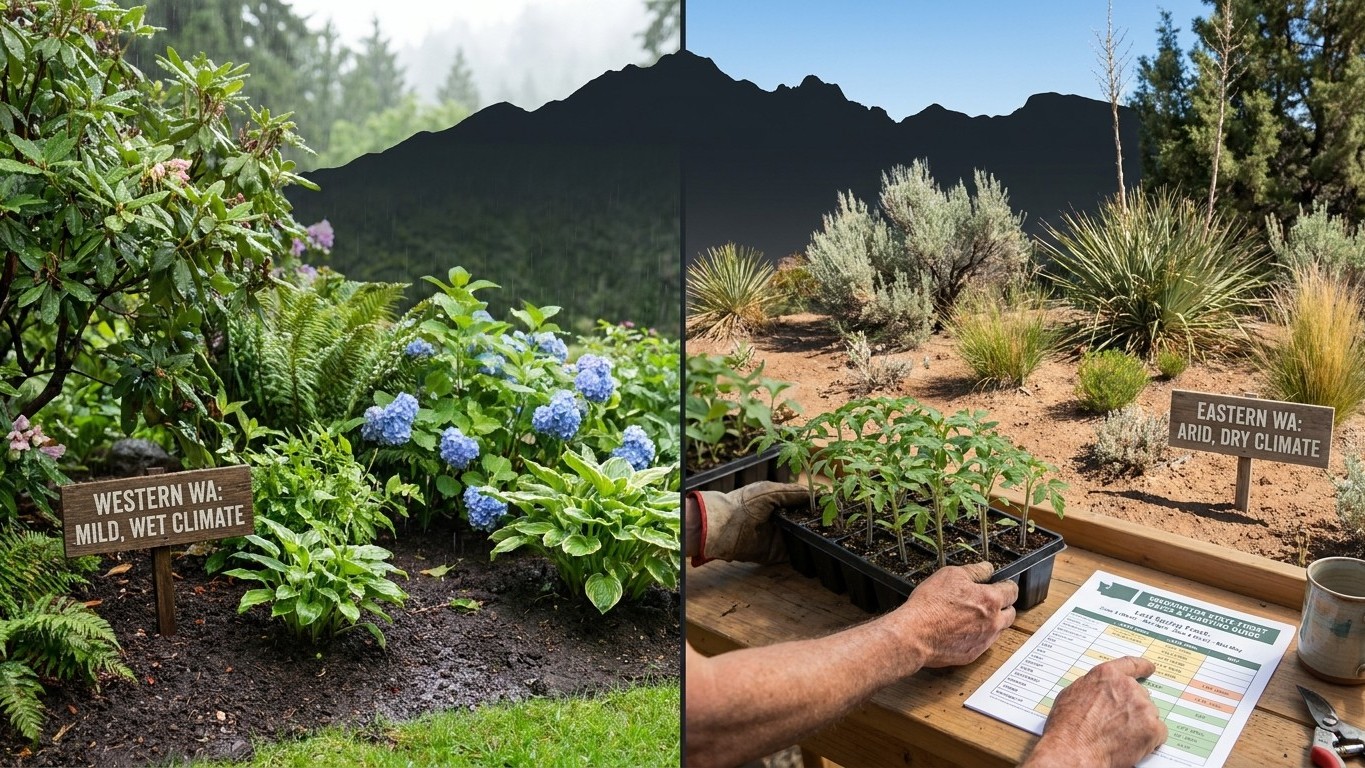

Two very different climates share this state line, and that changes what “planting season” even means. West of the Cascades, mild wet winters and cool summers push the frost-free window wide open. East of the mountains, a high-desert climate cuts that window down hard. Here’s what the numbers actually say you can plant, and when.
How long your season really is

The USDA Plant Hardiness Zone Map, built on the average annual extreme minimum temperature, puts Washington somewhere between zone 4a and zone 9a. That’s not a typo. It’s one of the widest hardiness ranges of any state, and it tells you immediately that a single planting calendar can’t cover the whole territory.
The frost data that matters more for day-to-day planning comes from a western Washington reference station (Seattle-area, station USW00024233), tracking 1991-2020 climate normals. The last spring frost there falls somewhere between February 27 and March 18. The first fall frost arrives between November 13 and November 30. Stack the earliest fall date against the latest spring date and you get a frost-free window of roughly 240 days. Stack the earliest spring date against the latest fall date and it stretches closer to 275 days. That’s a wide spread for a reason: these are averages, not guarantees.
Half of all years, by definition, run colder or shorter than that average. A frost date is a 30-70% probability band, not a line you can plant against with confidence. Treat the early end of the spring window and the early end of the fall window as the years to plan for, not the exception.
That said, this generous window applies to the mild, maritime side of the state. East of the Cascades, the climate turns to high desert, with harsher winter lows and a compressed season that the statewide 4a-9a range hints at but doesn’t spell out. A gardener there attempting a 110-day pumpkin, a crop covered in more detail in Growing Pumpkins in Washington, or a long-season dent corn like the kind detailed in Growing Sweet Corn in Washington is working with far less margin than someone on the coast, which also affects When to Carve a Pumpkin in Washington once the harvest comes in, while a shorter-season staple like Growing Potatoes in Washington tends to fit more comfortably within that compressed window, and the same is true for a quick-maturing root crop, as Growing Carrots in Washington shows, much like Growing Beets in Washington also fares well within a shorter season, as does Growing Parsnips in Washington a fast, cool-season leafy green, a point Growing Spinach in Washington makes clear as well. The frost-free window is generous in western Washington and it’s the reason long-season crops that fail in short-season states can work here, but it does not mean every corner of the state gets the same deal.
What the summer does to a garden here
Heat isn’t automatically good news for a vegetable garden, and Washington’s climate makes that easy to forget. At the reference station, the average is just 3.0 days a year reaching 90F or hotter. That’s a strikingly low number next to most of the country, and it shapes almost everything about what grows well here.
Above roughly 90F, tomato blossoms drop without setting fruit, and the same heat stress applies to other warm-season crops like peppers — see Growing Peppers in Washington for how to work around it, lettuce bolts and turns bitter, and most cool-season crops stop growing altogether. With only three days a year crossing that line on average, western Washington gardeners rarely deal with a scorched, dead middle of summer the way gardeners in hotter climates do. Instead, the season tends to run as one long, mild stretch rather than two short shoulder seasons bookending a heat wall.
The tradeoff is on the other end. Peppers, eggplant, melons, and other heat-loving crops need consistent warmth to size up and ripen, and a summer that barely touches 90F a handful of times a year often isn’t enough heat load to push them to full production. The coldest month’s average daily minimum sits at 37.1F, a figure that speaks to winter hardiness rather than summer heat, but it confirms the same pattern: this is a temperate, moderate climate, not an extreme one in either direction.
Practically, that means fewer disasters from heat stress and bolting, but also fewer bragging-rights tomatoes and melons than a gardener in a hotter inland state might expect from the same amount of effort.
What tends to go wrong in Washington
WSU Extension’s Hortsense fact sheets for home vegetable gardens flag a working list of pests that Washington gardeners actually deal with, as opposed to a theoretical list of every insect that exists. A handful show up again and again:
- Slugs — a near-constant presence in the wet, mild spring, shredding seedlings and leafy greens before they get established.
- Aphids — build up through the growing season on soft new growth, distorting leaves and spreading plant viruses along the way.
- Cabbage maggot — targets brassica roots early in the season, often before a gardener even notices the plant is struggling above ground.
- Brown marmorated stink bug — a more recent arrival that scars fruit and vegetables through the summer, particularly on tomatoes and tree fruit.
This isn’t the full list WSU tracks, and pest pressure varies by county and by year. The extension service doesn’t hand out a one-size treatment schedule for any of these, and neither should anyone else. What matters is recognizing the damage early and getting an identification from a local source before deciding what, if anything, to do about it.
Where to check before you plant
Everything above is a starting point, not a substitute for local knowledge. A state that spans zone 4a to 9a, with a maritime coast on one side and high desert on the other, cannot be reduced to a single planting date or a single frost window. The figures here come from a western Washington reference station, and they simply don’t apply the same way east of the Cascades.
Washington State University runs the land-grant extension service for the state, and its WSU Extension site is the place to find county-level offices, planting calendars, and pest identification resources built for actual local conditions rather than a statewide average. A planting calendar written around a location on the wet, mild side of the mountains can run three weeks or more off for a garden on the dry, cold side, and the reverse is just as true.
Before committing seed money and a season’s worth of effort to any planting date, a quick call or visit to the county extension office is worth more than any statewide figure. They’ll know what the last frost actually looked like in that specific valley last spring, not just what the average says it should have been.