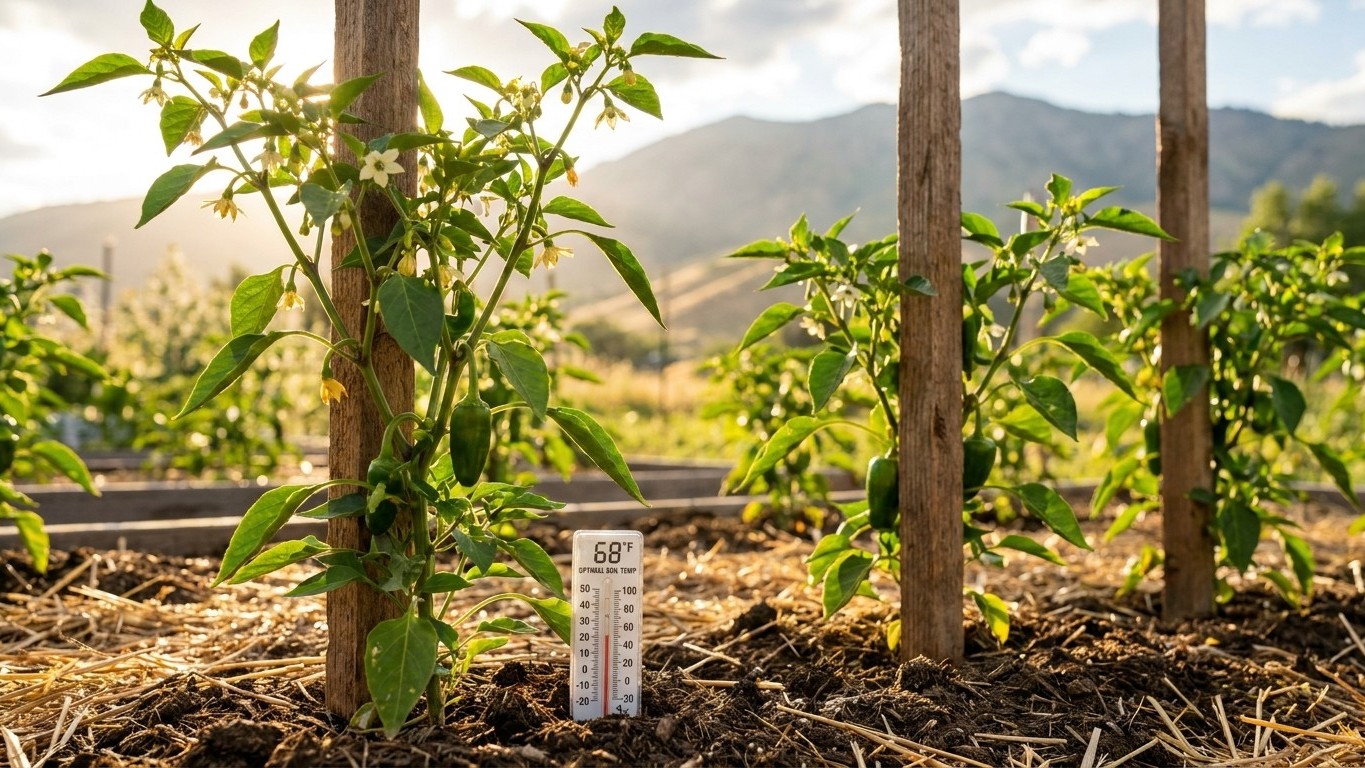

In western Washington, peppers rarely struggle with heat: the reference station near Seattle logs just 3 days a year at 90°F or hotter. The real limits are nights that drop below 55°F and a growing season that starts later than the frost date implies. East of the Cascades, the rules change again. Get the timing right for your county and most varieties will ripen before fall rain moves in.
The short answer

Start with the number that matters most for fruit set on the hot side: the Seattle-area reference station averages 3.0 days a year at or above 90°F, based on NOAA NCEI Climate Normals for 1991-2020. That’s a low heat load. Pepper flowers abort when daytime temperatures climb past 90°F for stretches, according to Utah State University Extension, so a garden sitting in the maritime lowlands of western Washington almost never sees that failure mode. Three days a year, scattered and usually brief, isn’t enough to wreck a pepper crop the way a string of 95°F afternoons would in a hotter climate.
The other end of the equation is the one western Washington gardeners actually need to watch. Utah State University Extension is clear that pepper fruit set fails just as reliably when nights fall below 55°F. This site tracks daytime heat extremes for Washington, but it does not carry summer overnight low temperatures for any specific location. That’s not a small gap to wave away. Maritime air keeps summer nights in the Puget Sound lowlands mild most years, but “mild” and “above 55°F on every July and August night” are not the same claim, and nothing here lets you assume one from the other. A garden tucked into a valley, near open water, or up in the foothills can post a very different nighttime pattern than a station a few miles away. Don’t guess based on how far north you are, and don’t assume a warm afternoon guarantees a warm night. Set a min-max thermometer in the garden bed itself if blossom drop becomes a pattern.
Eastern Washington runs on a different climate entirely. Once you cross the Cascades, the growing season shifts to a high-desert rhythm with its own frost dates, its own heat pattern, and its own frost-free window that has nothing to do with the Seattle numbers above. Applying the western Washington frost dates or the 3.0-day heat count to a garden in Yakima or Spokane would be a mistake in both directions. If you garden east of the mountains, treat the western Washington figures in this article as reference points for the wetter, milder side of the state only, and look for numbers specific to your own station.
When to start seed here
Working out a pepper seed-starting date for a Washington garden means counting backward from two things: when the soil is actually warm enough for transplants, and how many weeks a pepper seedling needs indoors before it’s ready to go in the ground. Here’s how that arithmetic plays out, step by step, so you can rework it for your own county.
- Locate your last spring frost window. For the western Washington reference station, NOAA’s 1991-2020 climate normals put the 32°F freeze probability window between February 27 and March 18. That’s a mild date on paper, and it’s specific to the maritime, western side of the state.
- Don’t stop at the frost date. A frost-free date is not a planting date for peppers. Cold, wet spring soil and the region’s low late-winter light hold soil temperatures down well after the last freeze has passed. Utah State University Extension sets the real threshold at soil reaching 60°F, and in a cool, cloudy maritime spring that can trail the frost date by several weeks.
- Watch the soil, not the calendar, for your transplant date. Push a soil thermometer a few inches into the bed on sunny afternoons starting in early spring. When it holds at 60°F or above through a cold morning, not just a warm afternoon spike, you’re close to safe transplant timing.
- Count back 8 to 10 weeks from that expected transplant date. That’s the indoor seed-starting window Utah State University Extension recommends for peppers. If your soil typically hits 60°F in mid-May, for example, working backward 8 to 10 weeks lands seed-starting in early to mid-March, well before the frost date has even passed.
- Rebuild the math for your own address. Because the frost window and soil-warming pace both shift with elevation, distance from water, and local cloud cover, run this same sequence with your own county’s frost data and your own soil thermometer readings rather than borrowing the Seattle-area numbers wholesale.
What goes wrong here
Most pepper failures in a Washington garden trace back to one of three things: temperature swings at either end of the fruit-set range, sun exposure, or inconsistent watering. Here’s what to watch for and how to respond.
- Blossom drop after a cool night. Flowers form and then fall off without setting fruit when nighttime lows dip below 55°F, per Utah State University Extension. Since this site doesn’t track summer night minima, keep a thermometer in the bed during any stretch of clear, cool weather common in a Washington spring or a cool August night. If drop is heavy, hold off on heavy nitrogen feeding, which encourages leafy growth over flowering, and consider row cover on the coolest nights to buffer the plant.
- Blossom drop during a hot spell. The same failure shows up at the other extreme, when daytime temperatures push past 90°F. Western Washington sees this rarely (3.0 days a year on average at the reference station), but a heat spike during flowering can still knock a plant’s fruit set back for that stretch. Shade cloth over the bed during an unusual hot run, and consistent watering to reduce plant stress, both help flowers hold through a short heat event.
- Sunscald on exposed fruit. Peppers that lose leaf cover to wind damage, disease, or aggressive pruning end up with fruit sitting in direct sun for hours at a time, and the skin can blister or turn papery white on the exposed side. Leave foliage intact rather than pruning it back hard, and stake plants so wind and their own fruit load don’t strip leaves away from developing peppers.
- Blossom-end rot. A dark, sunken patch at the blossom end of the fruit usually points to inconsistent watering rather than a soil calcium shortage outright, since uneven moisture interferes with how the plant moves calcium to the fruit. Even, regular watering, with mulch to hold soil moisture steady between waterings, is the most reliable fix.
Common questions
Does Washington get hot enough to stop pepper fruit set?
Rarely, on the western side of the state. The reference station near Seattle averages just 3.0 days a year at or above 90°F, the threshold Utah State University Extension identifies for heat-driven blossom failure. Eastern Washington’s high-desert climate runs differently, and this site doesn’t carry a separate day count for that region.
What nighttime temperature stops peppers from setting fruit?
Below 55°F, according to Utah State University Extension. This site tracks daytime heat extremes for Washington but not summer overnight lows, so check your own garden’s nighttime temperatures directly rather than estimating them from your latitude or from winter cold data.
When should I start pepper seeds indoors for a Washington garden?
Count back 8 to 10 weeks from your expected transplant date, and set that transplant date by soil temperature reaching 60°F rather than by the frost date alone. In western Washington, where the frost window falls between February 27 and March 18 at the reference station, soil often takes weeks longer than that to warm.
If my last frost date has passed, is it safe to transplant peppers?
Not necessarily. A frost date only marks when freezing temperatures become unlikely, it says nothing about soil temperature. In a maritime spring, cold, wet soil and low light routinely keep ground temperatures below the 60°F threshold peppers need well after the last frost has come and gone.