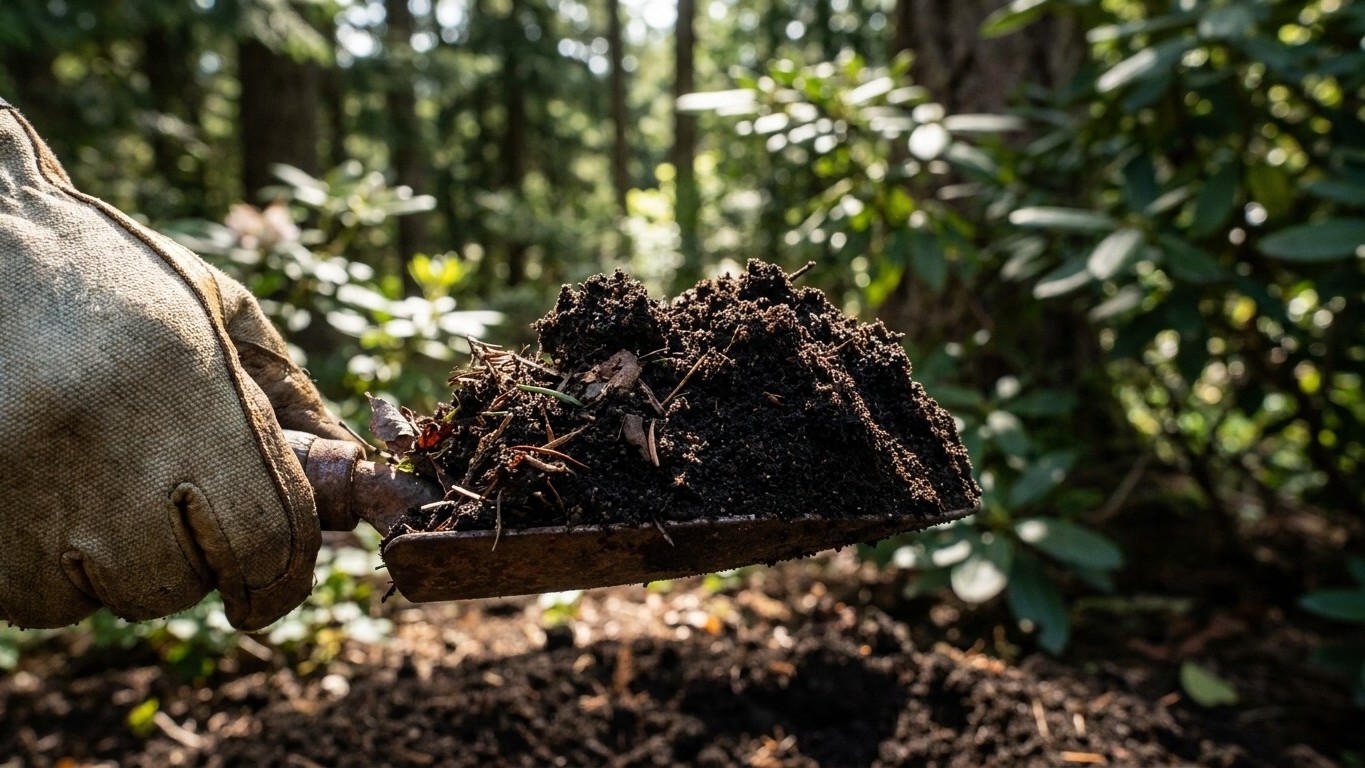

Dig a shovel into Washington ground west of the Cascades and you’re often standing on ash, not dirt in the ordinary sense. The state’s representative soil is light, sponge-like, and strongly acid, which explains why so many gardeners west of the mountains fight the same battle every spring: good drainage, stubborn acidity, and plants that stall unless they get iron or lime exactly right.
What is under your garden

The USDA NRCS names the Tokul series as the soil that represents Washington. It’s an Andisol, a volcanic-ash soil formed from the region’s long history of eruptions, and it behaves differently from the clay-heavy or sandy soils gardeners deal with in most other states. Ash-derived soils are famous among soil scientists for two things: they hold an unusual amount of water for how light they feel in the hand, and they lock up phosphorus more aggressively than almost any other soil type in the country.
Here are the surface horizon numbers the USDA records for the Tokul series, exactly as measured:
| Reading | Value |
|---|---|
| Surface pH | about 4.5 (strongly acid) |
| Sand | 45 percent |
| Silt | 45 percent |
| Clay | 10 percent |
| Organic matter | about 75.0 percent |
| Drainage class | moderately well drained |
Read that organic matter figure carefully. Seventy-five percent is not a number a cultivated vegetable bed will ever show. It reflects the natural surface layer as mapped, which in a forested or undisturbed Andisol is close to raw organic litter sitting on volcanic ash. Once a garden is tilled, planted, and weeded for a few seasons, that number drops fast. Treat it as a description of the native ground, not a promise about your raised bed.
Why your yard might be completely different
This is the soil series USDA lists as representative of the state, not a guarantee about the dirt under your tomatoes. Washington runs from rainforest to shrub-steppe, and a single county can hold a dozen different soil series. A house built in the last thirty years almost certainly sits on ground a builder scraped, graded, and refilled, which erases whatever the natural profile used to be. River bottoms, old floodplains, and hillside cuts all tell a different story than the ash-derived soils this series represents.
You can get a rough read on your own dirt in five minutes without a lab. Wet a small handful of soil and squeeze it between your thumb and forefinger to form a ribbon. Soil high in clay ribbons long and smooth. Sandy soil falls apart before it forms anything. Silty soil feels slippery but breaks into short pieces. For a slower but more revealing test, fill a clear jar one-third with soil, top it off with water, shake it hard, and let it sit overnight. The sand settles first at the bottom, silt layers above it, and clay stays suspended longest, often leaving the water cloudy for a day or more. Measure the layers and you have a rough percentage breakdown of your own yard, which is the number that actually matters when you start amending.
Testing before you amend
A soil test tells you things your eyes simply cannot pick up: exact pH, phosphorus and potassium levels, and often organic matter percentage and salt content. Guessing wrong on lime or sulfur wastes a season and, in acid soils like Tokul, can lock nutrients out of reach for a year or more while you wait to correct the mistake.
Given the regional pH the Tokul series shows, a gardener west of the Cascades can reasonably expect acid ground, likely somewhere in the strongly acid range. That expectation is a starting point, not a result. Expecting a number and knowing a number are two different things, and only a test gives you the second one.
Taking a sample correctly matters more than most gardeners assume. Follow these steps standing in the garden with a trowel:
- Pick 8 to 10 spots scattered across the bed, avoiding spots right next to a fence, a downspout, or a compost pile.
- Dig each core to the depth roots actually occupy, usually 6 to 8 inches for vegetables and lawns.
- Mix all the cores together in a clean bucket, breaking up clumps by hand.
- Remove rocks, roots, and mulch fragments from the mixed sample.
- Pull about two cups from the mixed soil and let it air dry before bagging it.
- Label the bag with the bed’s location and the crop you plan to grow there.
Send that sample to a lab, usually through the extension service, and expect results back with a pH reading, nutrient levels, and often a specific lime or sulfur recommendation calculated for your exact soil, not a regional average.
Amending it
The Tokul series sits at a surface pH of about 4.5, which is strongly acid. That single number points the whole amendment plan in one direction.
Liming the acid ground
At a pH near 4.5, lime is the correction and sulfur would be a mistake that pushes already-acid ground further the wrong way. Strongly acid soil locks phosphorus into forms roots can’t use, which shows up as stunted, purplish young plants even when the nutrient is technically present in the ground. Brassicas suffer worst in acid soil, since low pH favors the clubroot pathogen that deforms their roots. Lime doesn’t work fast. Plan on it moving soil pH over a season or two, not weeks, since it has to react with soil moisture and slowly neutralize acidity layer by layer. Fall applications, worked into the top several inches, give lime the most time to act before spring planting.
Organic matter for the ash-derived loam
With sand, silt, and clay at 45, 45, and 10 percent, this is a balanced loam texture rather than heavy clay or pure sand, and Andisols already hold water well because of their volcanic-ash structure. The real gap between the mapped natural surface and a working garden bed is organic matter. Since the 75 percent figure reflects undisturbed forest litter, not tilled soil, adding a couple of inches of compost each fall keeps that number where a cultivated bed actually needs it, supports the microbial life that helps ash-derived soil release phosphorus, and gives you a fix that lands within a single growing season.
If your own test comes back different
Plenty of Washington gardens sit on ground nothing like Tokul once a builder has graded or filled it. If your soil test shows heavy clay instead, work in organic matter every season, never dump sand into clay hoping to lighten it, and stay off the bed entirely when it’s wet, since compacting wet clay undoes years of amendment in one afternoon. If your test comes back sandy, organic matter again does the heavy lifting, paired with shorter, more frequent watering, since sandy ground won’t hold moisture or nutrients in place the way loam or clay does. Either correction, clay or sand, takes closer to three seasons to show up in plant performance, while the acid Tokul-type ground can shift with lime in one to two.
Drainage and compaction
Tokul series soil is listed as moderately well drained, which in plain terms means water moves through it at a reasonable pace but doesn’t disappear instantly. Stand in the garden an hour after a hard Pacific Northwest rain and you’ll likely see damp, dark soil with no standing puddles, unless foot traffic or heavy equipment has compacted a path through it.
Test your own drainage directly rather than trusting the mapped average. Dig a hole a foot deep and roughly a foot wide, fill it completely with water, let it drain once, then fill it again and time how fast the water level drops. A drop of 1 to 3 inches per hour is typical of decent garden soil. Faster than that and water and nutrients are washing straight through. Slower than half an inch an hour and you’re looking at a soil that holds water long enough to suffocate roots, especially in a wet Washington winter.
Compaction is the other half of the story. Foot traffic, parked equipment, and repeated tilling when soil is wet all press soil particles together and squeeze out the pore space roots and water both need. Double digging, once the standard fix, has fallen out of favor because it disturbs soil biology and often creates a hardpan layer just below where the shovel stopped. On ground that drains poorly and floods every winter, a raised bed filled with a purchased mix is often the honest answer rather than three years of amending native soil that was never going to cooperate.
- Do: work compost into the top layer every fall rather than deep-tilling once a year.
- Do: build a raised bed where the percolation test comes back under half an inch per hour.
- Avoid: walking or driving on garden beds when the soil is wet.
- Plant elsewhere: moisture-sensitive root crops if your test shows slow drainage; move them to a raised bed or a naturally sandier spot on the property.
Local help
Washington State University Extension runs soil testing and can walk you through results county by county. Start at extension.wsu.edu to find your local office, request a soil test kit, and get the pH and nutrient numbers read against your specific garden rather than a statewide average.
Common questions
Is all Washington soil this acidic?
No. The 4.5 pH belongs to the Tokul series specifically, and it represents ash-derived soils common west of the Cascades. Soil east of the mountains, in the drier shrub-steppe region, tends to run neutral to alkaline instead, so a statewide assumption about acidity will mislead gardeners in Eastern Washington entirely.
Can I use wood ash instead of lime to raise pH?
Wood ash does raise soil pH and can work in small doses, but it acts faster and less predictably than agricultural lime, and it’s easy to overshoot on already-light Andisol soil. A soil test result with a specific lime recommendation is a safer guide than estimating with wood ash.
Why does my soil test differ so much from the state soil figures?
Because the state soil describes one mapped series representing natural, undisturbed ground, not your specific yard. Grading, fill dirt, past land use, and even the previous owner’s landscaping choices can change texture and pH dramatically within a few hundred feet.
How often should I retest my garden soil?
Every two to three years is standard for an established garden bed. Retest sooner, within a year, if you’ve just added a large amount of lime, sulfur, or compost and want to check whether the correction is moving in the right direction.