
West Virginia sits at a latitude where the calendar and the variety bin matter equally. At 38.38 degrees north, the longest day of the year brings 14 hours and 41 minutes of daylight, enough to trigger bulbing in intermediate-day onions but too short to fully satisfy the long-season, long-day types that gardeners further north rely on. Get the timing and the variety group wrong together, and you end up with leaves, not onions.
The short answer for West Virginia

Plant onions in West Virginia in late winter to early spring, not in fall. This is not a mild-winter state where you tuck sets into the ground in October and let them overwinter as young plants the way gardeners do along the Gulf Coast. Most of West Virginia, including the mountains and the eastern panhandle, sees hard freezes that will kill young onion transplants left exposed over winter. The reference point for this advice is Charleston, at 38.38 degrees north, where climate data has been recorded for decades.
The variety group matters just as much as the date. At 14 hours and 41 minutes of daylight on the longest day, Charleston sits in the zone where intermediate-day onions perform reliably, and where many long-day varieties also work because their published range starts right around this latitude. Short-day onions, the type grown across the Deep South, are the wrong choice here: they’ll start bulbing before the plant has grown enough leaves to support a decent-sized onion.
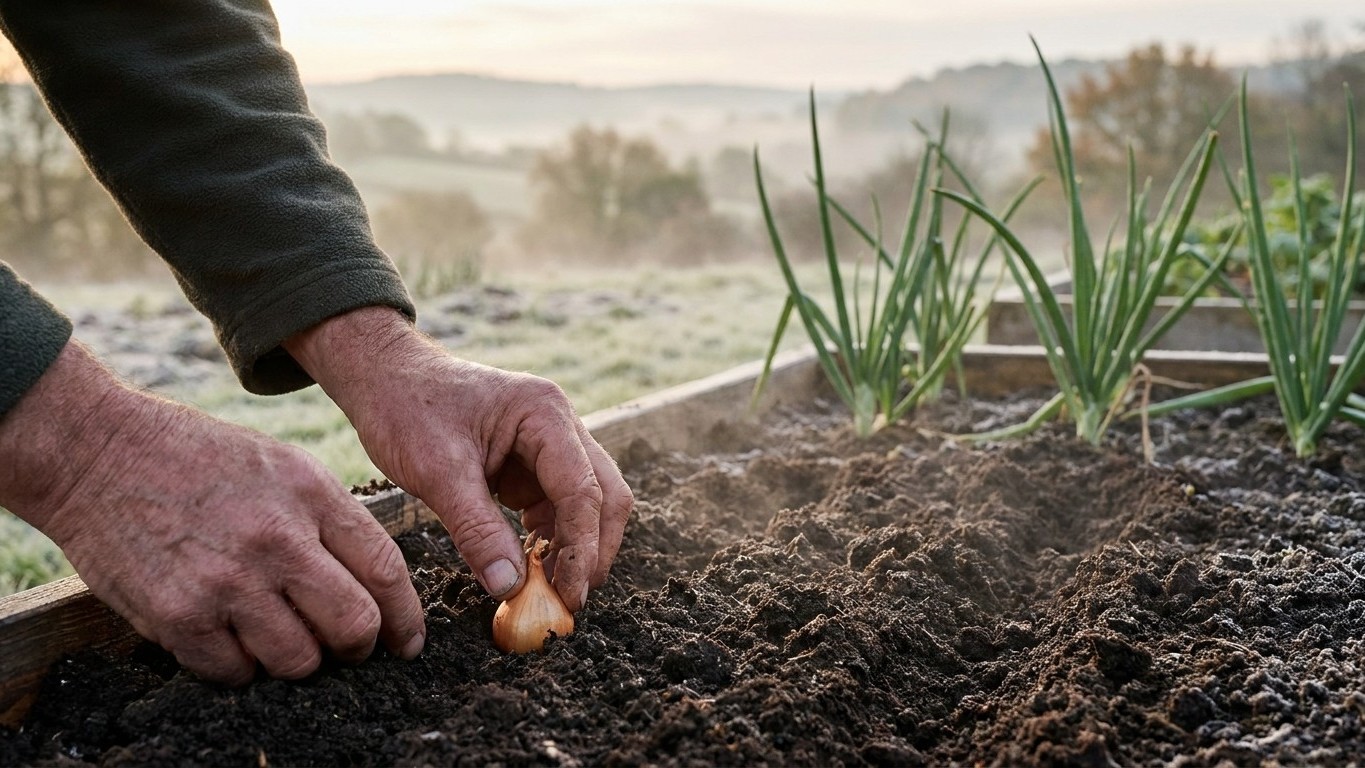
Practically, that means starting onion sets or transplants outdoors as soon as the soil can be worked, typically March into early April depending on elevation. Higher ground in the eastern mountains will run later than the Ohio River valley or the Eastern Panhandle lowlands. The goal is to get plants established early enough that they’ve built substantial leaf mass before day length climbs toward that 14-hour-plus threshold in June, because leaf mass at the moment bulbing kicks in is what determines final bulb size.
Why does this differ from a state like Georgia or Louisiana? Because those states sit at lower latitudes where the day never gets long enough to trigger bulbing in long-day types, but does get long enough, early enough, to trigger short-day varieties while the plant is still small and manageable. West Virginia’s higher latitude flips that logic: the day gets long enough later in the season, giving intermediate and long-day onions time to build size first. Plant on the wrong calendar, or with the wrong day-length group, and the mismatch between plant growth and daylight trigger costs you the harvest.
What will not work here
This is the part that gets skipped in generic planting guides, and it’s the reason bulb size ends up inconsistent for gardeners who buy whatever variety was on the shelf. Onions don’t bulb because of warmth. They bulb because of day length, and a variety bred for a different latitude will either bulb too early or never bulb at all in West Virginia.
Short-day onions are built for latitudes well south of West Virginia. Planted here, they hit their roughly 12-hour bulbing trigger long before the plant has developed real size, giving you small, unsatisfying onions no matter how well you feed and water them. This isn’t a fixable mistake with fertilizer. It’s a variety mismatch.
- Gabriella — short-day, published for 20-35N; bulbs far too early here, producing undersized onions
- Madalyn — short-day, published for 20-35N; same early-bulbing problem at this latitude
- Red Rock — short-day, published for 30-36N; still south of West Virginia, still triggers too soon
- Red Sensation — short-day, published for 25-35N; bulbs while plants are underdeveloped
- Texas Grano 1015Y — short-day, published for 25-35N; a Deep South variety, wrong trigger point here
- Vidora — short-day, published for 25-35N; will bulb small regardless of care
The opposite failure is worse, because it wastes an entire season. Long-day onions bred for latitudes north of West Virginia need daylight the state simply doesn’t get, even on its longest day. The plant just keeps making leaves, month after month, because the bulbing signal never arrives. Eventually the leaves collapse and the whole plant rots in the ground, with nothing to show for it.
- Frontier — long-day, published for 40-50N; daylight here never reaches its trigger point
- Powell — long-day, published for 43-47N; a northern-tier variety, no bulb forms in West Virginia
- Red Carpet — long-day, published for 40-45N; leaves only, no bulb, then rot
- Redwing — long-day, published for 43-65N; suited to far-northern summers, not this state
- Safrane — long-day, published for 42-50N; requires more daylight than West Virginia provides
- Talon — long-day, published for 42-50N; same failure, all season lost to leaf growth
Planting any of these in West Virginia isn’t a smaller risk than planting the right variety. It’s a guaranteed disappointment, whether that disappointment shows up as a marble-sized onion in July or a rotted stalk in September.
What changes across West Virginia
West Virginia is not one uniform latitude band, and treating it as one hides real differences a gardener needs to account for. The state runs from roughly the Ohio River valley in the west to the Eastern Panhandle, and from the southern coalfields up to the northern border with Pennsylvania, a spread of a few degrees of latitude plus significant elevation change in the mountains.
The 38.38-degree figure and the 14-hour-41-minute daylight figure both come from Charleston, near the center of the state geographically but at moderate elevation. A gardener in the state’s far northern counties, closer to the Pennsylvania line, sits at a higher latitude and will see slightly longer summer days and later frost dates in spring. Someone in the southern counties, closer to Kentucky and Virginia’s latitude, sits a bit further south and can generally start planting a week or two earlier than someone near Charleston.
| Location within West Virginia | Relative latitude | What it changes |
|---|---|---|
| Southern counties (near KY/VA border) | Slightly south of 38.38N | Soil workable and safe planting dates arrive a little earlier |
| Charleston (reference city) | 38.38N | Baseline for this page’s timing and variety guidance |
| Northern counties (near PA border) | Slightly north of 38.38N | Slightly longer summer daylight; frost risk lingers longer in spring |
Elevation complicates this further. The high ridges of the Allegheny Mountains in the eastern part of the state can run several weeks behind the Ohio Valley in spring warm-up, regardless of latitude. A gardener in Pocahontas or Randolph County shouldn’t use the Charleston timeline without adjusting for a colder, later spring. The daylight trigger for bulbing doesn’t change with elevation, but the safe date to get transplants in the ground without frost damage absolutely does.
Sweet now, or onions that last
Every onion gardener in West Virginia eventually runs into this trade-off, whether they realize it or not. The pungency of an onion, that sharp bite that makes your eyes water, comes from volatile sulfur compounds. Those same compounds are what protect the bulb during months of storage. Fewer sulfur compounds means a milder, sweeter onion that’s excellent sliced raw on a burger, but one that starts going soft in the pantry within weeks. More sulfur compounds means a stronger onion in the kitchen, but one that will still be firm in March.
This isn’t a matter of luck or growing technique. It’s chemistry, and it lines up directly with the day-length groups available at West Virginia’s latitude. Intermediate-day varieties, which make up a large share of what performs well here, tend to run milder and shorter-keeping than the long-day types bred for northern states. Long-day varieties that do fall within West Virginia’s usable range, such as those rated for 38 degrees north and up, generally lean sharper and store longer.
What does this mean for a West Virginia garden in practice? A gardener who plants mostly intermediate-day onions should plan to eat or preserve most of the harvest by late fall or early winter, because those bulbs won’t hold much past that point. A gardener who leans toward the long-day varieties suited to this latitude can expect a pantry that still has usable onions in March, at the cost of a sharper bite at the cutting board all winter. Growing a mix of both, rather than committing entirely to one side of the trade-off, gives you sweet onions to eat fresh through summer and pungent ones to fall back on once the garden is done for the year.
Checking this against your own garden
Everything above is anchored to Charleston’s latitude and its recorded climate data, and a state-wide figure is never a perfect stand-in for a specific backyard. Before committing to a planting date or a variety order, it’s worth confirming a few things against your own location, especially if you garden well north, south, or at higher elevation than the reference point used here.
- Look up your own county’s latitude if you’re near the northern or southern edge of the state, since a degree or two shifts both frost timing and daylight totals
- Check your local average last-frost date in spring, since mountain counties can run two to three weeks behind the Ohio Valley
- Contact your county’s West Virginia University Extension office for soil-specific planting windows, since they track local conditions than statewide averages
- Note your garden’s elevation, since a few hundred feet of elevation gain can push safe planting dates later even at the same latitude
- Track actual daylight hours locally around the June solstice if you want to confirm which variety group your garden falls into rather than relying solely on the state average
None of this requires special equipment, just a quick look at county-level data before the seed order goes in. A planting calendar built for Charleston is a solid starting point for most of West Virginia, but the mountains and the panhandles are where that starting point needs the most adjusting.