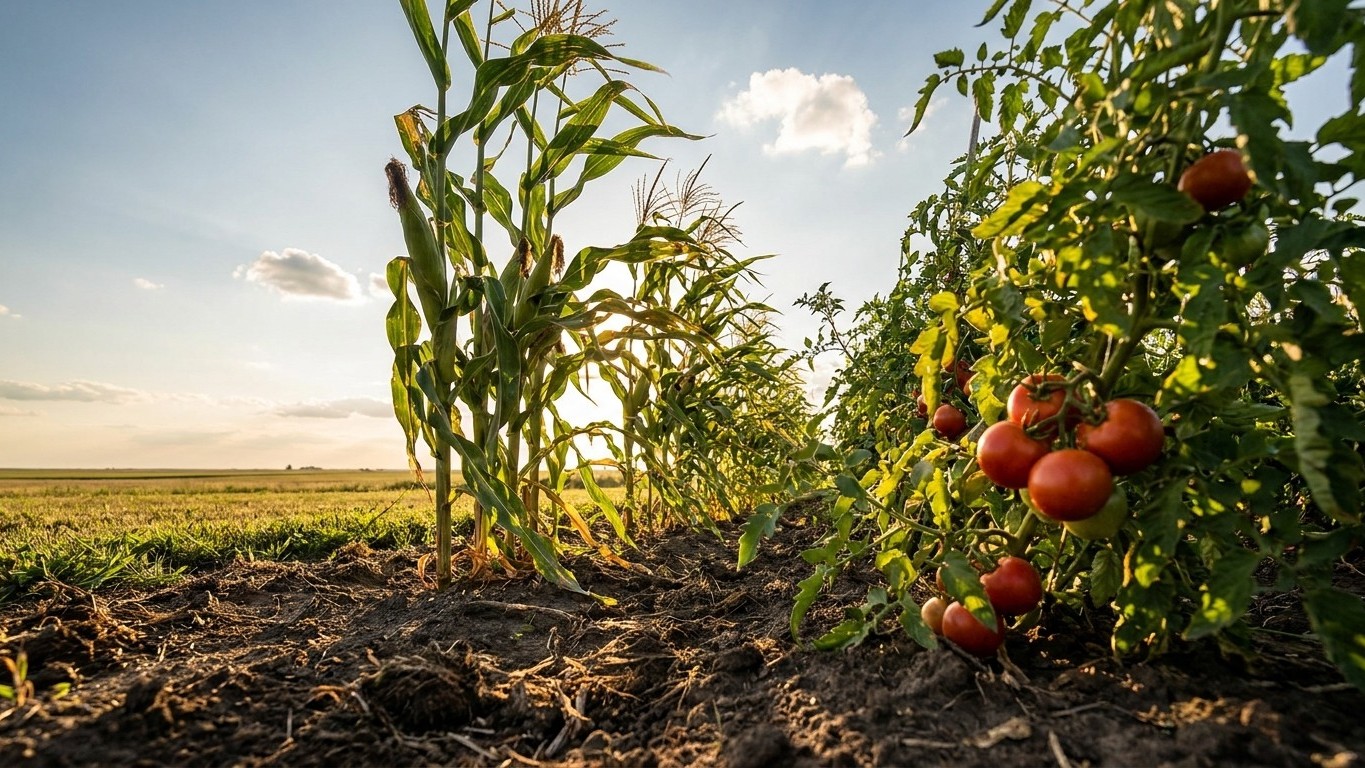

Corn in Yukon gets chewed at three points: as seedlings, as the leaves unfurl, and once silks and ears form. Few corn insects are documented for the territory, so the damage and the timing will tell you more than a species list. The season sets the clock. At Whitehorse A, the mean last spring frost is June 5 and the mean first fall frost is August 25, so every stage fits into a narrow window.
Which pests attack corn in Yukon
Very few corn insects are documented for Yukon gardens, so a long species list would be a guess. The Yukon government’s agriculture branch is the office to ask which ones have turned up near you, and its staff can identify an insect from a clear photo or a jar sample. What you can sort out alone is the kind of damage, because the feeders that matter on sweet corn fall into three groups by the plant part they eat:
- Seedling feeders cut or shred stems at or just below the soil line in the first weeks after the plants break the surface.
- Leaf chewers leave ragged holes and dark droppings in the whorl, the tight funnel of young leaves at the top of the plant.
- Ear feeders chew silks, nibble tips and damage kernels under the husk.
Weather shifts the odds, because insects run on temperature like everything else. At the Whitehorse A reference station, the mean is 0.92 days a year above 30 °C and 0.28 days above 32 °C. That counts extreme days only. The frost-free stretch and the summer means decide how corn does, and the Whitehorse A normals from Environment and Climate Change Canada put that stretch from June 5 to August 25.
Both dates are means. In one year out of two the last frost falls after June 5, and in one year out of two the first fall frost arrives before August 25. The station sits at an airport, and northern or upland districts of the territory run weeks behind it. If your garden is one of them, your pests and your corn both start later than these dates suggest.
When each one shows up, and what it does first
The calendar follows your sowing date, which depends on the soil. Clemson Cooperative Extension says: “Do not plant before the soil temperature at the 4-inch depth is at least 50 ºF. Wait to plant extra-sweet varieties until soil temperatures reach 65 °F.” Utah State University Extension asks for soil above 60 F. In a cool northern spring, use the warmer reading if you are unsure of the seed type. Soil warms well after the last frost, so the June 5 mean is no sowing date. For sowing windows, see When to Sow Sweet Corn in Yukon.
What shows up first after sowing?
Gaps in the row come first. A seed that never emerged may have rotted in soil too cold for an extra-sweet type, which is a different story from a seedling that emerged and then vanished. Look for a plant that wilted overnight with its stem chewed or cut at the soil line. That is the mark of a seedling feeder, and it happens in the first weeks after emergence.
A few weeks later the whorl forms. Leaf chewers show up as rows of holes that appear across the leaf once it unrolls, because the damage happened while it was still folded. Dark droppings caught in the funnel confirm that something is feeding there.
What shows up once silks appear?
Ear feeders arrive with the silks. You see silks chewed short, tips nibbled, or kernels damaged when you pull back the husk. This stage matters most for late sowings. Sweet corn needs 60 to 90 days from planting, and a sowing that goes in after the soil finally warms may reach silking close to the mean first fall frost of August 25. Cool nights slow ear fill, which leaves the ears on the plant longer. Whether a late type fits at all is covered in Will Sweet Corn Ripen in Yukon?
Telling the damage apart from everything else
Plenty of corn trouble has nothing to do with insects. The table lists common look-alikes and the sign that separates them. It describes what to look for, and it cannot tell you what is in your own bed.
| What you see | Possible causes | What settles it |
|---|---|---|
| Ragged holes in leaves | Chewing insect, or wind and hail tearing | Droppings in the whorl point to an insect. Tears with clean, torn edges across the whole planting point to weather. |
| Pale or yellow leaves | Nutrient shortage, cold soil | Yellowing that starts on the lower leaves points to a shortage. Whole plants that were pale early and greened up as the soil warmed point to cold. |
| Leaves rolled and gray-green | Water stress | Leaves that recover by morning point to dry soil. Check the soil a few inches down before blaming anything else. |
| Ears with gaps or scattered kernels | Poor pollination | Gaps spread across the ear point to pollination. Damage confined to the tip with chewed silks points to an ear feeder. |
| Tough, starchy kernels on sweet corn | Types that tassel at the same time crossing | A mix of sweet and starchy kernels on one ear, with no chewing, points to crossing. |
| Flattened or snapped stalks | Wind, animals | A clean break points to wind. Gnawed ears and tracks point to animals. |
| Leaves soaked, then blackened | Frost | The same damage on the whole planting after one cold night points to frost. |
The crossing row deserves a second look. Sweetness suffers when su, se and sh2 types tassel at the same time, which has nothing to do with pests. Plant in blocks of three or more rows so pollen reaches silks, and keep different types from tasselling together by staggering their plantings. Check for droppings and a feeding insect before you blame a bug. If you are still unsure, send a photo to the agriculture branch.
What actually works here, and what is a waste of time
A barrier laid at the right moment does more than any treatment. Cover the row the day you sow. A floating row cover or fine netting keeps seedling feeders off the stems during the vulnerable weeks, and it holds a little warmth too, which helps a short season. Take it off once tassels and silks need to meet, so wind can do its work.
Calendar choices come next. Waiting for warm soil at the 4-inch depth avoids the rotted seed that invites replanting and pushes silking even later. Sowing in blocks of three or more rows improves pollination, and a compact, healthy stand outgrows light feeding. A variety that cannot fit 60 to 90 days between warm soil and the first fall frost wastes both seed and effort, so pick for the season you have. Clean up crop residue at the end of the year so insects have less to shelter in.
Hand removal works on a small patch. Check the whorl and silks every few days from the time plants are knee high until the ears fill, and squash what you find.
The agriculture branch can tell you what is registered for home use in the territory and whether it suits your problem at all.
Several habits waste time. Spraying on a schedule before you know what is eating the plants hits nothing useful, because the damage may be frost, thirst or pollination. Sowing early to beat insects loses the seed to cold soil. Planting a single long row spreads pollen too thin.
Where to check this for your own county
Yukon has no counties, so the nearest equivalent is the agriculture branch of the Yukon government. It handles questions from growers around the territory, and the staff know which insects have been reported in which valleys. Corn pests vary inside the territory, and a note that something was documented in one part of Yukon does not say what is in your garden.
For the full picture of the crop here, start at Growing Sweet Corn in Yukon.
Take a clear photo or a jar sample to the agriculture branch, with your location and the date you sowed. Before you sow, push a thermometer 4 inches into the bed and wait for the reading that suits your seed.
Common questions
What eats sweet corn seedlings in Yukon?
Seedling feeders cut or shred stems at the soil line, and animals sometimes pull up seed. Look at the stem and the soil around it. A chewed stem points to an insect, and seed pulled up and left on the surface points to an animal. Send a photo to the agriculture branch if you cannot tell.
Do I need to spray sweet corn in Yukon?
Start with timing and a row cover. If damage continues after that, ask the agriculture branch what is registered for home gardens in the territory and whether it fits what you found.
Can I plant earlier to get ahead of insects?
No. Seed in cold soil sits and may rot, especially extra-sweet types that wait for 65 °F at the 4-inch depth. The frost date is only a mean, so half of all years bring a later last frost, and a few warm days do not make the soil ready.
How do I know ears are ripe before something else eats them?
Use three signs together: dry brown silks, husks still moist and green, and milky juice when you puncture a kernel. Then pick promptly. Clemson Cooperative Extension says: “Sweet corn loses sugar from the kernel rapidly at high temperatures… Sweet corn can be stored under optimal conditions for about five days, but will lose sweetness with each day of storage.” Types differ here. Su loses sugar fastest, se holds it longer, and sh2 holds it longest.