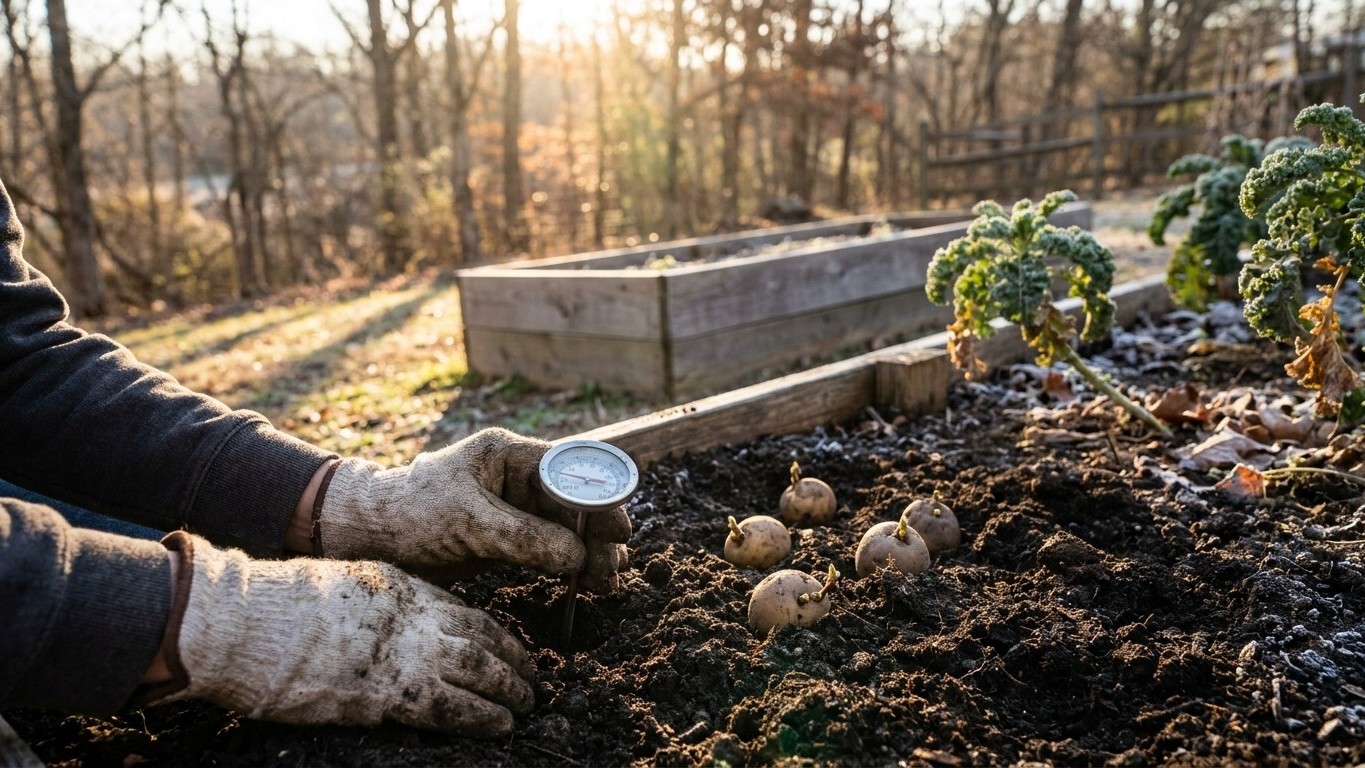

Count back 14 to 21 days from your last spring frost date, once soil temperature hits 50°F, and you’ve got your planting window. For Charleston, that frost date falls between April 9 and April 23, according to NOAA’s Climate Normals for station USW00013866. Counting back puts most river-valley gardens in the ground in late March.
The short answer
NOAA’s National Centers for Environmental Information track the last spring frost using 32°F freeze probabilities pulled from three decades of data (1991-2020) at weather stations across the country. For Charleston’s station, USW00013866, that 30-to-70% probability band runs from April 9 to April 23. That’s the reference window this whole calculation depends on, and it’s specific to that river valley, not the entire state.
Potatoes don’t wait for frost to pass, though. Both Utah State University Extension and the University of Maine Cooperative Extension point to soil temperature, not calendar dates, as the real trigger. Once soil reaches 50°F, seed potatoes go in the ground, and that moment typically lands 14 to 21 days before the last frost date itself. Applied to Charleston’s window, that math lands most plantings somewhere in the back half of March, sometimes stretching into early April depending on how quickly soil warms that particular spring.
The frost date isn’t really the finish line here. Foliage that pokes up into a light frost usually survives fine, since the tubers themselves sit protected several inches underground. What matters more is soil temperature on the front end, and heat on the back end. Utah State’s fact sheet is blunt about the ceiling: soil above 90°F stalls tuber set and fill, and no amount of watering reverses it. That’s the number that should worry a West Virginia gardener more than frost ever will, because a late spring frost bruises a few leaves. A hot July stops the crop from sizing at all.
So the short answer has two parts. Count back from Charleston’s April 9-23 window if that’s your reference city, watch your own soil thermometer rather than trust the calendar alone, and treat the heat ceiling as the deadline that actually decides whether you get a decent harvest. Neither source publishes a single “plant by” date for the whole state, and for good reason. Elevation changes everything about when frost arrives and how fast heat builds afterward.
What actually decides it
Two separate mechanisms are running here, and confusing them is where most planting schedules go wrong.
Soil temperature, not the calendar
The 50°F soil threshold isn’t a suggestion from either extension source, it’s the biological switch that lets seed pieces sprout without rotting in cold, wet ground. Air temperature can feel like spring while soil six inches down is still sitting in the 30s or 40s, especially in shaded gardens or heavy clay that holds winter’s chill. That’s why the 14-to-21-day window before last frost is a range and not a fixed number. A dry, sandy garden that gets full sun might hit 50°F on the early end of that window. A wet, north-facing plot in the same town could lag two weeks behind. Waiting for soil temperature to confirm the calendar’s suggestion is the only way to know for certain, rather than guessing off a date printed on a seed packet.
The heat ceiling that ends the season
Once soils climb past 90°F, tuber set and fill shut down, according to Utah State’s fact sheet. This is the mechanism that actually decides whether a West Virginia garden gets a full crop or a stunted one, and it works independently of frost entirely. In lower, warmer valleys where summer soil temperatures climb fast, the practical answer is to plant as early as soil allows and dig a spring crop before that ceiling hits, rather than trying to nurse plants through a hot summer. This is also why season class matters more than variety name. An early-season potato reaches harvest before peak heat arrives. A late-season class asks the plant to keep sizing tubers deeper into summer, right when soil temperature is working against it. Neither source publishes exact days-to-maturity figures for named varieties, but both confirm this season-class distinction as the deciding factor for timing a harvest around heat.
Elevation complicates both mechanisms at once. Charleston’s river valley warms differently than a mountain garden a few thousand feet higher. NOAA’s data for the higher terrain across the state trends toward frost arriving earlier in fall, which shortens the growing window on the back end even as spring frost dates on the front end shift as well. A gardener working at elevation needs their own station’s normals, not Charleston’s, to run this same math accurately.
How to do it
- Pull your local last spring frost data from NOAA’s Climate Normals for the station nearest your garden, since Charleston’s April 9-23 window only applies directly to that river valley.
- Count back 14 to 21 days from that frost date to identify your target planting window on the calendar.
- Check actual soil temperature with a soil thermometer at planting depth rather than relying on the counted date alone, and wait until it holds at 50°F.
- Buy certified seed potatoes rather than grocery-store tubers or leftover seed from a prior season, since uncertified stock can carry virus that weakens the whole planting.
- Choose a season class, early, mid-season, or late, based on how quickly your local soil tends to climb toward that 90°F ceiling in summer.
- Cut larger seed potatoes into pieces with at least one eye each, and let the cut surfaces heal for a day or two before planting to reduce rot risk.
- Plant seed pieces in a trench at the depth and spacing recommended for the variety, cut side down, eyes up.
- Hill soil around the stems as plants grow, covering developing tubers and keeping them shaded from surface heat.
- Track soil temperature through the season, and in warmer lowland gardens, plan to dig before soils push past that 90°F ceiling so tubers finish sizing before growth stalls.
What goes wrong
- Planting by a fixed calendar date instead of checking soil. A date that worked one year can miss badly the next if the season ran cold or wet. Use a soil thermometer and wait for 50°F rather than trusting the same weekend every time.
- Using uncertified seed potatoes. Tubers saved from last year’s harvest, or bought at a grocery store, can carry virus that neither looks obvious nor washes off. Buy certified seed potatoes specifically, since that’s the only stock inspected for it.
- Applying Charleston’s frost window to a garden at higher elevation. The river valley’s April 9-23 range doesn’t hold for mountain gardens, where frost arrives earlier in fall and the growing season runs shorter. Pull normals for the station closest to the actual garden.
- Growing a late-season class in a hot lowland spot. Asking tubers to keep filling deep into summer heat runs them straight into the 90°F ceiling, where sizing stops regardless of watering. Choose an early-season class in gardens known for hot summer soil, and dig before peak heat rather than after.
- Panicking over foliage frost damage. Since tubers sit protected underground, a light frost nipping the leaves after planting isn’t the crop-ending event it looks like. The bigger risk sits later in the season, with heat, not earlier, with cold.
Common questions
Can I plant potatoes before the last frost date in West Virginia?
Yes. That’s actually the point of the 14-to-21-day count-back. Potatoes go in the ground while frost risk is still present, because the seed pieces need cold soil to have warmed to 50°F, not a frost-free forecast. Foliage that emerges early and meets a light frost typically survives.
What if I garden at higher elevation than Charleston?
Charleston’s April 9-23 window comes from one station, USW00013866, in a river valley. Higher terrain across the state trends toward earlier fall frost, according to NOAA’s normals, which shortens the growing season from the back end. Pull the Climate Normals for the station closest to your actual garden rather than applying Charleston’s figures statewide.
Does hilling protect against frost?
Hilling’s main job is covering developing tubers and keeping them shaded from surface heat as the season warms, based on the mechanism both extension sources describe. It also happens to add a layer of insulation over the row, though neither source frames it as a frost-prevention step specifically.
Should I choose early or late season potatoes for West Virginia’s summer heat?
In gardens where soil reliably climbs toward the 90°F ceiling by mid-summer, an early-season class finishes sizing tubers before that heat shuts growth down. A late-season class, still filling tubers deep into summer, runs a higher risk of hitting that ceiling before it’s done. Neither Utah State nor the University of Maine publishes exact maturity timelines by variety, only this season-class distinction, so match the class to your local soil-heat pattern rather than a specific date.