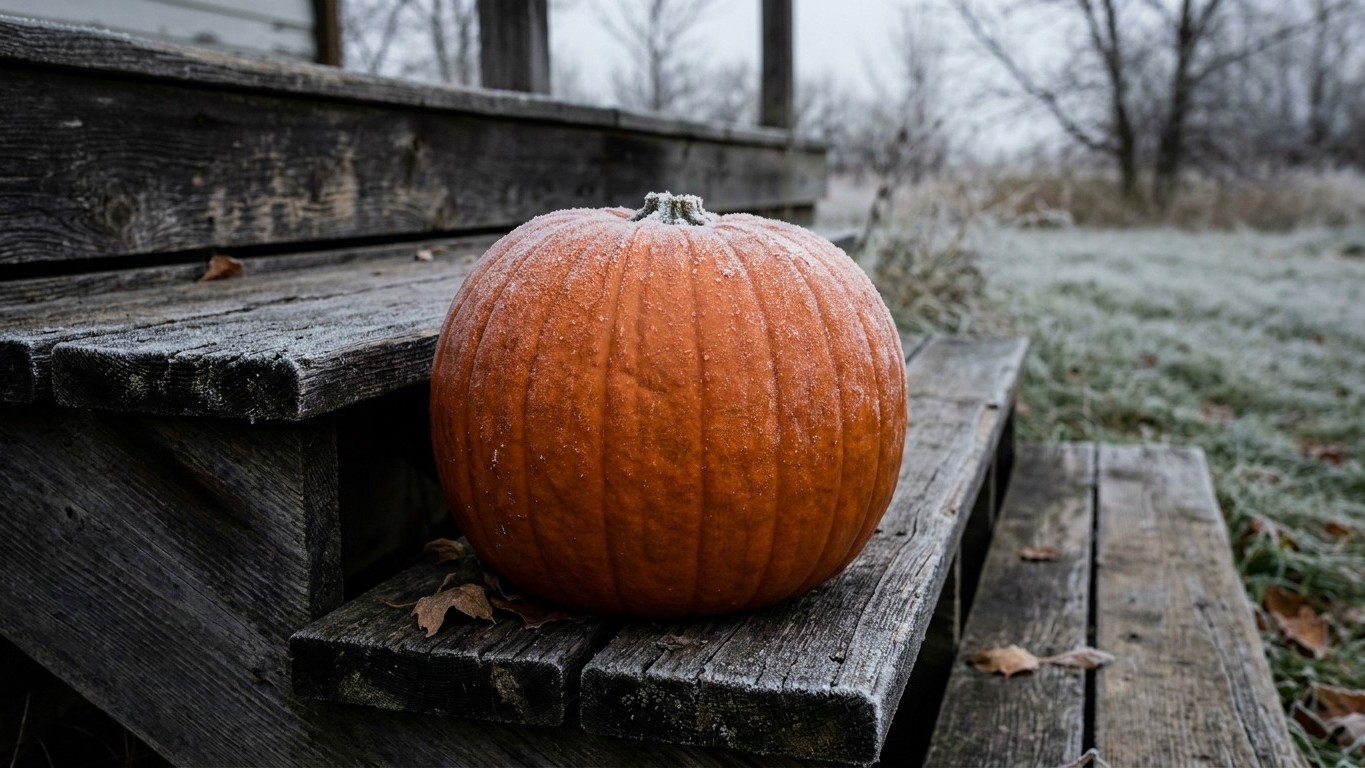

Squash bugs and cucumber beetles get most of the blame for lost pumpkins, but in West Virginia the calendar can take as big a bite as any insect. A fruit that hasn’t finished ripening when the first freeze arrives is gone. This page tracks that clock. The pests have their own pages on this site, and the wider picture lives in Growing Pumpkins in West Virginia.
The short answer
Start with the end of the season. NOAA’s NCEI climate normals put the first fall freeze at Charleston somewhere between October 18 and November 1. That is a window, not a single day, because the date swings from one year to the next. Everything else on this page counts backward from it.
A pumpkin needs 45 to 55 days to mature after the flower opens. That count starts at flowering, not at seeding or transplanting. The vine can spend weeks growing leaves and runners before it sets a flower, and none of that time counts toward ripening. Only the days since the flower opened do.
Now the arithmetic. Take the earliest frost, October 18, and subtract 55 days. You land on August 24. Subtract only 45 days and you get September 3. Take the latest frost, November 1, and the same subtraction gives September 7 on the slow end and September 17 on the fast end. So the latest a flower can open and still give a ripe pumpkin runs from roughly August 24 to September 17, depending on how early the freeze comes and how quickly that particular fruit finishes.
The safe habit is to plan for the early end. Nobody knows in August which end of the frost window this year will fall on. A flower that opens in the first days of September is a gamble, and one that opens later is almost certainly a loss. A bloom in early October has no chance at all.
The frost window carries a caution of its own. The station behind those dates sits in Charleston, a river valley. Higher elevations across the state freeze noticeably earlier in fall, and the sourced figures here do not publish a separate date for them. If your garden sits on a ridge or in a hollow well above the valley floor, shift the whole window earlier. Then set your cutoff for flowers earlier by the same amount, and lean toward the cautious end.
Harvest rules are simple. Cut the pumpkin with the stem attached, and do it before frost. Utah State University Extension, the source for the maturity clock, says to store pumpkins where they will not freeze. It gives no storage temperature or keeping time. For the stretch between ripening and frost, Will Pumpkins Ripen Before Frost in West Virginia? goes deeper.
When to sow here
Sowing is where the clock starts, even though the 45 to 55 days don’t. The seed goes in when the soil reaches 65 F, and that moment is not the last frost date. Soil lags the air by weeks. The steps below show how the dates stack up.
- Begin with the last spring frost. NOAA NCEI puts it at Charleston between April 9 and April 23. Air temperatures can fall to freezing up to about that point.
- Add the soil lag. Cold ground warms slowly, so 65 F soil arrives weeks after the last frost, not on the same day. Add those weeks to April 9 through April 23 and open-ground sowing lands in May, not April. No sourced calendar date for 65 F soil is published here, so the exact day is yours to find.
- Subtract two weeks if you use row covers. Covers buy about two weeks. Move the open-ground May sowing back by that much and the covered sowing falls roughly from late April into early May.
- Confirm with a thermometer. Push a soil thermometer a couple of inches into the bed and sow when it reads 65 F. The calendar gives you a target, and the thermometer settles it.
- Check the forward count. After sowing, the vine has to grow and flower before the 45 to 55-day count begins. The sourced figures here don’t say how long that takes. What they do give is the end point: flowers need to open by roughly August 24 to September 17 to have a chance at ripening.
For a closer look at timing by planting method, see When to Sow Pumpkins in West Virginia.
What goes wrong here
The growing season in West Virginia is long enough for pumpkins, but it leaves little room for error. These are the failures it tends to cause, with a fix for each.
- A late flower that never colors. A bloom that opens after the cutoff makes a fruit that stays green when frost arrives. Count back from the earliest frost date, and treat anything after the window, roughly August 24 to September 17, as a lost cause. Many gardeners pinch off those late flowers and tiny fruit so the vine’s energy goes to pumpkins that can still finish.
- A fruit caught by frost. Frost can strike before the fruit is ready, especially on high ground, where it comes earlier than the Charleston dates. Watch the forecast in mid-October and harvest with the stem attached before a freeze. Pumpkins belong where they will not freeze, so don’t leave them out overnight when a hard cold snap is coming.
- A vine that dies back before the skin hardens. When the foliage collapses early, the pumpkin can stop ripening with a soft rind. The fix is mostly timing: sow when soil hits 65 F, use row covers to gain two weeks, and keep flowers inside the window. If the vine does die early, cut the fruit with the stem attached rather than leaving it in the field.
- Ripe fruit damaged by the wrong neighbors. A whole pumpkin keeps three to six months in a cool, dark spot at 45 to 50 F, according to University of Illinois Extension. Ripening fruit gives off a gas that ages the pumpkin, so keep it away from apples, potatoes and tomatoes. The porch next to the apple crate is the worst place for it.
- Counting from the wrong date. Counting 45 to 55 days from seeding instead of flowering puts the cutoff weeks too late and produces green pumpkins. Mark the date a flower opens, even if it’s just a note on the calendar.
Common questions
What is the latest a pumpkin flower can open in West Virginia?
Counting back 45 to 55 days from the first fall freeze window of October 18 to November 1 gives roughly August 24 to September 17. Plan for the early end, since no one knows which end of the frost window the year will bring. Higher elevations freeze earlier than Charleston, so their cutoff falls earlier too.
Do the 45 to 55 days start when I plant the seed?
No. They start when the flower opens. Utah State University Extension gives that maturity clock as 45 to 55 days after flowering. Counting from seeding puts the whole calculation off by weeks.
Is 65 F soil the same as the last frost date?
No. The last spring frost at Charleston falls between April 9 and April 23, but the soil lags the air by weeks, so 65 F arrives later. Row covers can buy about two weeks, but they don’t erase the lag.
How long does a whole pumpkin keep, and where?
University of Illinois Extension says three to six months in a cool, dark location between 45 and 50 F, away from ripening fruit such as apples, potatoes and tomatoes. That figure applies to a whole pumpkin only, and no storage time for a carved one is given in the sourced figures here.