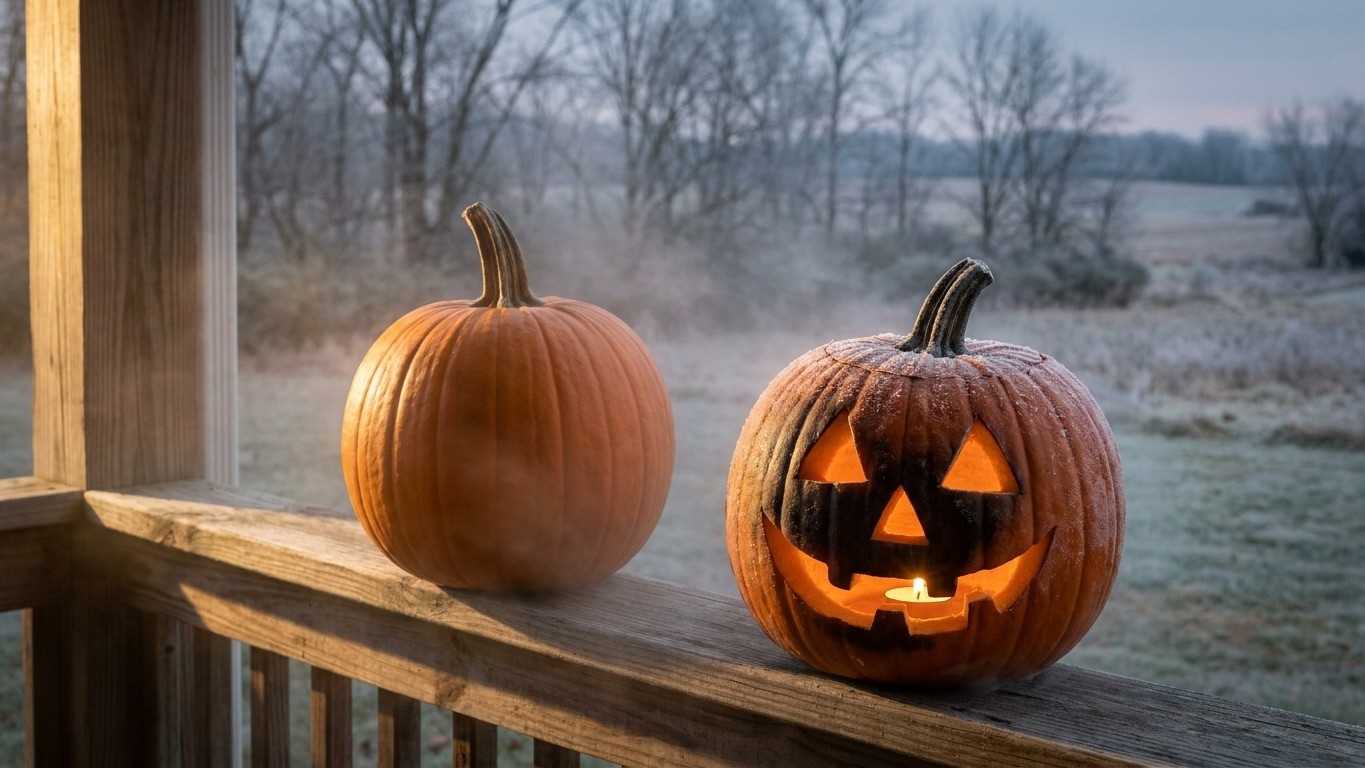

The thing that does the most damage to a Wisconsin pumpkin crop is the calendar. Squash bugs and cucumber beetles chew on vines all summer (this site has separate pest pages for both), but a freeze is what ends the season, and no spray changes its date. A pumpkin is only safe once it has finished maturing, so everything turns on when the flower opened. The seed’s start date matters much less.
The short answer
Wisconsin’s first fall freeze falls between October 17 and October 29, based on the 30 to 70 percent probability band for a 32 F freeze in NOAA NCEI climate normals. Utah State University Extension says pumpkins take 45 to 55 days to mature after flowering. Count back from the frost window and the latest a flower can open and still give a ripe pumpkin lands between roughly August 23 and September 14.
Working backward from the frost window
The arithmetic is short. Take the early edge of the frost window, October 17, and subtract 55 days: August 23. Subtract 45 days instead: September 2. Now take the late edge, October 29. Subtract 55 days and you reach September 4. Subtract 45 and you reach September 14.
That spread is why a single deadline would mislead you. The worst case is the earliest frost paired with the slowest pumpkin, and the best case is the latest frost paired with the fastest. A gardener who wants margin should plan on the early end of the window, and treat anything that flowers in the first two weeks of September as a gamble. A flower that opens after mid-September has almost no chance of giving a ripe pumpkin in this part of the state.
The count starts at flowering. It does not start at seeding or at transplanting. A pumpkin sown on a perfect date can still flower late and miss the deadline, and one sown a little behind can flower on time. The deadline is set by the flower, which is why the sowing calendar below works backward from it. If you want the broader picture of the crop, Growing Pumpkins in Wisconsin covers the full season.
Where the window moves
The October 17 to October 29 window comes from a single station, and Lake Michigan shifts the picture. The lake delays the first fall freeze at the lakeshore. Inland southern Wisconsin typically freezes in early October, and the north freezes far earlier than that. If you garden away from the water, move the whole flower deadline earlier by the same number of days your frost arrives sooner. Frost dates for inland and northern places are not published here, so check a local source before you commit to a variety.
Harvest the pumpkin with the stem attached, and do it before frost.
When to sow here
Sowing is its own calculation, and it rests on soil temperature rather than the date of the last frost. Pumpkin seed wants soil that has reached 65 F. In Wisconsin the last spring frost falls between April 16 and April 29 (same NOAA NCEI source), but soil lags the air by weeks. The two numbers are not the same date, and treating them as one is the most common early mistake.
The arithmetic, step by step
- Start with the last spring frost window, April 16 to April 29. This is when the air stops dropping to 32 F. It is not a sowing signal.
- Add the soil lag. Ground warms slowly, and it reaches 65 F weeks after those frost dates, which carries you into May. Check with a soil thermometer rather than trusting the calendar.
- Sow when the soil reads 65 F. That is the sowing date, and it will differ between a sunny lakeshore garden and a shaded inland one.
- Check the other end. The latest flower that still ripens is between August 23 and September 14, as worked out above. Between a May sowing and that deadline there is room to spare, so a normal sowing lands comfortably inside the window.
- Remember that the time from seed to first flower is not published in the facts used here. Leave a cushion for it, and for slow weather, rather than planning to the last day.
What row covers change
Row covers buy about two weeks. Slipped over a bed, they hold in heat, so the soil can hit 65 F sooner and sowing can move up by roughly that much. Two weeks does not move the frost deadline at the other end, but it does move the flowers earlier, and earlier flowers are the safest insurance against an early freeze. That is especially useful inland and in the north, where the deadline is already earlier. For exact timing by sowing method, see When to Sow Pumpkins in Wisconsin.
What goes wrong here
A season this length rarely fails all at once. It fails in three or four specific ways, each with a remedy.
In the field
- A late flower that never colors. A fruit set after the deadline stays green because the first freeze arrives before it matures. Remedy: stop counting on blossoms that open after roughly the first half of September, and pinch off late flowers so the plant puts its energy into fruit that can still finish.
- A fruit caught by frost. A freeze that reaches a pumpkin on the vine damages it, and the stem attached to a damaged fruit is a poor sign for storage. Remedy: watch the forecast from mid-October on, and harvest with the stem attached before frost. Cover the plants for one cold night only if the fruit still needs a few days.
- A vine that dies back before the skin hardens. Pests, disease or an early cold snap can strip the leaves while fruit is still maturing, leaving soft skin. Remedy: protect the vine through summer, using the site’s squash bug and cucumber beetle pages for the pest side, and harvest promptly once the vine fails instead of leaving fruit exposed.
After harvest
- A pumpkin stored next to ripening fruit. Ripening fruit gives off a gas that ages the pumpkin. University of Illinois Extension says to keep whole pumpkins away from apples, potatoes and tomatoes, which makes the porch next to the apple crate the worst place for one. Remedy: store the pumpkin on its own.
- A pumpkin kept somewhere that freezes. Utah State University Extension names only one rule for storage, a place where pumpkins will not freeze, and publishes no temperature or keeping time. Remedy: a whole pumpkin keeps three to six months in a cool, dark spot between 45 and 50 F, per University of Illinois Extension. That figure is for a whole pumpkin, not a carved one.
Common questions
What is the latest date to plant pumpkins in Wisconsin?
The deadline is set by the flower, not the seed. A flower has to open between roughly August 23 and September 14 at the latest, depending on your frost date and the pumpkin’s 45 to 55 days. The time from seed to first flower is not published here, so build in a cushion and sow when the soil reaches 65 F.
Can a green pumpkin ripen after frost?
Do not plan on it. Utah State University Extension says to harvest before frost, with the stem attached. For what to do with fruit still green as the freeze approaches, read Will Pumpkins Ripen Before Frost in Wisconsin?
How long does a whole pumpkin keep?
Three to six months in a cool, dark location between 45 and 50 F, according to University of Illinois Extension. Keep it away from apples, potatoes and tomatoes. The figure does not apply to a carved pumpkin.
Does Lake Michigan change these dates?
Yes. The lake delays the first fall freeze at the lakeshore. Inland southern Wisconsin typically freezes in early October, and the north far earlier, so gardeners away from the water should move the flower deadline earlier. Frost dates for those areas are not published here.