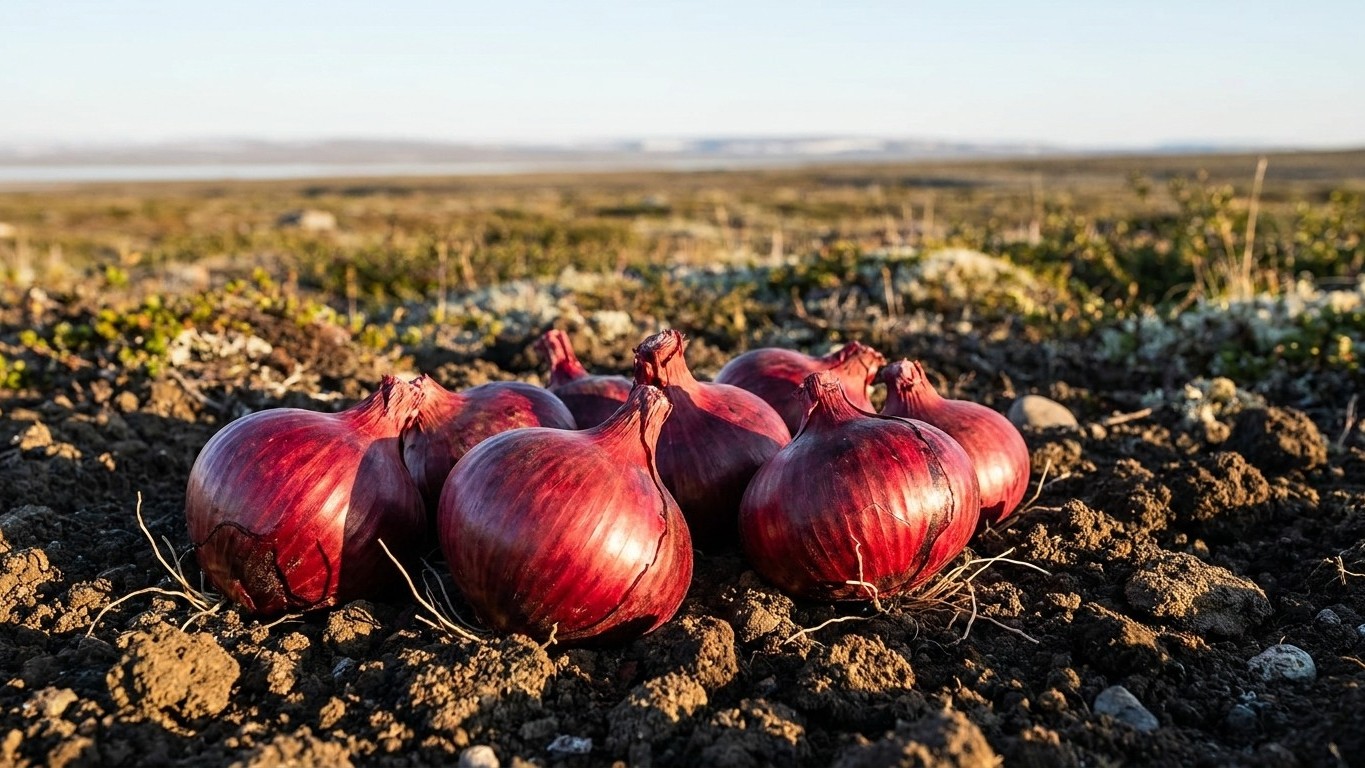

Lift Michigan onions when the tops fall over and yellow, which for most gardens means late summer. Then cure them in a dry, airy spot until the necks are tight and the skins papery. Only after that do they go into storage. The order matters more than the calendar date: an onion pulled with a green neck and stored straight from the ground rots from the top down. The sections below cover the day-length trigger, the mistakes that ruin a crop, and how Michigan’s spread of latitude shifts the advice. For the full growing picture, start with Onions in Michigan.
The short answer for Michigan
Detroit sits at 42.23 degrees north, and its longest day runs 15 h 05 (the geometric figure, since atmospheric refraction adds roughly seven minutes of real daylight). That number drives your harvest, because an onion decides to stop making leaves and start making a bulb by day length, not by warmth. A short-day variety starts bulbing at about 12 hours, according to Clemson Cooperative Extension. A long-day variety waits for 14 to 16 hours. Detroit’s 15 h 05 sits inside that window, so long-day onions bulb well here, swelling through the weeks around the June solstice and finishing in late summer.
Reading the tops
The plant tells you when it is done. Necks soften, the tops flop, and the leaves yellow. Wait until most of the row is down, then lift on a dry day. Loosen the soil with a fork rather than yanking, because a snapped neck or a bruised shoulder is where rot gets in. Bulbs with nicks, soft spots, or insect damage go to the kitchen first. If you are seeing a lot of damage, What Eats Onion in Michigan, and When explains which pests to blame.
Curing comes before storage
Spread the bulbs in a single layer with the tops still attached. Use a warm, dry, airy place out of rain and out of hot direct sun: a covered porch, a garage with the door cracked, a barn loft. Curing is finished when the neck is tight and dry, with no moisture when you squeeze it, and the outer skins are papery and rustle in your hand. Weather sets the timeline, so judge by the neck, not the calendar. Then trim the tops and roots.
Clemson Extension puts ideal storage conditions this way: “Ideal conditions are between 45 °F and 55 °F, and 50 to 60 percent humidity.” (Clemson Cooperative Extension, Home & Garden Information Center.) That is dry, the opposite of what carrots and other roots want. Many Michigan basements run damper than that, and one cellar cannot hold both crops well.
What will not work here
Planting late does not delay the harvest. It shrinks it. Whatever size the plant has reached when day length triggers bulbing is the size the bulb will be, and the trigger does not wait for a slow starter. A transplant set out weeks behind its neighbors bulbs on the same schedule with fewer leaves behind it, and you get a golf-ball onion where you wanted a baseball. The same logic cuts the other way in the South, where a long-day variety never gets its 14 to 16 hours and just makes leaves, then rots. Michigan escapes that problem. Its mistakes are different.
- Short-day varieties: they start bulbing at about 12 hours of daylight, and Michigan’s days are well past that long before summer. They bulb early and stay small, so you get a handful of sweet golf balls, not a pantry crop. The Best Onion Varieties for Michigan sorts out which groups to buy.
- Late-set transplants: the bulb is capped by the leaf area the plant had when bulbing began, so a late start means a small bulb, not a later one.
- Lifting with green, thick necks: the bulb has not finished, and a wide wet neck is an open door for rot in storage.
- Storing straight from the ground: uncured bulbs carry moisture in the neck and skins, and they spoil in weeks.
- Sweet types for winter: they are low in the compounds that protect the bulb, so they will not last the season.
- A damp cellar: above 60 percent humidity, even a well-cured onion starts to sprout and mold.
None of these is a “may struggle” case. Each one reliably costs you bulbs, and every one is avoidable.
What changes across Michigan
Every figure above belongs to Detroit, latitude 42.23 degrees north, the station these climate numbers come from. Michigan is not one latitude. The state stretches from the Ohio and Indiana border to the far end of the Upper Peninsula, a span of several degrees, and the farther north you go, the longer the longest day gets. That is why northern gardens run long-day onions with room to spare while southern gardens, in states far below Michigan, cannot. For a gardener in Marquette or Houghton, the daylight math only gets better. What worsens is the calendar, since spring arrives later and the season is shorter.
| Location | Latitude | Longest day | What it changes |
|---|---|---|---|
| Southern border counties | A little south of 42.23° N | Slightly under 15 h 05 | Still in the long-day range; earliest spring planting and earliest harvest |
| Detroit (reference) | 42.23° N | 15 h 05 | The figures on this page apply as written |
| Northern Lower Peninsula | North of Detroit | Longer than 15 h 05 | Later spring planting, so lifting slides later; sharper, longer-keeping onions |
| Upper Peninsula | Farthest north in the state | Longest in the state | Long-day types only; short-day onions make little sense; shortest season |
Exact latitudes and day lengths for these other locations are not published here, so check your own. The lakes complicate things too. Counties close to the big water warm up later in spring and hold mild air later in fall, so two gardens at the same latitude can plant and lift on different weeks. Use the ranges in the table to orient yourself, then confirm local dates with your county extension office.
Sweet now, or onions that last
Every onion grower makes this trade, whether they know it or not. The bite of an onion comes from volatile sulfur compounds, and those same compounds are what protect the bulb in storage. A sweet variety carries fewer of them. It tastes better raw and does not last the winter. University of Missouri Extension (G6355) says it plainly: “As a rule, ‘sweet’ onions do not store as well as the more pungent types.”
Day length lines up with this. Short-day types run sweeter, and long-day types keep longer. A southern garden therefore gives you onions to eat soon, while a northern one gives you onions that feed you into March. Michigan sits in the middle: its long-day window means pungent keepers are the natural crop, and that is what most of the state should grow for winter storage.
Here is what that looks like on a pantry shelf in March. Pungent long-day onions, cured well and kept at 45 °F to 55 °F in dry air, should still be firm, with tight necks and papery skins. Sweet ones from the same garden will have gone soft or sprouted months earlier, and the ones you ate in August and September were the best use of them. A sensible plan is to split the bed. Eat the sweet bulbs first, roughly the first weeks after harvest, and store only the sharp ones. Never count on a sweet onion that stores, because that onion does not exist.
Checking this against your own garden
The 42.23 degrees north and 15 h 05 figures describe Detroit, not every garden in the state. A gardener in the Thumb, the west coast, or the Upper Peninsula should confirm a few things before trusting any state-wide timeline, including this one. Here are checks you can finish this week:
- Look up your garden’s latitude on any mapping tool and compare it with 42.23 degrees north. The farther north you are, the longer your longest day.
- Call or visit your county extension office and ask for your local average first fall frost date. This page does not publish one, and a state-wide number would mislead.
- Note the date your onion tops start to fall in your own rows this year, and write it down. It is the most accurate local harvest signal you have.
- Put a thermometer and a humidity gauge in the spot where you plan to store onions. You want 45 °F to 55 °F and 50 to 60 percent humidity.
- Check which varieties you actually planted, and sort them into short-day, long-day, sweet, and pungent before harvest, so you know which ones to eat first.
Common questions
Can I leave onions in the ground after the tops fall?
Not for long. Once the tops are down the bulb has stopped growing, and extra time in wet soil only invites rot and sprouting. Lift on the next dry day.
Should I cut the tops off before curing?
No. Leave them on while the bulbs cure, because the neck dries down through the tops. Trim the tops and roots after the neck is tight and the skins are papery.
Where in my house can I cure onions?
Any warm, dry, airy place out of rain and direct hot sun works: a covered porch, a garage, a barn. Spread the bulbs in a single layer so air moves around each one.
Can I store sweet onions through the winter?
Plan on eating them first. Sweet onions have fewer of the sulfur compounds that protect a bulb in storage, so they spoil sooner than pungent types.