
Yes, in most of Wisconsin sweet corn ripens without trouble, but only if you match the variety’s day count to what’s left of the season once the soil is actually warm enough to plant, a question worth working through in full at Will Sweet Corn Ripen in Wisconsin?. Soil temperature, not the calendar date of the last frost, is what starts the clock. In southern and lakeshore counties the season runs long enough for the full 60 to 90 day range. Farther north, that window narrows, and a late 90-day type gets risky.
The short answer
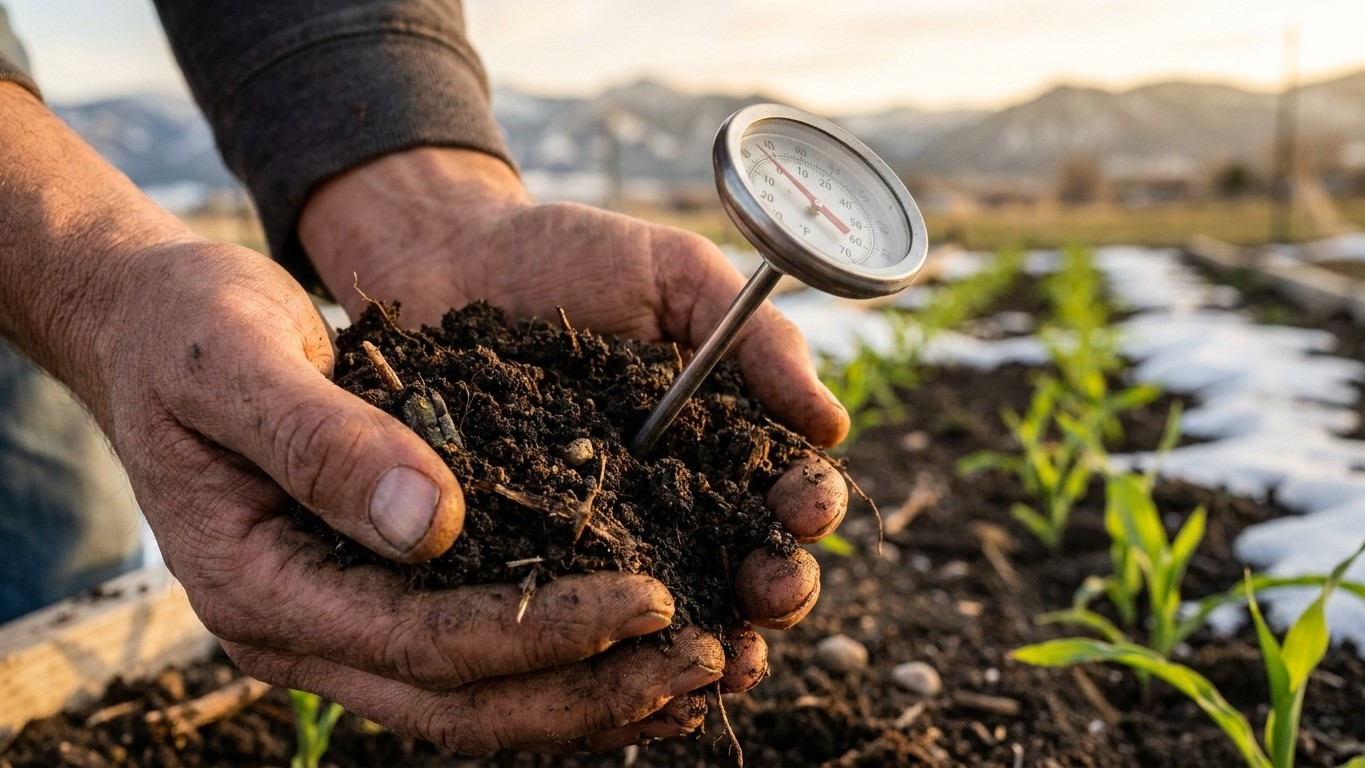
Planting a warm-season crop on a cold-season calendar is the most common mistake here, and it starts with a distinction gardeners skip: the last spring frost and the day soil is warm enough for corn seed are not the same day, and it is not even close. NOAA’s 1991-2020 climate normals put the last spring frost at station USW00014839 between April 16 and April 29. Soil at 60 F, the threshold Utah State University Extension gives for sweet corn, arrives later, since soil lags air temperature by weeks and needs sustained sun and settled nights, not one warm afternoon. Sow seed into cold, wet soil before that point and it rots or comes up thin and stunted; that’s the single biggest reason gardeners here end up with a spotty stand.
Once the ground has caught up, the real question is whether 60 to 90 days of growing time, the range Utah State gives for sweet corn from planting to harvest, still fits before the first fall frost. NOAA’s same station puts the first fall frost between October 17 and October 29. That’s a long back half of the calendar, but the caution built into that data matters: Lake Michigan pushes the actual freeze date later right along the shoreline, while inland southern Wisconsin typically freezes in early October and the far north considerably earlier still. The October 17-29 window applies best to the reference station and similar lakeshore-to-inland conditions, not uniformly across the whole state.
Run the arithmetic conservatively. Take the latest last frost, April 29, add the weeks soil needs to reach 60 F, and planting lands somewhere in May for most of southern and central Wisconsin, which lines up with guidance on When to Sow Sweet Corn in Wisconsin. Counting even 90 days forward from a May planting still lands well before an October 17 frost, let alone October 29. There’s slack in the schedule. Add the fact that Milwaukee’s climate normals show only about 7 days a year reaching 90 F or hotter, and it’s clear this is a climate of moderate, not blistering, summer heat, so corn here isn’t fighting the drought stress and pollination failure it battles farther south. The season is long enough and the summers are mild enough. The variable that actually decides success is matching variety length against your specific county’s frost dates, which is what the next section works through.
Does a late variety fit here?
Utah State University Extension gives 60 to 90 days as the span sweet corn needs from planting to harvest, without naming particular varieties, so the two ends of that range are what a gardener has to test against Wisconsin’s frost dates, not a seed catalog.
A 60-day variety
Start counting from a May planting, the earliest point soil is reliably above 60 F across most of southern and central Wisconsin, and 60 days lands in early July. Even a delayed planting into late May still finishes by late July. Measured against a first fall frost of October 17 to October 29, that leaves two to three months of open calendar doing nothing. A short-season variety is the safest choice everywhere in the state, including the north, where the growing season is shorter and the margin for error smaller. There’s no version of Wisconsin’s climate, per the data here, where a 60-day type runs out of season.
A 90-day one
The math gets tighter at the far end. A May planting plus 90 days lands in late July to August in most of the state, still comfortably ahead of an October frost inland or along the lakeshore. In southern Wisconsin and the areas Lake Michigan warms into fall, a 90-day variety fits the window described by the station data here. But the same caution that widens the season near the lake narrows it going north: inland southern Wisconsin typically freezes in early October, and the far north considerably earlier than that. Neither of those inland or northern dates is spelled out numerically in the data behind this article, so treat this plainly: a 90-day variety planted late, or grown in the northern part of the state, does not have the comfortable margin a 60-day type does, and in a cool, late spring it can run out of season before it finishes. If you’re gardening north of the state’s midline, a shorter-season variety removes that risk rather than betting on a long, warm fall.
What goes wrong here
Three failures account for most disappointing sweet corn harvests in Wisconsin, and only one of them has anything to do with the climate covered above.
- Soil sown too cold. Seed goes into the ground on the calendar date of the last frost, or soon after, while the soil itself is still well below 60 F. The result is rot, uneven germination, or a thin stand that never catches up. The remedy is patience: wait until the soil, not the air, has held above 60 F for several days before planting, even if that means sowing weeks after the frost date has passed.
- A variety too late for the season. A 90-day type planted late, or grown in the northern part of the state where the first fall frost arrives well before the dates recorded near Lake Michigan, can still be filling out its ears when the first hard freeze hits. The remedy is matching variety length to your actual local frost date rather than a statewide average, and defaulting to a shorter-season type when there’s any doubt.
- Sweetness lost to cross-pollination timing. This one has nothing to do with frost dates or soil temperature. Utah State University Extension is specific that su, se and sh2 sweet corn types lose their sweetness if they tassel at the same time nearby, and the kernels turn starchy instead of sweet. No isolation distance is published in that guidance, so don’t rely on a fixed number of feet between plots to solve it. The fix is timing and layout: stagger planting dates so different types don’t tassel together, keep each type to its own block, and plant in blocks of three or more rows rather than a single thin row, which also improves pollination generally.
Checking this against your own county
Everything above is built on one reference station’s climate normals, and Wisconsin’s weather is not uniform enough to treat that as gospel for every backyard. The lakeshore runs weeks behind inland counties in both spring warm-up and fall freeze timing, and the difference between the state’s southern border and its northern counties is even larger. Before committing a season’s seed order to a 90-day variety, check your own county’s frost dates against what’s presented here.
The University of Wisconsin-Madison Division of Extension maintains county offices across the state, and its horticulture staff track local frost data and variety performance specific to each county’s conditions. That local read is worth more than any statewide average, particularly if you’re gardening near the lake, in the northern counties, or in a low spot known to hold cold air late into spring.
Common questions
How do I know the soil is actually 60 F, not just the air?
Check with a soil thermometer pushed a few inches into the bed, taken at the same time of morning over several consecutive days rather than a single reading. A warm afternoon doesn’t mean the soil underneath has caught up; it’s the multi-day trend that matters for germination.
How do I know exactly when to pick, versus when to plant?
These are two separate clocks and they answer different questions. The 60 to 90 days from planting tells you whether the crop fits inside the season at all. Picking time is a different count, roughly 17 to 24 days after silk emergence, and the actual signal to harvest is three things checked together: dry, browned silks, husks that are still moist and green, and milky (not clear, not thick) juice from a punctured kernel. One sign alone isn’t reliable; all three together are.
Does Wisconsin’s summer heat stress sweet corn?
Not much, based on the climate normals for the reference station. Milwaukee averages about 7 days a year reaching 90 F or hotter, which points to a moderate summer heat load rather than the kind of prolonged high heat that stresses pollination and drives up water demand in hotter regions.
Can I grow two different sweet corn types in the same garden?
You can, but the guidance behind this article gives no safe isolation distance in feet between plots, so don’t lean on a fixed spacing number. What matters is timing: stagger the planting dates of su, se and sh2 types so they don’t tassel during the same window, and grow each type in its own block of at least three rows rather than mixing them in a single row.