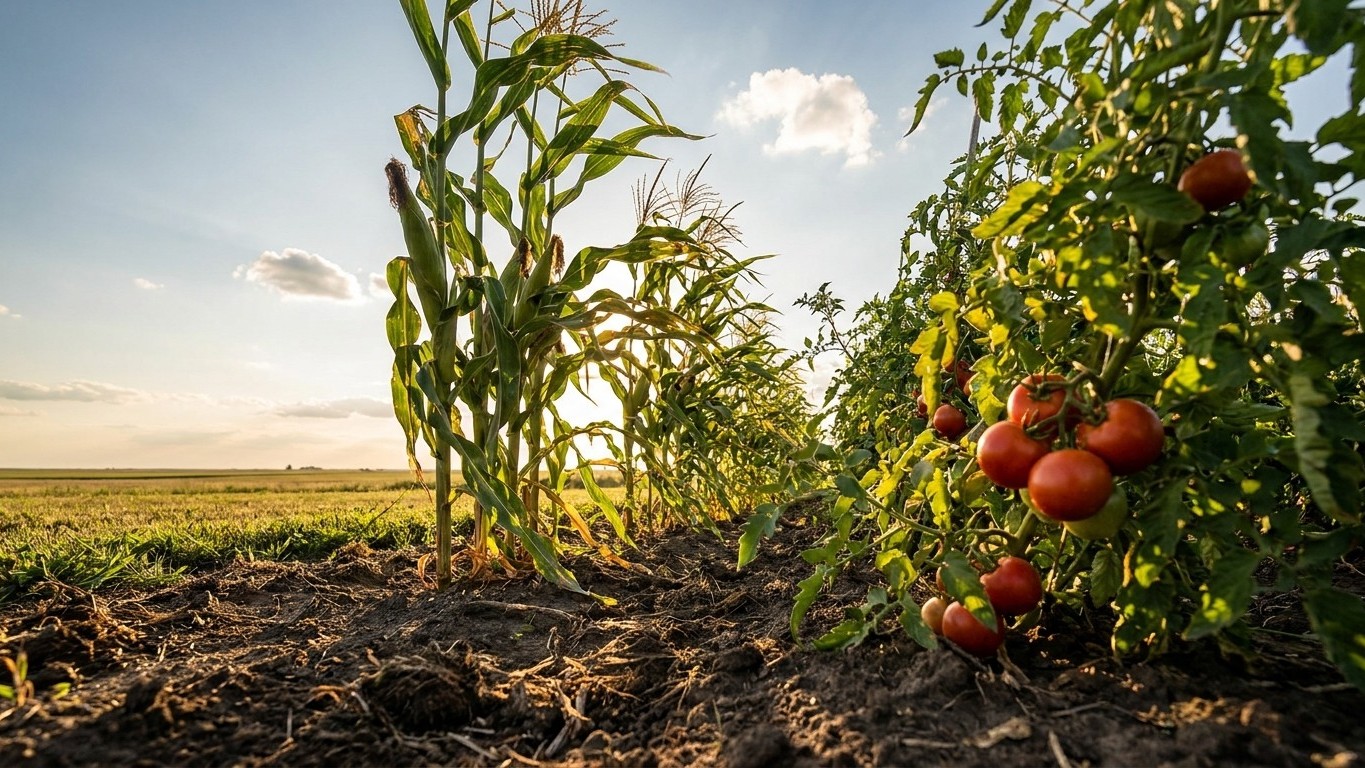

Sweet corn is ready when the silks are dry and brown, the husks are still green and moist, and a punctured kernel gives milky juice. For corn sown once the soil has warmed, that lands roughly from late July through September in Wisconsin. The window is short. After picking, sugar leaves the kernel quickly, and Clemson Extension puts the best-case keeping time at about five days. The details of both clocks follow.
When sweet corn are ready in Wisconsin
Watch the ear, not the calendar. Silks first appear at the tip of the husk, and watching for them is the cue to start checking. That clock answers which week to pick. A separate clock, 60 to 90 days from planting, answers whether the variety fits your season at all. Keep the two apart, because mixing them is how people pick a week too early or too late.
Three signs have to agree before you pull an ear:
- The silks have turned dry and brown.
- The husks are still moist and green.
- A punctured kernel releases milky juice (clear juice means early, doughy paste means late).
Any one of these alone misleads. Silks can brown before the kernels fill, and husks stay green on ears that have already gone starchy. If you can only check one thing, puncture a kernel, but use all three when you can.
How do Wisconsin frost dates shape the sweet corn season?
NOAA’s NCEI climate normals put the last spring freeze between April 16 and April 29 and the first fall freeze between October 17 and October 29 (the 30 to 70 percent probability band at the reference station). Planting does not start at the last frost, though. Utah State University Extension says sweet corn wants soil above 60 F, and soil reaches that well after the last frost. Clemson Extension is more specific: do not plant before the soil at the 4-inch depth is at least 50 ºF, and wait until it reaches 65 °F for extra-sweet varieties. A surface reading runs warmer than the 4-inch depth, so push a thermometer down before you trust it. For more on sowing, see When to Sow Sweet Corn in Wisconsin.
Those two thresholds are not interchangeable. An ordinary type can go in at the lower number, while a supersweet seed sown into 50 F soil is likely to rot. That is why a gardener can succeed one year and fail the next after switching varieties.
Lake Michigan delays the first fall freeze along the lakeshore. Inland southern Wisconsin typically freezes in early October, and the north freezes far earlier. A 90-day type sown into warm soil has room in the south. In the north, margins shrink fast, so choose an earlier type or ask your county extension office what has worked locally. Pests also time their arrival to the ears, which is covered in What Eats Corn in Wisconsin, and When.
One more timing rule shapes flavor. Sweetness is lost when su, se and sh2 types tassel at the same time, so keep those types from tasseling together. Plant each in blocks of three or more rows, which is a shape of garden rather than a date. For the full growing picture, see Growing Sweet Corn in Wisconsin.
Keeping them, and for how long
Clemson Cooperative Extension states it plainly: “Sweet corn loses sugar from the kernel rapidly at high temperatures… Sweet corn can be stored under optimal conditions for about five days, but will lose sweetness with each day of storage.” That sentence is the reason for the old advice to run from the garden to the pot. About five days is a ceiling under optimal conditions. Warm storage will cut it, and sweetness slips a little every day even when everything goes right.
Heat is the accelerator. Wisconsin summers are mild by national standards, with about 7 days a year reaching 90 F or more at the reference station. A closed car, a sunny porch or a countertop beside the stove can still mimic a hot spell for a basket of ears. Sugar loss does not wait for a heat wave, so the sooner the corn is cool, the more sweetness you keep.
Which type of sweet corn keeps its sugar longest?
The genotype matters as much as the fridge. The su type loses sugar fastest, se holds it longer, and sh2 holds it longest. That is the practical reason to pick a type for how you plan to eat the corn:
| Type | Sugar loss after picking | Best fit |
|---|---|---|
| su | Fastest | Pot within hours of picking |
| se | Slower than su | Eaten within a day or two |
| sh2 | Slowest | Sharing, roadside sales, longer holds (soil at 65 °F needed) |
Choosing sh2 means waiting for warmer soil, as Clemson’s 65 °F rule says. Weigh that against the end of the season. If fall comes early in your part of the state, an earlier ordinary type may be the safer bet, and you simply eat it fresh.
Where in the house that actually is
A domestic refrigerator is the closest match to the cool conditions Clemson describes. Corn tolerates steady cold well, so the issue with a fridge is not that it runs too cold. The two rooms to avoid are the opposite kind. A heated kitchen speeds sugar loss, and a garage swings with the weather, running warm in an August afternoon and cold on a September night. Either swing works against you.
Corn does not belong on the counter, in a sunny window or in the trunk of a car. A basement can look promising, but check it first, because a basement in a warm Wisconsin August is often warmer than expected. Compare it with the refrigerator before you decide anything.
A cheap appliance thermometer settles the question. Place it on the shelf where the corn will sit, leave it overnight, and read it in the morning. Check the door shelf and the crisper separately, since the door is usually the warmest spot. If a thermometer shows a shelf that is steadily cold and does not frost the husks, that is the spot. Put the ears in the refrigerator the same day you pick them, because every warm hour comes straight out of the sweetness.
The best arrangement is to pick close to dinner. Early morning is the coolest part of the day, which helps because sugar loss rises with heat. Pick only what you can eat in a day or two, and spread the rest of the harvest across the season by sowing in separate plantings.
Common questions
How many days from planting to ripe sweet corn?
Sweet corn needs 60 to 90 days from planting, depending on the type. Once silks emerge, watch the ears closely for the ripeness check. The planting count tells you whether a variety fits the season, and the silk count tells you which week to pick.
Can I grow a late variety in northern Wisconsin?
Check first. The north freezes far earlier than the south, so a 90-day type may not finish before the first freeze. Your county extension office can tell you which maturity ranges have worked in your area. Remember that soil also warms slowly there, which eats into the season before the corn is even up.
Does extra-sweet corn keep better after picking?
Yes. The sh2 type holds its sugar longest, se is in between, and su loses it fastest. The tradeoff is that Clemson recommends waiting until the soil at the 4-inch depth reaches 65 °F before planting extra-sweet varieties.
How can I stretch the harvest without losing sweetness?
Keep su, se and sh2 types from tasseling at the same time, and keep each planting in a block of three or more rows. That spreads the harvest over several weeks and protects sweetness from cross-pollination.