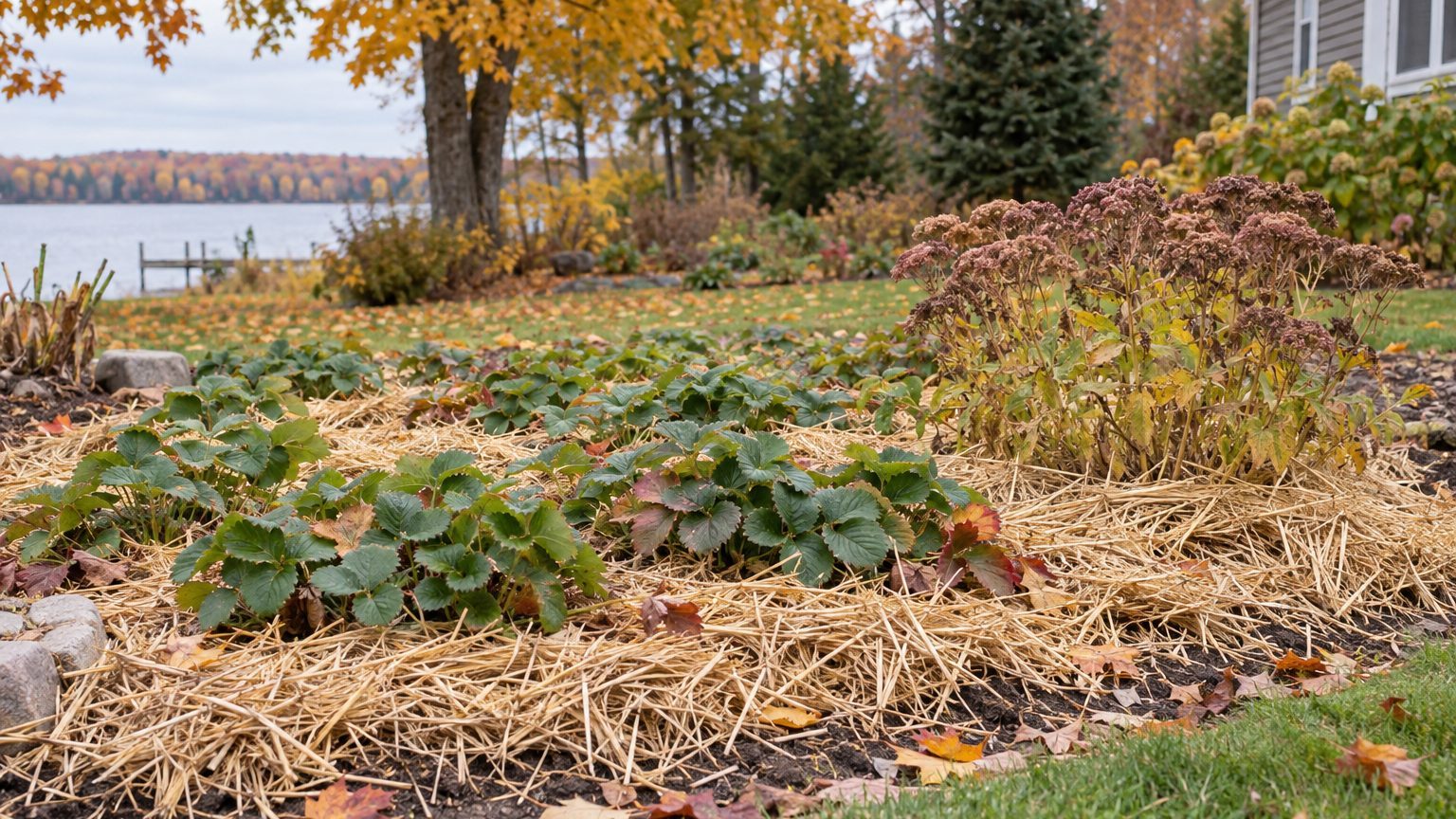

Wyoming gardeners should put winter mulch on strawberries and perennials after the ground begins to freeze, not when the first frost shows up. Near Cheyenne, that first frost arrives between September 24 and October 5, and the mulch goes down well after it. Early mulch holds warmth and shelters mice. Late mulch does its real job: keeping frozen soil frozen. Pull it back in spring as growth restarts.
When to put winter mulch down in Wyoming
The window is a “wait” rule, and it surprises people. Winter mulch is not a blanket meant to keep roots warm. Its job is to keep the soil at a steady temperature once it is already cold, so it doesn’t thaw on a sunny afternoon and refreeze overnight. Spread it over warm fall soil and you do the opposite: you trap heat and moisture around crowns that should be going dormant.
Reading the calendar
The calendar gives you a starting line, not a finish line. NOAA’s 1991-2020 Climate Normals for the Cheyenne station (USW00024018) put the first fall 32°F freeze in a band running from September 24 to October 5. That is the stretch where the odds of a freeze in a given fall climb from 30 to 70 percent. It marks the end of the growing season. It does not mark mulching time. Mulch goes down after several hard freezes have killed back tender growth and the soil surface has started to stiffen, which lands well after that window closes.
Cheyenne is the reference point here because the state is too varied to give one date. USDA’s 2023 Plant Hardiness Zone Map, which is built on the average annual extreme minimum temperature, runs from 3a to 6a across Wyoming, so your own garden may sit well away from the Cheyenne numbers. The direction is predictable, though. Farther north and higher up, the first frost comes earlier and the ground freezes earlier, so the mulching window opens earlier there too. At roughly 6,000 feet, the frost-free season is only about 130 days. At higher elevations frost can show up in any month, which is why many gardeners up there keep straw within reach all year. You can compare your own town in First and Last Frost Dates in Wyoming.
Reading the soil
Soil tells you more than the date does. The coldest month at the Cheyenne station averages a daily minimum of 18.1°F (NOAA Climate Normals 1991-2020). That is an average night, not a record low, so the ground certainly freezes, and Wyoming has no mild corner in these data where mulching can be skipped. The dates just move.
Mulch after the ground starts to freeze, which means after the September 24 to October 5 first-frost range, once plants are dormant and the soil is stiff in the morning. If you cannot tell, push a trowel into the bed. When the top layer resists and comes up in crusty chunks that stay firm through midday, you are in the window.
| What you see | What it means | Mulch yet? |
|---|---|---|
| First light frost, leaves still green | Growing season ending, soil still warm | No |
| Several hard freezes, tops blackened or dormant | Plants are shutting down | Almost |
| Soil surface stiff in the morning | Ground has started to freeze | Yes |
| Soil frozen hard, snow on the way | Deep winter | Yes, but do not delay further |
A general walkthrough of materials and technique is in Mulching Without Killing the Plant. The timing logic above is what changes in a cold, dry, windy state.
Strawberries
Strawberries are the plant most worth mulching on time in Wyoming. A strawberry crown sits right at the soil surface, with shallow roots just below it. That makes it the first thing to suffer when winter swings between freezing and thawing.
Two things hurt the crowns. The first is heaving. When soil thaws and refreezes, it expands and contracts, and the shallow roots can be pushed upward until the crown sits exposed on the surface. The second is bare cold. A crown with no snow or mulch on it takes the full force of dry winter wind and subzero nights. With a coldest-month average minimum of 18.1°F at the Cheyenne reference station, and colder nights in the extremes, bare crowns have little margin.
Clean straw is the standard material. Look for straw that is free of weed seed, not hay, which can seed your strawberry bed with grass and weeds for years. Shredded leaves can mat into a wet, airless sheet that sits on the crowns and encourages rot. Straw stays fluffy, sheds water, and lets the plants breathe.
For depth, the only figure we can cite comes from NC State Extension, and it concerns mulch in general, not strawberries specifically: “A 2-inch to 3-inch layer of mulch suppresses most annual weed seeds and makes it easy to hand-pull any that do germinate.” That range is a sensible guide for settled straw over a strawberry bed. Thicker is not better. A deep, packed layer holds moisture against the crowns and slows spring regrowth.
Timing follows the same rule as everything else: cover strawberries after the ground has started to freeze, and uncover them when growth begins, not by a fixed calendar date. In spring, watch for new leaves pushing up under the straw. They will look pale yellow-green, since they have been growing in the dark. When you see that, rake the straw off the crowns and tuck it between the rows, where it keeps berries clean and holds down weeds. Colder, higher gardens uncover later, because their last spring frost comes later.
Do not remove it all and forget it. Late frosts are common across the state, and a flower damaged by frost will not set fruit. Keep the straw close at hand and be ready to pull it back over the plants on a frost night. Variety choice, bed layout, and renovation are covered in Growing Strawberries.
Perennials and borderline plants
Most hardy perennials in Wyoming do not need a thick winter blanket. A plant rated for your zone has already been through hard winters and has its own defenses. Mulch earns its place on certain plants, not on every bed.
The ones that benefit most are new plantings in their first winter, since their roots have not spread far enough to buffer the cold. Plants whose hardiness rating sits right at the limit for your area gain the most. So do shallow-rooted perennials and evergreen types, which lose moisture through their leaves while the ground is frozen. Check your own zone before deciding. USDA’s 2023 map runs from 3a to 6a in Wyoming, and that rating comes from the average annual extreme minimum, which is colder than the 18.1°F average night at the Cheyenne reference station. A perennial that survives an average night can still die in the worst night of the decade.
The method matters as much as the material. Mulch goes on in a ring around the plant, not in a pile on top of it. Piling mulch over a crown holds moisture against the stems and buds, and in a thawing spell that is where rot starts. Leave the crown itself clear and build the ring outward from it, like a doughnut, not a volcano.
For depth, NC State Extension again gives the range, this time for woody plants: “Provide a 3-inch layer of mulch to reduce water loss and maintain uniform soil moisture and temperature around roots.” Combined with the earlier line about weeds, that gives you the working number. Use a ring of 2 to 3 inches, with the crown itself left clear. Do not extend it upward. Those sentences come from a North Carolina handbook, so treat them as a depth guide, not a Wyoming-specific rule. The Wyoming-specific part is the timing, which comes from the freeze.
Perennial herbs fall into the same group, with an extra wrinkle: some prefer dry, lean soil and resent heavy mulch near the crown. The ring method suits them well. More on that is in Getting Perennial Herbs Through the Winter.
What goes wrong
Four mistakes account for most winter mulch failures, and each one has an easy prevention.
Mulching too early
Mulch laid right after the first frost, in the September 24 to October 5 range, sits on warm soil. The plant keeps drawing moisture, the crown stays damp, and rot has time to start. The same cozy layer also invites mice and voles to settle in before winter even begins. Waiting for the ground to freeze solves both problems.
Matting and rot
Wet leaves and grass clippings pack down into a dense mat. Under it, crowns stay soggy through every thaw. You will see it in spring as black, mushy stems and a sour smell when you lift the layer. Prevent it by using loose straw or similar material that lets air through, and by keeping the layer in the 2-to-3-inch range described above.
Voles and mice
Rodents like a deep, undisturbed layer of mulch because it is warm and hidden. The damage shows up in spring as chewed crowns, gnawed bark on young woody plants, and runways under the straw. The cure is partly timing, since late mulching leaves less time for nesting, and partly keeping the layer thin and the ring clear of trunks and crowns. Cutting tall grass near beds also removes cover.
Forgetting to uncover
Straw left on past the start of growth smothers new shoots, keeps soil cold, and slows everything down. Check the beds as soon as the snow melts, and rake the mulch back once you see pale new growth. Colder, higher sites start later, so look at your own garden, not at the neighbor’s down the valley.
Common questions
Can I mulch strawberries right after the first frost?
It is too soon. The first frost in the Cheyenne reference data falls between September 24 and October 5, but the soil is still warm then and plants have not gone dormant. Wait until the ground starts to freeze, with several hard freezes behind you.
Does snow count as mulch?
A steady snow cover insulates the ground well, but wind across open Wyoming ground can strip it off, and a thaw can melt it away. Mulch covers the gap when snow does not stay. Where snow reliably piles up, the protection is stronger, but you cannot count on that from year to year.
Is straw better than shredded leaves or wood chips?
For strawberries, clean straw is the better choice because it stays loose and does not mat the way wet leaves do. Wood chips suit permanent shrub and tree rings, not strawberry crowns. For perennials, any loose material works if you keep it in the 2-to-3-inch range and off the crown.
How do I know when to take it off in spring?
Look under the straw for pale yellow-green growth, then rake it back from the crowns. Do not wait for full green. Keep the straw nearby, because frost can still arrive, and at higher elevations it is possible in any month of the year.