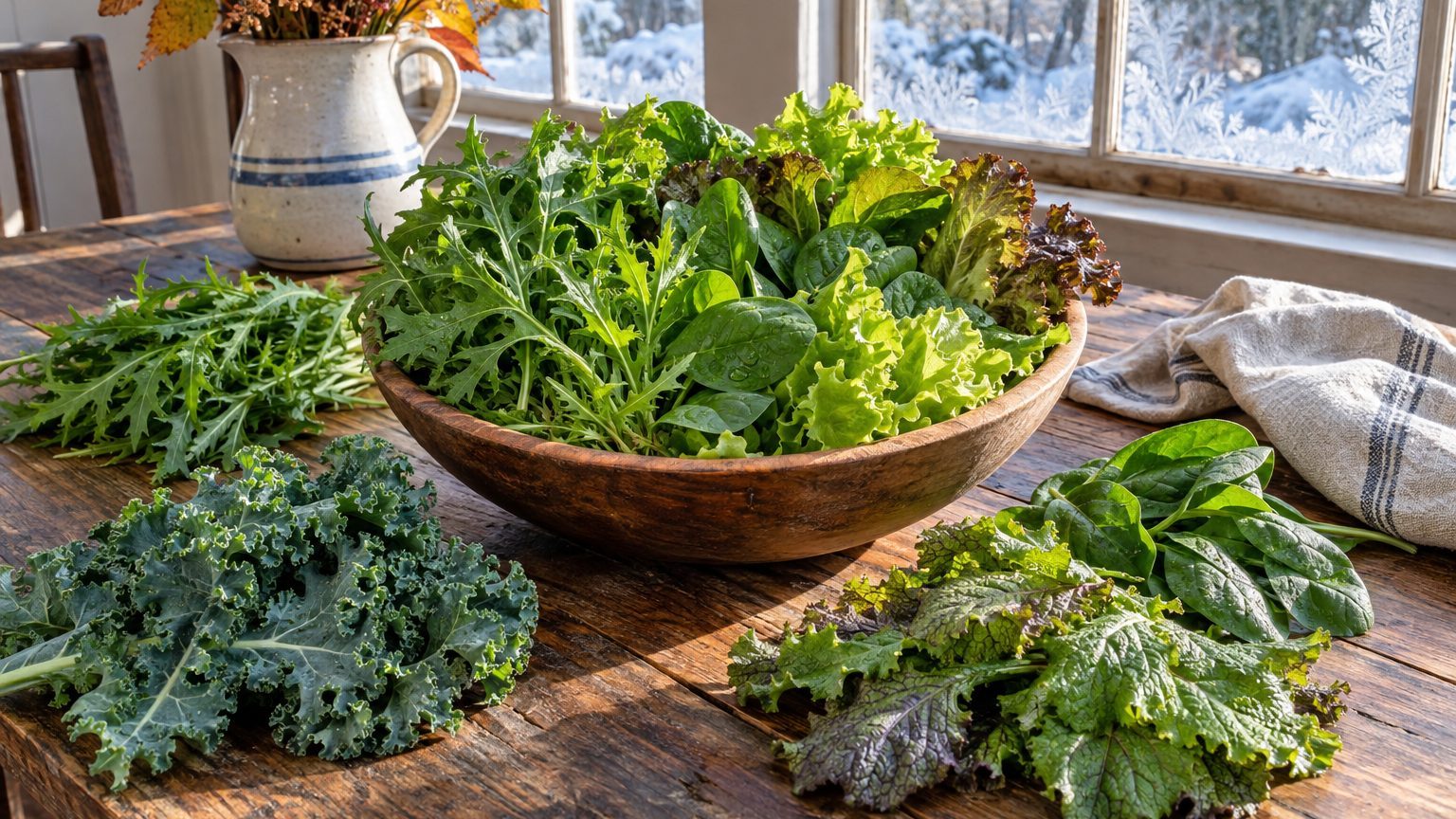

For Wisconsin, choose the cold-hardy leaf crops: spinach, mâche, claytonia, and hardy kale. Add quick Asian greens and arugula for fall, and hold the tender lettuces for a covered bed. The season is short and the winter is cold, so type matters more than any single cultivar. Variety names matter less than sowing early enough and giving the bed a cover.
The short answer for Wisconsin
Start with the numbers that frame the decision. At the Milwaukee reference station, NOAA’s 1991-2020 Climate Normals put the last spring freeze between April 16 and April 29. The first fall freeze falls between October 17 and October 29. Both are 32°F freeze probabilities in the 30-70% band, meaning the dates when a freeze is neither unlikely nor certain. They are not guarantees, and a freeze can land outside that window. The coldest month has a mean daily minimum of 17.2°F, the figure that decides whether a plant survives the winter at all.
That 17.2°F is an average of nights, so the worst nights run colder. Plants that shrug off a hard freeze in October can still fail in January. That splits the winter salads into three groups.
| Type | Cold tolerance | Best role in Wisconsin |
|---|---|---|
| Spinach | High | Fall sowing, held under cover, picked through winter thaws |
| Mâche (corn salad) | High | Low rosettes that sit through hard cold and are harvested into early spring |
| Claytonia (miner’s lettuce) | High | Succulent leaves for a covered or protected bed |
| Hardy kale and similar brassicas | High | Tough leaves for fall salads, sweeter after frost |
| Tatsoi, mizuna, arugula | Moderate | Fast fall crops, best under a cover once nights drop |
| Leaf and head lettuce | Low to moderate | Early fall harvest, or a cold frame with careful venting |
If you have one bed, plant spinach and mâche first. They are the most forgiving in a state where the first freeze can arrive in early October inland and far earlier in the north. A second bed of claytonia and a few rows of fast Asian greens gives you texture and a faster first harvest.
The dates for when to sow each type are on a separate page, When to Sow Winter Salads in Wisconsin. For the full picture of how these crops fit together over a season, start with Winter Salads for Wisconsin Gardens.
What will not work here
Late sowing fails first. A winter salad needs most of its growth before the light fades, because in deep winter plants mostly hold what they have instead of growing. With a first fall freeze as early as the first days of October inland, a crop sown in a hurry in late autumn never gets big enough to harvest. The slowest types, such as heading lettuces and anything that wants a long run to full size, are the first casualties.
Bare, uncovered beds are the second failure, for tender types. Against a coldest-month minimum of 17.2°F on average, and colder nights than that in practice, an unprotected lettuce planting will not carry through. Spinach and mâche can live outdoors in many Wisconsin winters, though they do far better with a simple cover. Gardeners in the colder zones should not expect lettuce to overwinter with no help.
Cover that cooks or collapses
A cover can fail too. A closed cold frame or low tunnel on a sunny day in late winter can overheat, and the damp, still air inside invites rot and mildew. Crowded rows make it worse. Vent on sunny days, even when it is cold outside, and give the plants room for air to move.
Snow is the other trap. Wet snow piling on a hoop can flatten it and crush the crop beneath. Use a steep or sturdy frame and clear the load after heavy snowfall.
Summer heat is a gap in this page
This page does not carry a measured figure for summer heat in Wisconsin, so it will not claim one. The general rule still applies: lettuce and spinach seed sown in hot soil germinates poorly. If you start seed in late summer for fall and winter crops, shade the seedbed and keep it moist instead of assuming the soil is cool enough.
Weekly watering is not enough for new seedlings in a dry late summer. Thin seed beds dry fast, and seedlings that sprout and then dry out are lost entirely.
What changes across Wisconsin
There is no single Wisconsin garden. The USDA Plant Hardiness Zone Map (2023, built on 1991-2020 normals) places the state across zones 3b to 6a. That is a wide spread, and the system rests on a single variable: the average annual extreme minimum temperature. It tells you nothing about frost dates, snow cover, or summer heat, so treat it as one input.
The Milwaukee figures above belong to the lakeshore. Lake Michigan delays the first fall freeze there, while inland southern Wisconsin typically freezes in early October and the north far earlier. So a gardener inland should count on a shorter fall than the October 17 to October 29 window suggests. Someone in the north has even less runway, and the cold is more severe once it arrives.
The practical shifts are straightforward. In the colder north:
- Sow earlier, because the fall window closes sooner.
- Put the hardiest types (spinach, mâche, claytonia) in the main bed.
- Count on a cover for everything, with extra layers or a sturdier structure.
- Skip tender lettuce for winter harvest and grow it only in the early fall.
Near the lake and in the warmer south, you have more room. You can stretch the harvest of tatsoi, mizuna, and arugula later into fall, and a modest cover may carry a wider range of crops through winter. Even so, no part of the state gets an easy ride.
To see where your own garden sits, use the USDA hardiness zone map and look up your location. Do not guess from a neighbor’s experience, since a few miles and an elevation change can move you a half zone.
Where to check this for your own county
The best next step is your state extension service. University of Wisconsin Extension is the land-grant program for Wisconsin, and it has county offices staffed by people who know the local soil and weather. This page is the state view. A county recommendation beats a state one, because it reflects your local frost pattern, soils, and what has been grown there.
Two things are worth looking for. The first is a local planting calendar, ideally one built for your county or nearby region, with fall sowing dates for cool-season greens. The second is any list of varieties trialled locally. Variety trials show which cultivars of spinach, lettuce, kale, and Asian greens held up in conditions close to yours, which is exactly what a statewide page cannot tell you.
If you cannot find a calendar for winter salads specifically, look for fall vegetable gardening guides and season-extension material, then match the crop types to the table above. Extension offices also answer questions directly, and local master gardener programs often know which crops have worked in the area.
One caution. Calendars from other states do not transfer. Extension calendars are usually published per crop or per species and tied to the local climate, so take the one that matches both your crop and your region, not the nearest-sounding one.
Checking this against your own garden
Your own observations outrank every date on this page. Three are easy to make without special tools.
Soil warmth by feel. In late summer, push your hand into the seedbed. If the soil still feels warm to the touch, even a few inches down, lettuce and spinach seed may refuse to sprout, so wait or shade the bed. In fall, soil that feels cold and damp right through tells you growth is winding down. Low spots and shaded sides of the house reach that point sooner than a sunny, sheltered bed.
The first flush of male flowers. When the squash and cucumbers in your garden start showing male blooms in spring, that is a sign of warming. Late-summer decline in those vines tells you the season is turning, and your fall greens should already be in the ground. Compare year to year, and you will learn whether your garden runs ahead of or behind the state averages.
The first true leaves. Seedlings first show seed leaves, then the true leaves that look like the mature plant. If your fall sowings have true leaves before the cold nights arrive, they usually have a good chance of reaching harvest size. If they are still tiny when frost threatens, protect them or expect a thin harvest. Note the date each year.
Write these down. A few seasons of notes on your own bed will do more than any regional calendar.
Common questions
What is the best winter salad green for Wisconsin?
Spinach and mâche are the safest picks. Both tolerate hard cold, and both can be sown in fall for harvest through winter thaws and into early spring, especially under a simple cover.
Can lettuce survive a Wisconsin winter?
Not reliably without protection. With a coldest-month mean daily minimum of 17.2°F at the Milwaukee reference station, and colder nights in practice, tender lettuce needs a cold frame or tunnel, and it is best treated as an early fall crop.
When is the first fall freeze in Wisconsin?
At the Milwaukee reference station, NOAA’s 1991-2020 normals give October 17 to October 29, as 32°F freeze probabilities in the 30-70% band. Inland southern Wisconsin typically freezes in early October, and the north far earlier.
What hardiness zone is Wisconsin?
The USDA Plant Hardiness Zone Map (2023) spans zones 3b to 6a across the state, so there is no single answer. Check the map for your own location instead of assuming a zone.