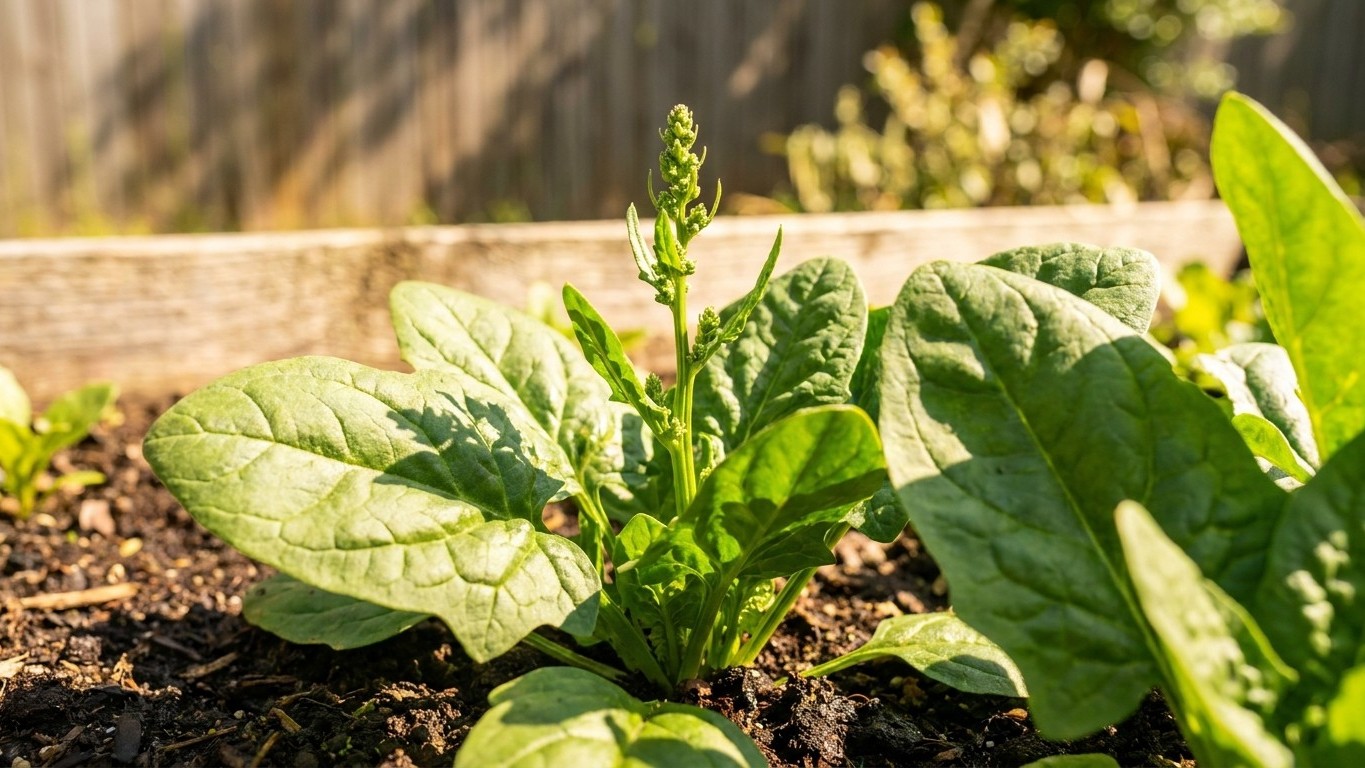

Spinach in Wyoming almost always bolts before a gardener expects it to. The state’s long summer daylight, not brutal heat, does most of the damage, and that means the trick to a longer harvest isn’t shade cloth or watering more, it’s timing the sowing date around the calendar rather than the thermometer.
The short answer
On the longest day of the year, Cheyenne gets 14 hours and 58 minutes of daylight. That’s the number that matters most for spinach, because flowering in this crop is triggered by long days as much as by warmth. A stretch of cool weather in July doesn’t cancel that signal out. The plant reads the clock, not the thermostat, and once daylight stretches past a certain point, spinach starts throwing up a flower stalk whether the afternoon high is 68F or 88F.
Here’s what makes Wyoming’s case a little different from a hot southern garden: the reference station near Cheyenne averages only 10.4 days a year at 90F or above. That’s a light heat load, especially for a High Plains location sitting around 6,000 feet. So the pressure on spinach here comes mostly from day length, with heat playing a supporting role rather than the lead. Compare that to a lowland garden in a warmer state, where 90F afternoons stack up for weeks and heat alone can bolt a crop even under shorter days. In Wyoming, the sun simply stays up too long for too much of early summer, and that alone pushes plants toward flowering.
The 75F growth ceiling published by Utah State University Extension still applies, and it cuts two ways. Below that number, spinach grows steadily and stays sweet. Above it, growth slows and leaves turn bitter, on top of whatever bolting pressure the long days are already applying. So the honest read on Wyoming is this: day length sets the outer limit on the season no matter what, and the relatively modest number of 90F days here means gardeners get a slightly wider margin than they would in a hotter state, but not a wide one. Both factors matter, but if forced to pick a single culprit, day length is the one doing the heavy lifting.
That combination explains why spinach here behaves less like a crop you can “extend” with good luck and more like a crop you schedule around two narrow windows, one in spring and one in fall, with the long middle of summer basically written off.
How long the spring window really is
- Start with the frost data. NOAA NCEI’s 1991-2020 climate normals put the last spring freeze in the Cheyenne area, station USW00024018, somewhere between May 7 and May 18, using the 30-70% probability band for a 32F freeze.
- Standard spinach sowing guidance calls for planting two to three weeks before that last frost date. Counted back from the earlier end of the range, that lands sowing around April 16. Counted from the later end, it lands around April 27. Either way, spinach seed is going into cold ground in mid-to-late April, which is normal for this crop since it tolerates a hard chill far better than heat.
- From that sowing date, the plant has roughly six to seven weeks of daylight that stays short enough and temperatures that stay cool enough to grow well, before the calendar tips toward the June 21 solstice and its 14 hours and 58 minutes of light at Cheyenne’s latitude.
- By late May into early June, daylight is already long enough to start pushing spinach toward flowering, and this happens before the region even reaches its handful of 90F days, which mostly show up in July.
- The practical result: a Wyoming gardener gets a spring window of roughly six weeks of good leaf production, from mid-to-late April sowing to early-to-mid June harvest, before long days end the run regardless of how mild the weather stays.
The autumn crop, and when the soil lets you sow
Fall spinach is where Wyoming’s climate gets more forgiving, since shortening days work in the plant’s favor instead of against it. The obstacle in autumn isn’t the sun schedule, it’s the ground itself, followed by the calendar running out before frost.
Warm soil delays sowing
Utah State University Extension notes that spinach seed germination drops off once soil temperatures climb above 80F. That threshold, not the air temperature, decides when a fall sowing can actually go in the ground. Late summer soil at 6,000 feet still holds heat from July and August sun, so a gardener has to wait for that warmth to bleed out of the top few inches before seed will come up reliably. There’s no published soil-temperature calendar for this region specific to spinach, so the safe approach is to test the soil directly rather than guess a date, and to sow once it has clearly cooled rather than by habit on a fixed day.
First fall frost sets the finish line
The first fall freeze at the Cheyenne-area station falls between September 24 and October 5, per the same NOAA NCEI climate normals used for the spring date. That gives a hard finish line for any fall crop. Working backward from that window using the 50 to 75 day range Utah State University Extension gives for planting to harvest, a target harvest right at the frost line means sowing sometime between mid-July and early August, depending on how close to the frost date the gardener is comfortable cutting it.
Stack those two constraints together and the fall window looks tight: soil needs to have cooled below that 80F germination ceiling, which in a high-elevation, strong-sun climate often doesn’t happen until early-to-mid August, while the harvest needs 50 to 75 days before a frost that can arrive as early as September 24. That leaves a fall sowing slot of roughly two to four weeks in early-to-mid August, shorter than the spring window and considerably less forgiving. Gardeners who watch soil temperature directly, rather than sowing by a fixed date, get the better shot at a usable fall crop before frost ends the season.
Common questions
Does shade cloth stop spinach from bolting in Wyoming?
Shade cloth can lower leaf temperature and help keep the plant under the 75F growth ceiling on hot afternoons, but it does nothing about day length, which is the main trigger here. It buys a few extra days at best, not extra weeks.
Which spinach varieties are recommended for this climate?
Utah State University Extension names Bloomsdale, Melody, Teton, and Olympia as varieties suited to home gardens, but the source publishes no data comparing their bolt resistance or days to maturity, so no specific claim can be made about performance differences between them here.
Can I sow spinach again in midsummer if my spring crop bolts?
Midsummer sowing runs straight into the longest daylight of the year, the same 14 hours 58 minutes at the solstice that pushed the spring crop to flower. A midsummer sowing will almost certainly bolt faster than the spring one did, not slower.
Is elevation the reason spinach struggles in Wyoming?
Elevation shapes the frost calendar, since roughly 130 frost-free days at 6,000 feet is a short season and frost is possible in any month at higher elevations, but it isn’t the direct cause of bolting. Day length and the 75F growth ceiling drive that, independent of how high the garden sits.