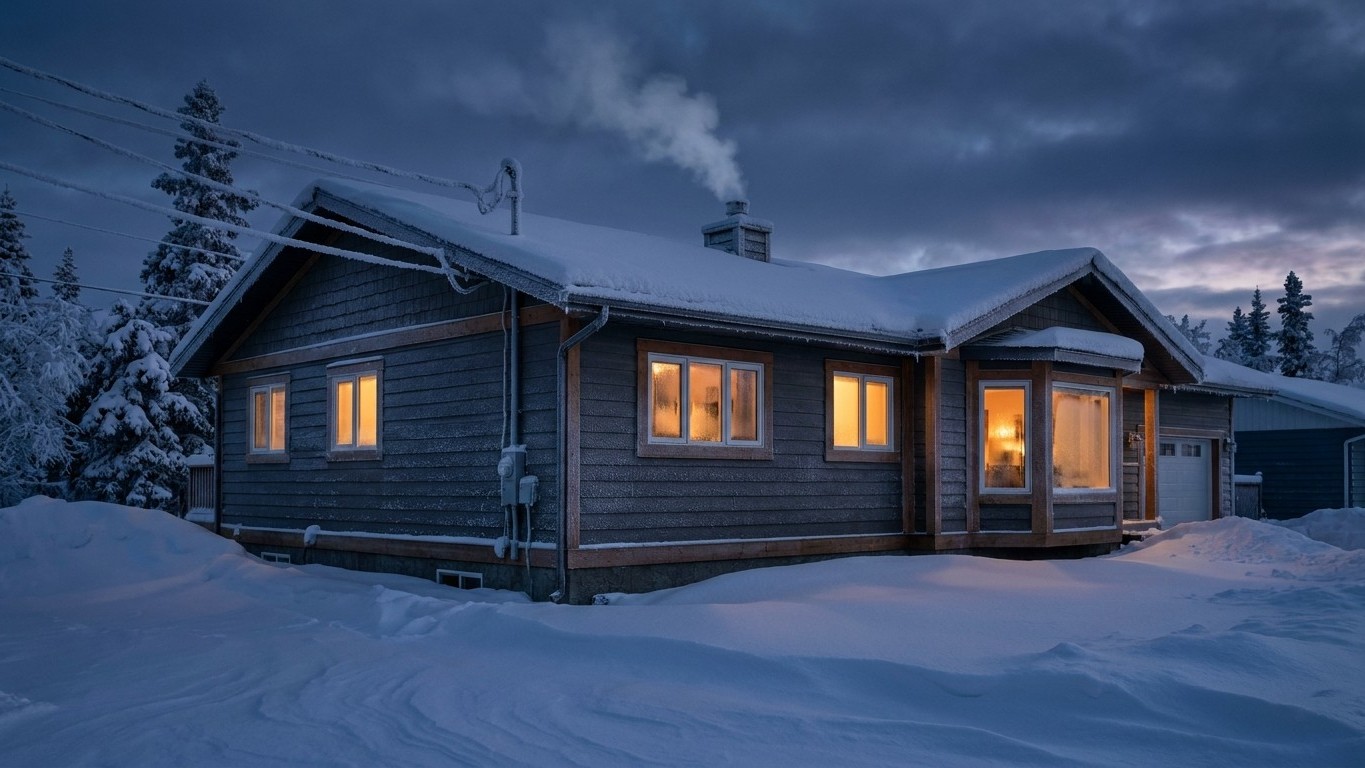

Whitehorse averages -2.6°F for the coldest month’s daily minimum, and that single number explains why heating costs in Yukon run higher than almost anywhere else in North America. The real driver isn’t just how cold it gets, but how long the furnace has to fight before spring shows up.
How cold it gets, and for how long

Minus 2.6 degrees Fahrenheit sounds almost survivable until you realize it’s not the record low. It’s the average daily minimum for the coldest month, based on Environment and Climate Change Canada’s 1981-2010 normals for Whitehorse. That means on a typical night in the depths of winter, the temperature is sitting well below zero as a matter of routine, not as an outlier. Half the nights that month dip even colder than that.
This is the number that separates a heating season from a heating emergency. A place where winter hovers near freezing for four months asks a furnace to work steadily but moderately. A place where the coldest month sits at -2.6°F asks something different: sustained, high-output heat for a long stretch, with almost no margin for a system that’s undersized or aging. Yukon falls squarely into the second category.
What this means for a house
Heating equipment sized for a milder climate will run constantly and still lose the battle on the coldest nights. That’s why homes in this territory typically lean on higher-capacity furnaces, well-sealed envelopes, and backup heat sources, wood included, rather than a single system doing all the work. When Does the Heating Season Start in Yukon? Often, it begins as early as September and runs through May, which means the equipment isn’t just working harder on the worst nights. It’s working for more months of the year than a homeowner in Ohio or Virginia would ever plan for.
That length matters as much as the depth of cold. A furnace that only has to handle two brutal months can be forgiven for running inefficiently. One that has to handle eight cannot. Every inefficiency gets multiplied by the calendar.
What a cord of wood is worth here
A cord of well-seasoned hardwood delivers about 20 million BTU, according to Michigan State University Extension. That’s an average, not a guarantee. Species and moisture content swing it considerably, but as a baseline it’s useful: MSU points out that one cord is roughly equivalent to the heat in 145 gallons of #2 fuel oil, or 215 gallons of LP gas. In a territory where the heating season runs long and cold, that comparison is worth sitting with. Wood isn’t a novelty fuel here. It’s a serious contender against oil and propane, measured in the same units.
But “cord” is the word that gets buyers cheated more than any other in the firewood trade, and it’s worth being blunt about that. A cord is a volume, not a weight, and it has an exact legal definition: a stack measuring 4 feet by 4 feet by 8 feet, or 128 cubic feet total.
| Dimension | Measurement |
|---|---|
| Stack size | 4 ft x 4 ft x 8 ft |
| Total volume | 128 cubic feet |
| Heat energy (seasoned hardwood) | about 20 million BTU |
Because a cord is a volume, density is what actually decides how much heat you’re bringing home. A loosely stacked cord of a light softwood and a tightly stacked cord of dense hardwood occupy the same 128 cubic feet, but they do not contain the same mass of wood, and they do not deliver the same heat. This is the entire trick of buying firewood: measure the stack, then ask what’s in it.
Seasoning matters just as much as species. Wet wood spends a chunk of its potential heat simply boiling off the water trapped inside it before any warmth reaches the room. That’s energy the household paid for and never gets to use.
How long wood takes to dry in Yukon
MSU Extension puts the target at 20 percent moisture or less before wood is ready to burn efficiently. Green, freshly cut wood can carry more than 60 percent moisture, which means a lot of drying has to happen before that wood earns its place in a stove.
Split green wood usually reaches that 20 percent threshold after one full summer of seasoning, but only if it’s split and stacked so air can move through the pile. Wood left in rounds, or piled without airflow, dries far more slowly no matter how many months pass. Red oak is a notable exception even under good conditions. MSU flags it specifically as a species that dries slowly because of its cell structure, so it needs more time than the one-summer rule suggests.
Yukon’s climate adds its own wrinkle. Seasoning time isn’t a fixed number handed down from a firewood chart. It’s a function of local humidity and how much summer heat the wood actually gets to sit in. A short, cool summer season does less drying work than a long, hot one, which is exactly the kind of climate variable that makes a one-size answer unreliable here.
Burning before wood is properly seasoned doesn’t just mean weaker heat. It means more of the fire’s energy goes into evaporating water instead of warming the house, and the unburned byproducts of that inefficient combustion condense in the flue as creosote. Over a season, that buildup accumulates faster than it would with dry wood, which means the chimney needs sweeping sooner rather than later. It’s not a dramatic hazard on any single cold night. It’s a maintenance bill that shows up earlier than it should, and a heat output that never quite matches what the wood was capable of.
Where to check before you buy
Everything above describes Whitehorse, the reference station for Yukon’s climate normals, and it’s a reasonable stand-in for the territory as a whole. But Yukon spans real differences in elevation and exposure, from river valleys to higher, more wind-exposed terrain, and those differences shift both how long a heating season runs and how fast a woodpile dries.
Before buying firewood or sizing a heating plan around it, it’s worth checking with a source that can speak to local conditions rather than a single reference point. The territorial government’s own site currently blocks automated verification, so the more reliable link for now is Canada’s federal agriculture department at agriculture.canada.ca, which can point toward regional guidance on species availability.
One thing worth saying plainly: burn restrictions, including any seasonal limits on outdoor or open burning, are set at the local level and can change from year to year. What was allowed last winter isn’t a guarantee for this one. Checking current rules before stocking a woodpile or lighting the first fire of the season isn’t optional caution, it’s the difference between a heating plan that works and one that runs into a restriction nobody warned you about.