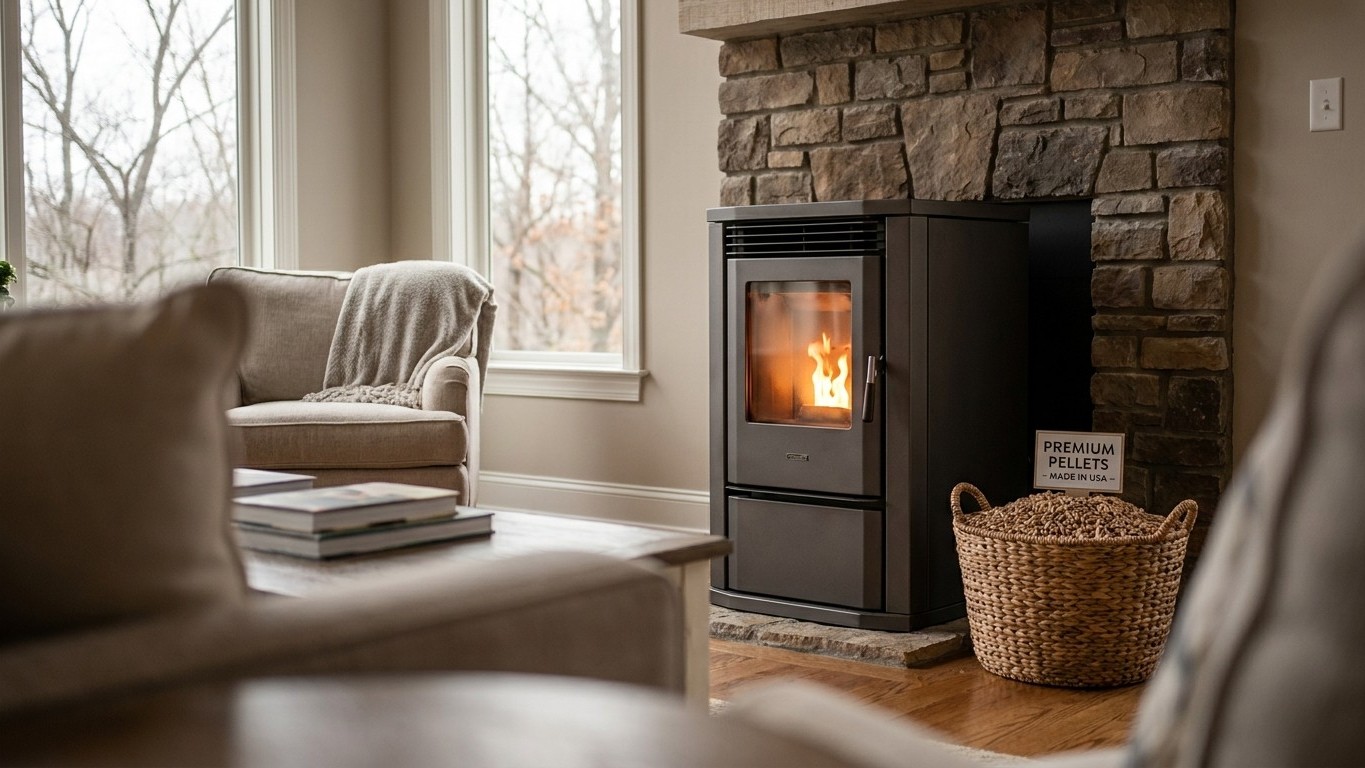

Whitehorse racks up about 6,584 heating degree days a year below 18°C, and the heating season here never really closes. That single number is why a pellet stove in the Yukon isn’t a cozy accessory: it’s asked to do real work, often as the main heat source or as a heavy supplement to a furnace, for most of the calendar year.
How hard the winter works here

The reference point is Whitehorse A, the Environment and Climate Change Canada normals station for the territory’s capital. Over the 1981-2010 period, the site logged about 6,584 heating degree days below 18°C annually. That’s a demanding figure by any Canadian standard, and it tells you plainly that a pellet stove operating here is closer to a heating system than to ambiance. Anyone relying on one as their sole comfort accessory is going to find out fast that the appliance runs almost constantly.
What makes the Yukon figure unusual isn’t just its size. It’s the shape of the year. At Whitehorse A, the mean daily temperature stays below the 18°C base in every single month, including July, the warmest month, which still averages 14.3°C. There’s no month where the heating math resets to zero. Demand peaks hard in January, with 1,028 degree-days that month alone, but December (945) and February (864) aren’t far behind. Even the shoulder months carry real load: November sits at 823, March at 754. The summer low point, July, still logs 117 degree-days, and by September the number has already climbed back to 325.
This distinction between depth and length matters for planning. A mild winter that drags on for eight months isn’t the same animal as a brutal one that’s over in ten weeks. Whitehorse has both: a long season and a deep one. That combination is what pushes total fuel consumption higher than almost anywhere else this kind of page gets written for.
One caution worth repeating: Whitehorse A is a single weather station, not a stand-in for the whole territory. A homeowner near Watson Lake, Dawson City, or up toward the Dempster corridor is looking at a different microclimate, sometimes colder, sometimes with a different snow-to-cold ratio. The normals for Whitehorse are a starting reference, not a guarantee for every address in the Yukon. Checking the closest station’s own normals, where available, gives a more honest baseline before ordering fuel for the season.
How many tons a winter takes here
Nobody can hand you a Yukon-specific tons-per-winter number, and any source that claims to has skipped a step. What you can do is work the math yourself, using the same logic that produces the degree-day figure above.
Start with the units. A standard bag of wood pellets weighs 40 pounds. Fifty bags make a ton. From there, consumption tracks the heat your house actually needs to replace, which is exactly what heating degree days measure: more degree-days, more fuel burned to hold the same indoor temperature. Given that Whitehorse racks up roughly 6,584 of them a year, with almost 3,600 concentrated in the four coldest months (December through March combined), a Yukon household leaning on a pellet stove through that stretch is going to move through fuel at a rate that would surprise someone moving up from a milder province.
But the degree-day number only sets the ceiling. Three things push the real number up or down for a specific house:
- How well the house holds heat — insulation, air sealing, and window quality can swing consumption by a wide margin between two homes on the same street facing the same winter.
- Whether the stove is the only heat source or a supplement — a stove backing up a furnace burns far less than one carrying the whole load through a Whitehorse January.
- The setting it runs at — a stove dialed to a high, constant output for months burns through pellets at a different pace than one cycling on a thermostat alongside another heat source.
Because of that spread, the only estimate worth trusting is the one you build yourself. Track how many bags you burn through the first winter, from whenever the stove starts running regularly in fall to whenever it stops in spring, and use that number as your baseline going forward. One measured season on your own equipment, in your own house, beats every published average, because no average accounts for your walls, your thermostat habits, or your stove’s actual output setting. For the general mechanics of that calculation, including how climate and house type interact nationally, see our page on how many pellets a winter takes.
Buying and storing them in this climate
Because the Yukon heating season never fully closes, there’s no obvious “before winter” deadline the way there might be somewhere with a hard stop in October. But there is a low-demand window worth using: the months where degree-days bottom out, June through August, when demand across the region drops and pellets tend to be priced lowest and most available. Waiting until the shoulder months, when September’s degree-days jump back to 325 and October climbs to 542, means buying into rising regional demand right as everyone else restocks. A cold snap in that window can empty shelves fast, and a household caught short in November or December is choosing from whatever’s left rather than what’s cheapest.
Storage is where the Yukon’s specific climate matters more than the calendar. Wood pellets are compressed sawdust held together by natural lignin, with no added glue, which means they’re structurally dependent on staying dry. Any dampness swells the wood fibers, and the pellet crumbles back toward sawdust, losing both its burn efficiency and its shelf life. In a climate this cold and generally dry, the bigger risk usually isn’t summer humidity soaking through a bag, it’s condensation. A garage or shed that swings from deep cold to a warmer stretch can sweat on interior surfaces, and pellets stacked directly against a damp concrete floor or a cold exterior wall can wick moisture from below even when the air feels dry. Keeping bags up on pallets or shelving, off the slab, and away from any wall prone to condensation, matters more here than protecting against rain.
On pricing, the only number worth comparing between suppliers is cost per ton. Bag sizes and per-bag prices vary enough between sellers that comparing anything else invites a bad deal. For a full breakdown of storage conditions and how to judge pellet quality by hand, the national pages on pellet storage and pellet quality cover the mechanics in more depth than a territorial page needs to repeat.
What a winter outage means here
A pellet stove isn’t a wood stove with a hopper bolted on. It depends on electricity to auger fuel into the burn pot and to run the fan that moves heat into the room. Cut the power, and the stove goes cold no matter how full the hopper is. That’s the one structural difference between the two appliances, and it matters more here than almost anywhere else on this site, given how far into the calendar the Whitehorse cold season extends.
Cross that dependency with the degree-day numbers above and the stakes become clear. An outage in July, when degree-days sit at just 117, is an inconvenience, maybe a chilly evening. An outage in January, sitting at 1,028 degree-days and deep in a season where the mean temperature never gets close to comfortable without supplemental heat, is a real emergency for a household that leans on the stove as primary heat.
What do Yukon households fall back on when that happens? The most recent territorial breakdown, from Statistics Canada’s 2012 dwelling equipment survey, shows hot-air furnaces as the dominant primary heating equipment at 58% of homes, with electric heating (including baseboards) at 18%, and heating stoves, including wood stoves, at 16%. That 2012 figure is over a decade old and almost certainly understates how much the mix has shifted since, particularly toward heat pumps, but it’s the only territorial-level survey year available. It’s worth noting for outage planning that a majority of Yukon homes still have a furnace as backup, which itself typically needs electricity to run its blower, meaning a power cut can knock out more than one heat source in the same household at once.
Sizing a generator or a battery backup for your specific stove isn’t something to guess at from a general article. Check the appliance’s own electrical draw on its rating label, and see the national page on power cuts and pellet stoves for how to plan around that draw responsibly.