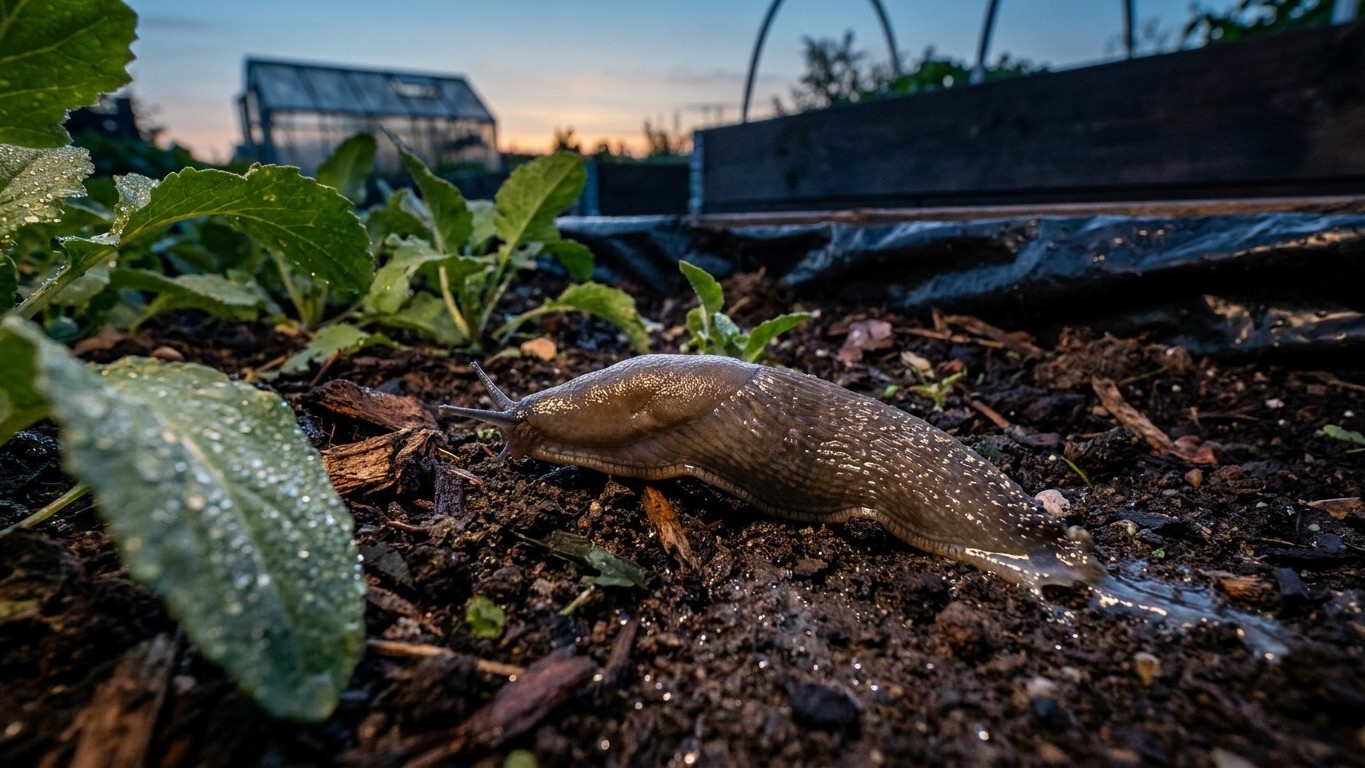

Slugs show up in Yukon gardens once soil temperatures climb past 50°F, which usually happens in mid-to-late June around Whitehorse and even later near Dawson City. What stops them isn’t frost, since Yukon winters kill nearly every adult slug outright. What actually controls populations is the territory’s dry summer air combined with a few deliberate moisture-management habits, because slugs can only travel and feed on a thin film of their own mucus, and that mucus evaporates fast when humidity drops.
Why Yukon Isn’t Prime Slug Territory (But Still Gets Them)

Whitehorse averages under 11 inches of precipitation a year, drier than Denver. Compare that to coastal British Columbia or western Washington, where slugs thrive year-round in 40+ inches of rain, and the mismatch is obvious. Yukon’s subarctic climate, short growing season, and low ambient humidity should, in theory, make it inhospitable ground for mollusks that need constant moisture to survive.
Yet local gardeners still find them, mostly in raised beds, greenhouses, and yards with heavy mulch or frequent evening watering. The territory’s long summer daylight, sometimes 18 hours of light in June, keeps soil temperatures stable overnight, and irrigated garden plots create exactly the damp microclimate slugs need even in an otherwise dry landscape. A watered raised bed under black plastic mulch can hold moisture like a sponge for days, essentially building a private rainforest in the middle of a semi-arid valley.
Greenhouses and cold frames, common across the Yukon because they extend a growing season that otherwise runs from late May to early September, are the other reliable habitat. Warm, humid, and sheltered from wind, they mimic the conditions slugs evolved for far better than the open yard ever could.
The Freeze Factor
Adult slugs don’t overwinter in Yukon soil the way they do in milder Canadian provinces. Ground temperatures that drop well below 0°F for weeks kill exposed slugs and most of the ones burrowed into unprotected topsoil. Survival depends almost entirely on eggs laid in late summer, tucked into compost piles, under boards, or beneath thick mulch layers where insulation keeps them from freezing solid. That’s the biological bottleneck worth understanding: control the fall egg-laying season, and you control next year’s population before it even starts.
When Slug Activity Peaks Through the Yukon Growing Season
Timing matters more in Yukon than in wetter climates because the window is so narrow. Here’s roughly how the season unfolds:
- Late May to mid-June: Eggs that survived winter hatch as soil warms past 50°F; young slugs are tiny, translucent, and easy to miss.
- Late June through July: Peak feeding activity, especially on seedlings, lettuce, and soft new growth in irrigated beds.
- August: Adults reach breeding size and begin laying eggs in moist, sheltered spots as nights cool.
- September: Final egg-laying push before hard frost arrives, usually by mid-to-late month in the interior.
Nighttime and early morning are when they’re actually visible. Slugs are photophobic, meaning they retreat from direct light, so a flashlight check at 10 or 11 p.m. during the long summer twilight will reveal far more activity than a daytime inspection ever would.
What Actually Stops Them: Moisture Control First
Since Yukon’s dry climate already works against slugs, the fastest fix is removing the artificial wet spots gardeners accidentally create. Watering in the early morning instead of evening gives soil surfaces hours to dry out before nightfall, cutting off the moist conditions slugs need to move and feed. Switching from continuous mulch layers to periodic top-dressing, or pulling mulch back a few inches from stem bases, removes the daytime hiding spots where slugs shelter from sun and wind.
Raised beds help for a different reason than most gardeners assume. It’s not the height that matters, it’s drainage. Beds built with well-draining soil mixes dry faster after watering than dense native clay, shrinking the daily window of slug-friendly humidity.
Physical Barriers That Work in Cold Climates
Copper tape around raised bed edges creates a mild electric charge when slug mucus contacts the metal, and it holds up fine through Yukon’s freeze-thaw cycles since it’s not affected by cold the way some organic barriers are. Diatomaceous earth, a powder made from fossilized algae, works by drying out a slug’s underside on contact, but it loses effectiveness once wet, so it needs reapplying after rain or heavy watering, an easier task in a low-precipitation territory than in coastal climates.
Crushed eggshells and coarse sand get recommended constantly online, but the actual barrier effect is modest at best. They’re worth using as a supplement, not a primary defense.
Bait, Traps, and Natural Predators
Iron phosphate baits, sold under various garden center brands, are the standard low-toxicity option and safe around pets and wildlife when used as labeled. They work by disrupting a slug’s digestion after ingestion, and slugs typically die within several days, retreating underground rather than leaving visible carcasses on the soil surface.
Beer traps remain a favorite low-cost method: a shallow container sunk to soil level and filled with a few inches of beer draws slugs in with the yeast scent, and they drown. It’s not glamorous pest control, but it’s cheap, and in a territory where hardware store shelf space for specialty products can be limited outside Whitehorse, it’s often the most accessible option.
Natural predators are thinner on the ground in Yukon than in southern gardens. Ground beetles and some bird species, including robins and thrushes that pass through during the short breeding season, will eat slugs opportunistically, but the territory lacks the dense predator populations, garter snakes, toads, larger beetle species, that keep slug numbers in check in temperate zones farther south. That absence is part of why even a small irrigated garden plot can see a noticeable slug population build up over a single wet week, with little natural pushback to slow it down.
Greenhouse and Cold Frame Management
Because greenhouses are where Yukon slug problems concentrate most reliably, they deserve separate attention. Ventilation is the single biggest lever: cracking vents or doors during warm afternoons drops interior humidity fast, and slugs that can’t find a moist refuge by evening will often retreat rather than risk exposure. Removing plant debris and dead leaves at the base of greenhouse crops eliminates the daytime hiding spots that let slug populations build up unnoticed between waterings.
Copper mesh or tape around greenhouse bench legs and raised bed frames works particularly well indoors, since it’s not exposed to rain that would otherwise wash away conductivity over time. Combined with morning-only watering schedules, most greenhouse slug problems in the territory can be brought under control within a couple of weeks without resorting to chemical treatments at all.
What Not to Worry About
Yukon’s climate genuinely limits how bad slug problems can get compared to coastal regions. There’s no need for the aggressive, season-long control programs that gardeners in Oregon or British Columbia’s Lower Mainland run. A few targeted interventions, morning watering, pulled-back mulch, copper barriers on raised beds, and iron phosphate bait during the June-through-August feeding window, handle the vast majority of cases in a single season.
The one habit worth keeping year after year is a fall cleanup before hard frost hits. Clearing garden debris, turning over compost, and disturbing soil in known slug hotspots exposes overwintering eggs to the cold that Yukon provides in abundance anyway. It’s the one piece of pest control where the territory’s brutal winter does most of the work, as long as gardeners don’t insulate the eggs by accident with a thick layer of undisturbed mulch left sitting through October.