
Yukon gardeners work with a short, intense growing season and a climate that rarely turns brutally hot, which changes both how much water a garden needs and when the rules around using it might kick in. The short version: water deeply, water in the morning, check your local water authority before assuming your hose is unrestricted, and lean on mulch and drip lines to stretch every gallon across a growing window that runs from roughly June to late August. For a closer look at keeping beds alive when the rain stops altogether, see Watering Through a Dry Spell in Yukon.
How much, how often

The single most common mistake in a Yukon garden is watering a little bit every day. Shallow, frequent sips train roots to stay near the surface, where the top inch of soil heats up and dries out fast even without extreme heat. Yukon’s own climate record backs this up in an odd way: the reference station at Whitehorse averages zero days a year above 90°F, so the garden isn’t fighting scorching afternoons the way a Texas or Kansas bed would. But that mild heat profile doesn’t mean the soil stays moist on its own. It means the danger isn’t flash evaporation, it’s a short season where every root system needs to get established and productive fast, and shallow roots simply can’t keep up once the plant starts fruiting or setting seed.
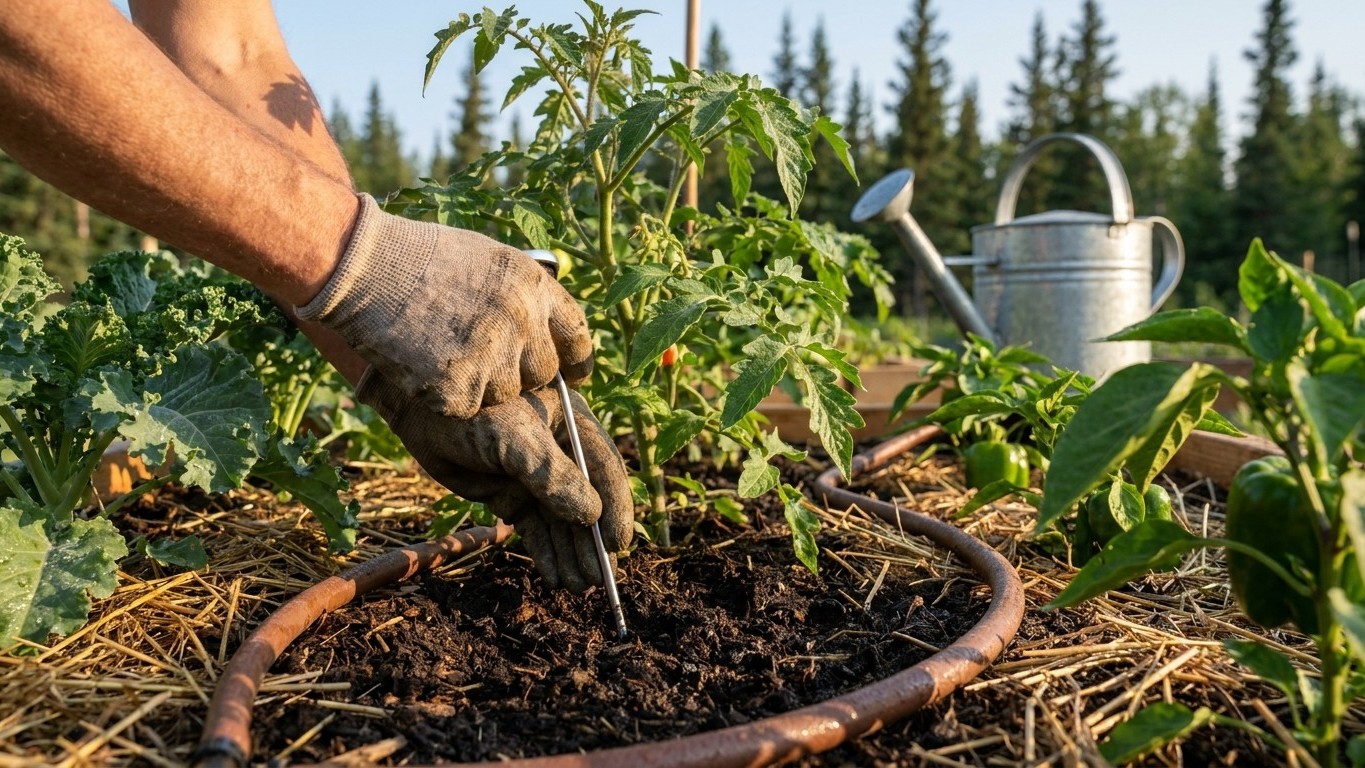
Deep, infrequent watering solves this by pushing moisture down 6 to 8 inches, which forces roots to follow it. The way to know it’s time to water again isn’t a calendar, it’s the ground itself. Push a finger, or better, a trowel, about two inches into the soil near the base of the plant. If it comes out dry and crumbly, water. If it’s still cool and slightly damp, wait another day or two and check again.
A watering routine that works for Yukon beds
- Check soil moisture two inches down at the base of the plant, not just at the surface, before deciding to water at all.
- Water early morning, ideally before 9 a.m., so moisture has time to soak in before any midday warmth and so foliage dries before evening, cutting down on fungal issues.
- Aim the water at the base of the plant and the root zone, never over the leaves, using a soaker hose, drip line, or the spout of a watering can held low; for tips specific to container gardens, see Watering Pots and Containers in Yukon.
- Soak deeply, roughly 1 to 1.5 inches of water per week for most vegetable beds, delivered in one or two sessions rather than daily splashes.
- Adjust for soil texture: sandy ground drains fast and holds little, so it needs shorter, more frequent soakings, maybe every 2 to 3 days. Heavy clay holds a week’s worth of water in reserve but drowns roots if watered again before it’s dried out, and it should never be walked on, dug, or soaked while it’s still wet, since compacted clay loses structure for the rest of the season.
- Stretch the interval as the season winds down, since Yukon’s frost-free window is tight, running on average from June 5 to August 25, a season of roughly 81 days. Watering can taper as that first fall frost date approaches and plants finish their cycle rather than push new growth.
That June 5 date is a mean, not a guarantee. In roughly half of all years, the last frost lands later than that, so gardeners who water and plant right on the average date are gambling on a coin flip. The same caution applies at the other end: August 25 is the midpoint of when the first fall frost tends to arrive, and northern or higher-elevation parts of the territory typically run behind the Whitehorse station by weeks, not days.
Restrictions and rules
Watering restrictions are common across Canadian municipalities during dry stretches, and they change from year to year depending on reservoir levels, snowpack, and local infrastructure. Some towns limit watering to specific days tied to street address, others restrict it to early morning or evening hours, and some ban hose-end sprinklers outright during drought advisories while still allowing hand-watering or drip irrigation. Because these rules shift with conditions and aren’t fixed from one summer to the next, the only reliable way to know what applies to a specific yard is to check directly with the municipal water authority or utility serving that address.
Yukon’s climate profile adds a wrinkle worth flagging. With essentially no days reaching 90°F in a typical year, the territory doesn’t face the kind of extreme evaporative demand that triggers emergency restrictions in hotter provinces. But the growing season is short and the frost-free window is tight, which means any restriction that lands in July or August, exactly when plants are setting fruit or filling out root vegetables, can do outsized damage in a season that has no slack to make up lost growth later. That’s a good reason to check restrictions before setting up a timer or an automatic drip system, rather than after.
For general guidance on water use, soil management, and season planning at the federal level, the Department of Agriculture and Agri-Food Canada maintains resources at agriculture.canada.ca, though local municipal bylaws will always take precedence over anything at that level.
Using less
Cutting water use in a Yukon garden isn’t about one big fix, it’s a handful of small habits stacked together. Each one below saves water in a different way, and together they can cut a garden’s outdoor water use significantly without any loss in plant health.
- Mulch: A 2 to 3 inch layer of straw, wood chips, or shredded leaves over the root zone slows evaporation from the soil surface and keeps roots cooler, which matters even in a climate with no 90°F days, since dry wind alone can pull moisture out of exposed soil.
- Drip irrigation or soaker hoses: Delivering water directly to the root zone instead of spraying it into the air cuts losses to wind drift and evaporation, and it lines up naturally with the deep, infrequent watering approach that Yukon’s short season rewards.
- Grouping plants by water need: Putting thirsty crops like squash or leafy greens together and drought-tolerant perennials elsewhere means nobody gets overwatered just because they share a bed with a heavier drinker.
- Organic matter in the soil: Compost worked into sandy soil helps it hold moisture longer between waterings, while the same compost worked into clay improves drainage so it doesn’t stay waterlogged after a soak.
- Rain barrels, where local rules allow them: The math behind a rain barrel is straightforward. An inch of rain falling on 1,000 square feet of roof yields about 600 gallons of runoff. A modest garden shed or garage roof can fill a standard barrel fast during a good rain event. The catch in Yukon is the season itself: with a frost-free window of only about 81 days and no long-term precipitation figures included here to promise steady summer rain, a barrel can just as easily sit empty for stretches. The practical approach is to track fill rate through June and July rather than assume the barrel will keep up with a dry spell, and to have a backup hose connection ready for weeks when it runs dry.
Common questions
How often should I water a vegetable garden in Yukon?
Most vegetable beds do well with one to two deep waterings a week rather than daily light watering, adjusted for soil type. Sandy soil may need a shorter interval, closer to every 2 to 3 days, while clay can often stretch to once a week or slightly longer.
Is there a set watering schedule required by Yukon municipalities?
There’s no single territory-wide schedule. Restrictions are set locally and change based on conditions each summer, so the only accurate answer for a specific address comes from that municipality’s water utility or public works department.
When is it safe to plant and start a regular watering routine outdoors?
The average last spring frost at the Whitehorse reference station is June 5, but that’s a midpoint, not a safe date. Frost falls later than June 5 in about half of all years, so many gardeners wait a week or two past that average before relying on outdoor watering routines for tender plants.
Does Yukon’s cooler climate mean gardens need less water overall?
Not necessarily. With zero average days above 90°F, evaporative demand is lower than in hotter provinces, but the frost-free season is short, roughly 81 days between the average last spring frost and first fall frost. That compressed window means consistent, well-timed watering matters more, even if the total volume needed is less than a garden further south would require.