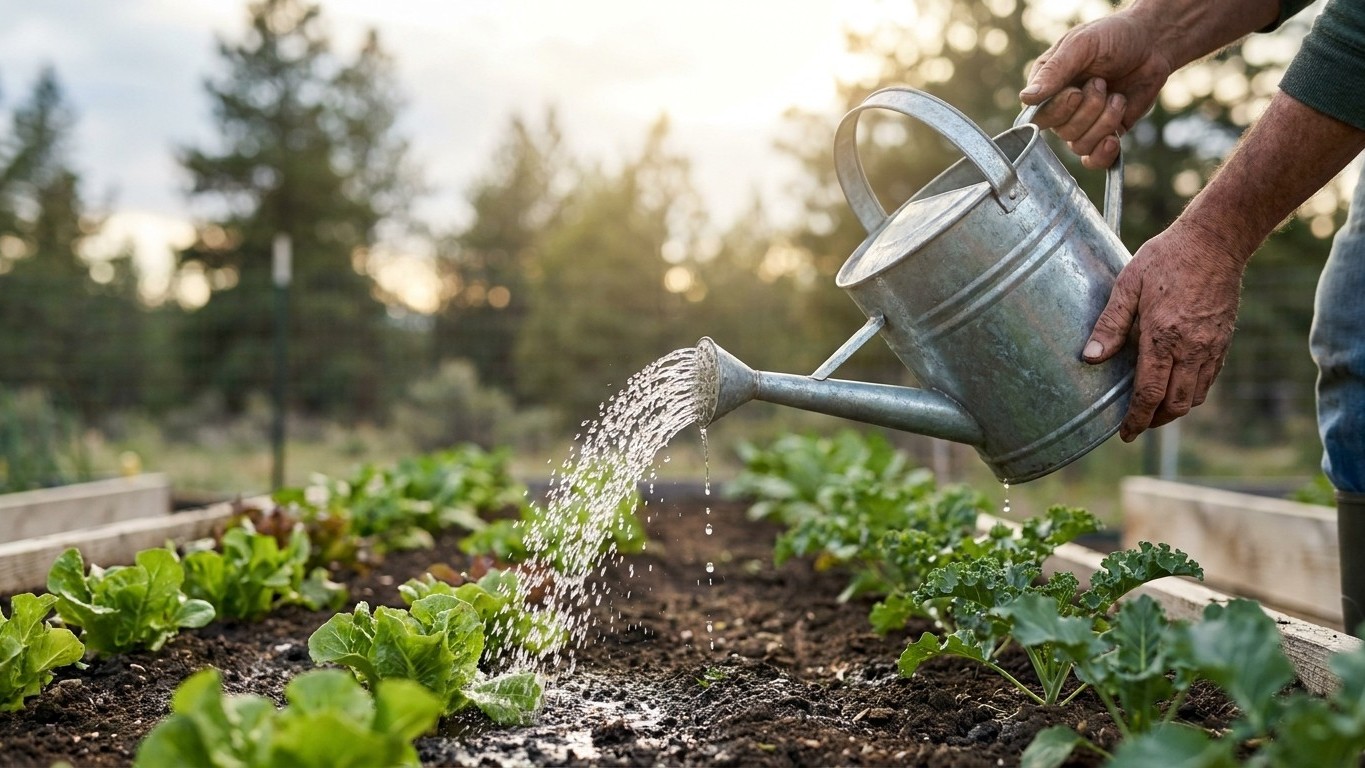

In Yukon, watering through a dry spell means supplementing a genuinely modest summer rainfall rather than fighting off heat. June, the driest month, brings just 1.28 inches, and the territory averages zero days a year at or above 90F. That pairing calls for a slow, deep soak reaching root depth once or twice a week, checked against how the soil itself drains, rather than a daily splash timed to hot afternoons that almost never arrive here.
What changes here

Two numbers set the terms for every Yukon garden. June, the driest month of summer, averages 1.28 inches of rain. And the territory sees, on average, 0.0 days a year reaching 90F. Read together, those figures describe a garden that has to have nearly all of its water carried in by hand, but almost never under the kind of heat that burns that water off in an afternoon.
The arithmetic makes the point plainly. A vegetable bed or a perennial border generally wants about an inch of water a week to keep growing steadily. Spread June’s 1.28 inches evenly across the month’s roughly four and a third weeks, and the sky is supplying only around 0.3 inch of that weekly inch. The other 0.7 inch has to come from a hose or a watering can, week after week, through the driest stretch of the season. July climbs slightly to 1.5 inches for the month and August settles at 1.41, so the gap narrows a little as summer goes on, but it never closes on its own.
What that carried-in water actually does once it lands depends on the ground it hits. The same 0.7 inch behaves very differently on a sandy plot than on heavy clay: sand lets water pass through toward deeper soil layers within hours, so it needs replenishing sooner, while clay holds onto that moisture for days, sometimes closer to a week, before it dries out at root depth. Neither the sand content nor the clay content of a given Yukon yard is something a regional average can tell a gardener. It has to be checked on the actual plot, because a garden bed a mile away on a different soil type can need watering on a completely different schedule even under the identical June rainfall.
The absence of hot days changes the risk profile too. Without the evaporative pull that comes with 90-degree afternoons, water applied to Yukon soil tends to linger longer than a gardener used to a hotter territory might expect. That is useful on sand, where it stretches out the time between soakings, but it becomes a liability on clay, where a bed that already holds its water for a week can be pushed into staying soggy if it is watered again before that week is up.
How to water when it matters
The method that fits Yukon’s ground is deep and infrequent, delivered at the base of the plant, in the morning. Deep watering pushes moisture down to where roots actually grow, rather than wetting only the surface crust. Infrequent watering forces those roots to reach downward and spread, which builds a plant that can ride out the dry gap between one soak and the next. Watering at the base, instead of overhead, means the water goes where it is used rather than evaporating off leaves or drifting off in the wind. And morning watering gives the plant a full day to take up what it needs before cooler night air arrives, when standing moisture on leaves and stems is more likely to turn into disease.
Knowing when to water starts below the surface, not above it. A soil that looks dry and pale on top can still be damp two inches down, and a soil that looks fine on top can be bone dry at root depth. Pushing a finger, or the tip of a trowel, two inches into the bed before every watering decision settles the question far better than glancing at the ground or trusting the calendar.
- Check the soil two inches down with a finger or trowel before deciding to water at all.
- If it is dry at that depth, apply about 1 inch of water in a single deep session as a starting point, then adjust up or down after checking the same spot a few days later.
- On sandy ground, shorten the interval and water in smaller, more frequent sessions, since the profile drains fast and holds little.
- On heavy clay, lengthen the interval and let the bed dry back out between soakings, since clay can hold a week’s worth of water and drown roots if it is watered again too soon.
- Water at the base of the plant, in the morning, rather than overhead in the evening.
That 1-inch starting figure is exactly that, a starting point. The only way to know whether a given Yukon bed needs more or less is to check it against its own soil, its own drainage, and its own results a few days after watering.
What goes wrong
Watering a little every day
A light daily sprinkle wets only the top inch or so of soil. Roots follow the water, so they stay shallow and close to the surface, right where the sun reaches them first and dries them out fastest. A plant grown this way has no deep root system to fall back on the day watering is skipped.
Wetting the leaves at night
Watering overhead in the evening leaves foliage damp through the cool night hours. That extended dampness is exactly the condition fungal diseases need to take hold, and Yukon’s cooler nights slow evaporation, so leaves wetted at dusk can stay wet far longer than they would in a hotter territory.
Trusting the sky after a shower
A passing summer shower can look like a soaking, but it often wets only the top half-inch of soil before running off or evaporating. Given how little rain the driest month actually delivers, roughly 1.28 inches for the whole of June, a single shower rarely reaches root depth. Checking with a finger after the rain settles the question a lot more reliably than watching it fall.
Skipping the mulch because the air feels cool
With no days a year reaching 90F, it is easy to assume Yukon soil does not need protecting from the sun the way it would somewhere hotter. But bare soil still loses moisture to sun and wind, and with rainfall already this scarce in summer, that loss matters more here, not less. A two- to three-inch layer of mulch holds onto the water that was just carried in by hand, which is the mistake that costs the most in a territory where every inch of water is scarce to begin with.
Local help
For soil testing, planting guidance and season-specific advice, Yukon gardeners can turn to Agriculture and Agri-Food Canada, at agriculture.canada.ca/en. Watering restrictions during dry spells vary by municipality and water district and can change from one summer to the next, so always confirm current rules with the local water provider before setting a routine.
Common questions
How often should a Yukon garden be watered in June?
With June averaging only 1.28 inches of rain, most beds need a deep watering roughly once or twice a week, adjusted after checking soil moisture two inches down.
Does Yukon’s cool summer mean less watering overall?
Fewer days of extreme heat reduce evaporation, but it does not reduce the need for water. With so little summer rain falling to begin with, gardens still depend heavily on watering carried in by hand.
Is morning or evening better for watering in Yukon?
Morning. It gives plants a full day to absorb moisture before the cooler night air arrives, when damp leaves and soil are more likely to encourage disease.
Can mulch really make a difference given how little heat Yukon gets?
Yes. Mulch reduces moisture loss from bare soil regardless of temperature, and since summer rainfall here is already limited, holding onto what water does arrive matters more, not less.