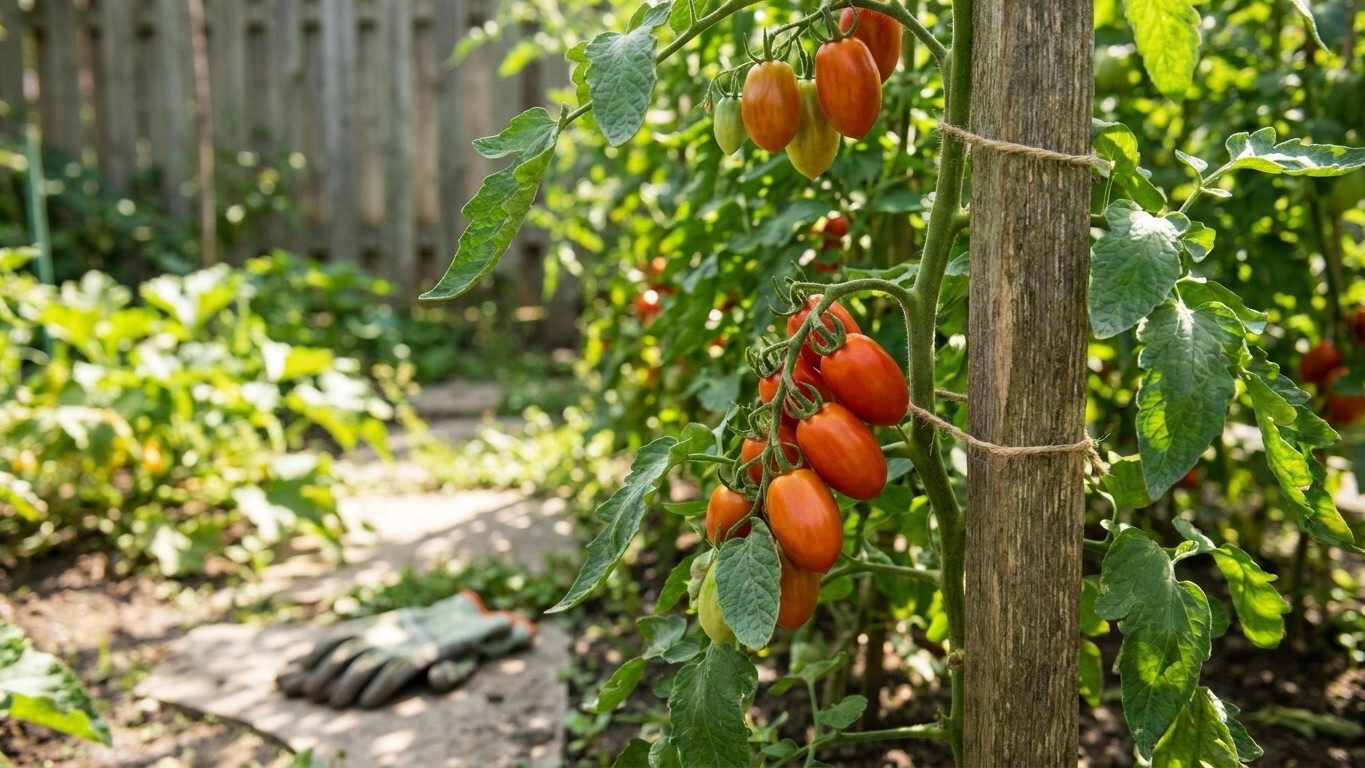

Amalfi is a hybrid paste tomato bred to set its fruit in one concentrated flush rather than trickling tomatoes out all summer. Seed catalogues list it at about 68 days from transplant, and that single-flush habit is exactly why nailing the transplant date matters more here than it does with a tomato that keeps producing until frost. Count 68 days forward from your realistic set-out date and see whether that lands with real margin before your area’s first fall frost, or right on top of it.
What Amalfi actually is

Amalfi is a determinate, or close to it, paste tomato: the plant grows to a set size, throws most of its flowers within a fairly narrow window, and then ripens that fruit together instead of spreading it across the season. Seed catalogues put the days to maturity at about 68 days, counted from the date you set transplants in the ground, not from the day you sowed seed indoors. That distinction matters because a gardener who starts counting from sowing will think the crop is running late when it is actually right on schedule.
The fruit is Roma-shaped: an elongated, blunt-ended plum tomato that holds its shape well through cooking, which is the whole point of a paste type. It is bred for sauce, canning and drying rather than fresh slicing, and the flesh runs meatier and drier than a slicing tomato, with fewer seed cavities. Because the plant sets flowers over a compressed period rather than continuously, it does not need the tall, ever-climbing trellis a rangy indeterminate variety demands. A sturdy cage or a single stake with regular tying is usually enough to keep the fruit off the ground through harvest.
That single-flush habit is a deliberate trade. A grower who wants a steady trickle of tomatoes for the table all summer is better served by an indeterminate producer like Juliet, which keeps setting new fruit until frost instead of handing everything over at once. Amalfi’s whole reason for existing is the opposite: you get a batch big enough to can in a weekend, then the plant is largely done. If your goal is a beefsteak that ripens over the season and finishes some fruit green rather than on the vine, look at Unity instead, which fills a different niche entirely within the broader world of tomato varieties.
What Amalfi is good for
A paste tomato like Amalfi exists because of what’s packed inside its flesh: dense walls, small seed cavities, and comparatively little water. Amalfi’s flesh is dense and comparatively low in water, with thick walls and small seed cavities, so when you cut it open there is more solid material and less liquid to cook off. Put that into a pot and it collapses into sauce in a fraction of the time a watery, cavity-heavy tomato would take, because you’re not standing over the stove reducing liquid down to nothing before the flavor concentrates. Amalfi’s dense, low-water flesh is exactly why paste types like it get bred for sauce and canning rather than the salad bowl: that same scant juice makes a slicing tomato refreshing raw but thin and watery once you try to cook it down into something thick.
That same low-moisture flesh is also what canners want. A tomato that holds together and doesn’t weep excess liquid packs better into jars, keeps its texture through processing, and doesn’t dilute whatever it’s canned in. Amalfi’s shape and wall structure work in the same direction, holding up under heat rather than dissolving into mush.
The determinate habit adds a practical dimension here rather than a culinary one: because most of the crop ripens in a compressed window instead of trickling in over months, a grower ends up with a lot of tomatoes ready at once. That’s inconvenient for someone who wants a few ripe fruit for sandwiches every week all summer, but it’s actually well matched to sauce-making and canning, both of which are batch jobs — you want a big pile of tomatoes on one afternoon, not two at a time.
Nothing about sweetness, acidity, or aromatic character is documented for this variety, so no claims are made here beyond what the category and structure of the fruit already explain.
Where it ripens in time, and where it is a gamble
The math behind whether Amalfi finishes in your garden is simple to lay out even without a number specific to your county. Take your area’s frost-free window, the stretch between the last spring freeze and the first fall freeze, as reported by NOAA’s climate normals or your state extension service. Subtract roughly two weeks, because tomato roots do not want to go into soil that is still cold, so transplanting happens after the frost date, not on it. Then subtract Amalfi’s roughly 68 days to first ripe fruit. Whatever remains is your margin, the number of days left between the first ripe tomato and the season’s end. A margin under thirty days means you are looking at one flush with no room for a cool spring or a late-arriving fall freeze to take it from you.
How the margin plays out across the country
At the tight end, Yukon, using Whitehorse as the reference station, comes out with a margin of about minus one day: set out around mid June, first ripe fruit would arrive in late August, right as the season is closing, and the region also accumulates only around 600 growing degree days across the whole year, which is short of what a paste tomato needs regardless of frost dates. Outdoor Amalfi is not workable there without a greenhouse or high tunnel. Nunavut, at Rankin Inlet, is only slightly better: a margin of about four days with fruit setting out in early July and ripening in early September, and a growing degree day total near 159 for the year, again a heat shortfall a tunnel has to make up.
Move into the prairie provinces and the picture improves but does not clear. Saskatchewan, at Saskatoon, shows a margin of about 41 days with an early-June set-out and first fruit in early August, and a growing degree day count around 1,549, described as marginal rather than comfortable. A season extender like plastic mulch, paired with an early-maturing planting plan, changes that outcome meaningfully. Farther west, Alberta, at Calgary, sits close behind with a 36-day margin and a similar greenhouse-recommended verdict.
At the wide end, Washington, using Seattle as the reference, shows a margin of about 158 days with transplanting from mid March into early April and first ripe fruit by early June, plenty of room even though Seattle’s cool marine summers keep its seasonal heat accumulation, around 2,353 growing degree days, closer to marginal than generous. Widest of all is Louisiana, at New Orleans, with a margin near 230 days, transplants going in from early to late February and first fruit by early May. The table below lines up the spread.
| Territory | Reference station | Set-out window | First ripe | Margin | Verdict |
|---|---|---|---|---|---|
| Yukon | Whitehorse | mid June | late August | -1 days | impossible outdoors |
| Nunavut | Rankin Inlet | early July | early September | 4 days | risky, single flush |
| Saskatchewan | Saskatoon | early June | early August | 41 days | greenhouse recommended |
| Washington | Seattle | mid March to early April | early June | 158 days | comfortable |
| Louisiana | New Orleans | early to late February | early May | 230 days | comfortable |
The two ways a season goes wrong
A long frost-free window on paper does not guarantee a good crop, and Amalfi’s compressed ripening makes both failure modes sharper than they’d be on a variety that spreads its harvest out. In the north, the problem is rarely frost dates alone. It is accumulated warmth. A place can have a technically long enough gap between frosts and still fall short on growing degree days, the running total of heat a tomato plant needs to move from flower to ripe fruit. Saskatchewan and Manitoba both show this: their frost windows leave a workable margin on paper, but their seasonal heat totals sit right at the edge of what a paste tomato needs, which is why an early-maturing planting approach and black plastic mulch to warm the soil make a real difference there. On top of that, tomato flowers simply will not set fruit once night temperatures fall much below 50°F, so a cool snap during Amalfi’s narrow flowering window can blank out the one flush the plant was going to give you, with no later flowers coming to make up for it.
In the south, the failure runs the opposite direction. Once daytime temperatures climb above roughly 86°F, tomato pollen goes sterile and flowers drop without setting fruit at all. South Carolina, Florida, Texas, Nevada and Louisiana all carry this note for their hot months, meaning growers there effectively get two growing seasons, a spring crop and a fall crop, rather than one long summer of production. For an indeterminate variety that would mean losing the entire middle of the season while still trying to keep the same plants alive. For Amalfi, the single-flush habit actually works in the grower’s favor here: time the transplant so the 75-day countdown lands the ripening flush before the sterile heat sets in, harvest the whole batch, and start over for a fall run rather than fighting to keep one plant productive across a summer it cannot pollinate anyway.
For this variety specifically, the heat-accumulation limit matters more in the northern territories listed above, where the frost window and the heat total can disagree with each other, while the pollen-sterility limit matters more in the deep south, where the frost window is never the constraint but timing around the hot months is.
What it resists, and what it does not
Amalfi carries real disease resistance, and it is worth knowing exactly what grade applies to each one, because the difference between intermediate and high resistance is the difference between slowing a disease and stopping it. The variety carries a high resistance rating against Fusarium wilt races 1 and 2, which means plants growing in soil carrying that pathogen should largely avoid the wilting and vascular collapse that would otherwise take the crop down mid-season.
- Late blight: resistance graded intermediate, meaning infection can still take hold in a wet, cool season, just more slowly than on an unprotected variety.
- Early blight: also graded intermediate, so the lower leaf spotting and defoliation this fungus causes will still show up, just later and less severely.
- Fusarium wilt races 1, 2: graded high resistance, the strongest protection this variety offers.
An intermediate rating is not an escape clause. It buys time and reduces severity, but a grower who treats it as immunity and skips basic sanitation, crop rotation and airflow around the plants will still lose foliage to both blights in a bad year. The catalogue lists no resistance at all to Septoria leaf spot, bacterial spot or speck, or to root-knot nematodes, which means those remain a straightforward risk wherever they are already a problem in the soil or the local weather pattern favors them. If any of those have hit your garden before, Amalfi’s resistance package does nothing to change that history and normal precautions, mulching to stop soil splash and rotating away from last year’s tomato bed, still apply in full.
Growing it without the usual mistakes
Because Amalfi is bred to front-load its harvest, the mistakes that cost the most are the ones that push that single flush later than it needs to be. Give plants a sturdy cage or a stake with ties every foot or so of growth rather than letting them sprawl, since sprawling fruit sitting on damp soil is where blossom end rot and soil-splashed blight get their start. Space plants with enough room for airflow between them. Crowded rows hold humidity around the lower leaves and that is exactly the environment early blight needs to move faster than the plant’s intermediate resistance can slow it.
Feeding and the timing trap
Stop pushing nitrogen once the first fruit sets. A determinate paste tomato that gets heavy feeding late in the season puts energy into leafy growth instead of ripening the fruit it has already set, and on a variety whose whole value is a tight, predictable flush, that delay is the mistake that costs a canning weekend. Switch to a lower-nitrogen, higher-potassium feed, or stop supplemental feeding altogether if your soil is already reasonably fertile, once the first trusses are visibly sizing up.
The other trap is expecting Amalfi to behave like a continuous producer. New gardeners coming from an indeterminate slicer sometimes keep checking the plant weekly through midsummer waiting for more flowers, and there mostly aren’t any coming. If a steady supply matters more to your kitchen than a single big batch, the fix is not to wait on this plant. It is to start a second round of Amalfi transplants a few weeks behind the first, staggering the flush rather than hoping one plant will do both jobs.
Common questions
Is Amalfi determinate or indeterminate?
It grows and fruits like a determinate, setting most of its flowers over a compressed period and ripening the resulting fruit together rather than continuously. Some catalogues describe it as semi-determinate, which in practice still means one dominant flush rather than season-long trickle production, so plan your harvest and canning schedule around a single busy window rather than weekly picking.
Can I grow Amalfi in a container?
Yes, provided the container is large enough to support a full-size determinate plant, generally something in the 15 to 25 gallon range with a cage or stake anchored into the pot. Container-grown plants dry out faster than in-ground ones, and inconsistent watering right as the fruit is sizing up is a common cause of blossom end rot on paste tomatoes specifically, since their lower moisture flesh shows calcium deficiency symptoms readily.
Why did all my Amalfi tomatoes ripen green-shouldered or unevenly?
Uneven ripening on paste tomatoes usually traces back to heat stress during the fruit-sizing stage rather than a disease. High daytime temperatures while the fruit is coloring can interrupt the pigment development that turns the shoulders red, leaving a yellow or green patch at the stem end. Some afternoon shade during the hottest stretch of the ripening window reduces this, and it is more common in the far southern part of Amalfi’s range than in cooler climates.
Does Amalfi need pruning like an indeterminate tomato?
Not to the same degree. Indeterminate varieties are routinely pruned to a single or double stem to manage their endless vertical growth, but an aggressively pruned determinate loses fruiting wood it needed for its one flush. Limit pruning to removing the lowest leaves for airflow and any visibly diseased foliage, and leave the rest of the plant’s natural branching alone so it can set the full crop it was bred to produce.