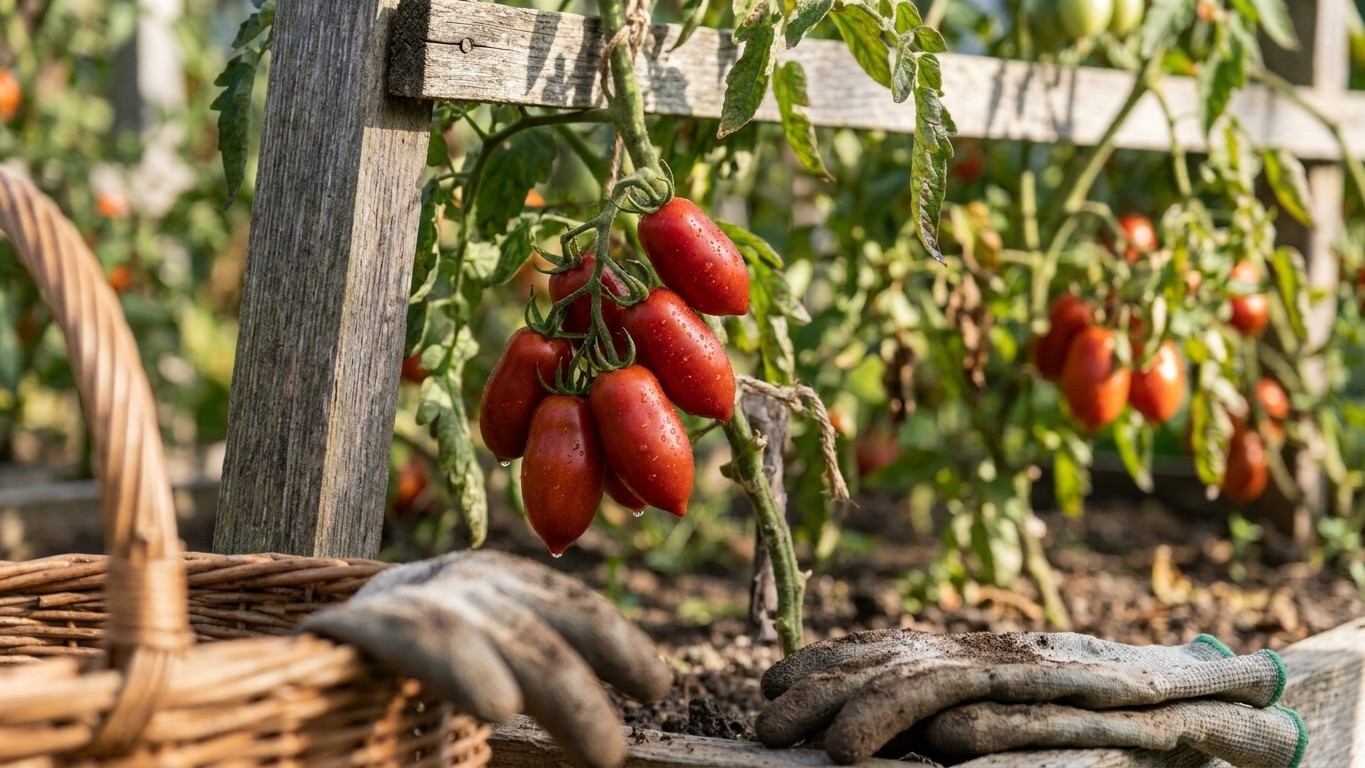

Juliet’s seed packet says 60 days, and that number tricks people into planning like they would for a determinate Roma — one big canning weekend, then done. Juliet isn’t that plant. It’s indeterminate, hanging cherry-sized clusters on a paste-shaped fruit that keeps setting new trusses long after that 60-day mark passes, which means the planting date you pick is really a bet on how many weeks of frost-free growing you can give it, not on hitting one harvest.
What Juliet actually is

Juliet sits among the tomato varieties bred specifically for the vine rather than the can, and it does that job by hanging fruit in clusters like a cherry tomato while sizing up like a small Roma. Catalogue descriptions put it at about 60 days from transplant to first ripe fruit, and that figure moves a week or two either way depending on the season, the soil temperature at planting, and how much heat the plant gets once it’s in the ground. Add the four to six weeks most gardeners spend raising transplants indoors before that clock even starts, and the total run from seed to sauce lands closer to fifteen weeks.
The plant itself is indeterminate, which means it doesn’t stop at a set height or a single flush of fruit. It keeps growing, flowering and setting new trusses along the main stem until frost, disease, or the gardener cuts it back. That habit is the whole point of the name: a determinate paste type ripens most of its crop in a two- or three-week window and is finished, while Juliet spreads production across the entire season, a few pounds at a time, right up to the first hard freeze.
The fruit runs one to two ounces each, oblong and thick-walled, holding twenty or more per cluster, and the skin is thin enough that plenty of gardeners eat them straight off the vine rather than saving every last one for the sauce pot. If your kitchen wants a paste tomato that ripens green instead of red, Tiren covers that use in a similar plant size.
What Juliet is good for
Juliet is a paste tomato, and that classification is about dense, low-water flesh, not just a shape. Paste flesh carries less water and more solid tissue than a slicer’s, so when it hits a hot pan it reduces to sauce quickly, without the long simmer needed to cook off the liquid that a beefsteak or slicing variety would release. That same low-water structure is what makes canning practical: less juice to strain off, less time on the stove, more flesh per jar. A slicing tomato, built to be eaten raw in a sandwich, holds onto that water and turns watery and bland once cooked down, which is why the two categories rarely swap jobs well.
Where Juliet complicates the usual paste-tomato logic is its size and habit. Fruit this small, growing in clusters the way a cherry tomato does, tends to get picked and eaten straight off the vine before it ever reaches a cutting board, let alone a stockpot. A grower harvesting a handful during a garden walk is using it the way a cherry tomato gets used, not the way a Roma does. But the underlying flesh is still paste flesh, so when the fruit does make it to the kitchen in volume, it behaves like a paste tomato should: it breaks down into sauce and holds up to the canner without turning the batch runny.
On taste, the documented facts state that Juliet is sweet and slightly larger than the Santa grape tomato, which puts its flavor in the same general register as that popular snacking type rather than the more acidic profile typical of many canning romas. Beyond that comparison, no further detail on acidity, sugar level, or how it performs raw versus cooked has been published, so nothing more specific can be said about its eating quality.
Where it ripens in time, and where it is a gamble
The arithmetic that decides whether Juliet finishes before frost is the same in every garden. Take the frost-free window for your area, subtract roughly two weeks for the soil to warm enough to set transplants safely, then subtract Juliet’s 60 days to first fruit. What’s left over is how many weeks of picking you get before the first ripe fruit meets the first freeze. In a long-season garden that remainder runs into months. In a short one it can shrink to a single flush, or vanish before it starts.
Where the margin is thin
In Yukon, at the Whitehorse station, gardeners setting out in mid June see first ripe fruit by mid August and only 7 days of margin before frost typically returns. That’s one flush, and a cool summer takes even that. In Nunavut, near Rankin Inlet, the margin runs slightly longer at 12 days with a July set-out, but the accumulated warmth for the season sits far below what a tomato plant needs regardless of how long the frost holds off. Further south but still short, Alberta (Calgary), Manitoba (Winnipeg) and Saskatchewan (Saskatoon) all land in the 42 to 49 day margin range with early June set-outs, which is workable but tight enough that most growers there run Juliet under a tunnel or in a greenhouse rather than trust the open garden.
Where the margin is comfortable
At the other end, Washington (Seattle) sees 166 days of margin from a March or early April set-out, and states like Nevada (Las Vegas) and Louisiana (New Orleans) run 236 and 238 days respectively, with set-out as early as late January in Nevada. That’s not one flush, it’s most of a year of picking, though as the next section covers, a long frost-free window doesn’t automatically mean a long unbroken harvest.
| Territory (station) | Set-out window | First ripe | Margin before frost | Verdict |
|---|---|---|---|---|
| Yukon (Whitehorse) | mid June | mid August | 7 days | risky, one flush at best |
| Manitoba (Winnipeg) | early June | early August | 48 days | greenhouse or tunnel advised |
| Saskatchewan (Saskatoon) | early June | late July | 49 days | greenhouse or tunnel advised |
| Washington (Seattle) | mid March to early April | late May | 166 days | comfortable |
| Nevada (Las Vegas) | late January to mid February | mid April | 236 days | comfortable |
| Louisiana (New Orleans) | early to late February | late April | 238 days | comfortable |
The two ways a season goes wrong
A long frost-free window is not the same thing as a good season, and a frost table can’t show you either of the two ways it goes sideways.
In cold climates, accumulated warmth can run short even when the calendar looks fine. Saskatoon accumulates around 1549 growing-degree-days across the season and Winnipeg around 1832, and both totals sit close to the edge of what a tomato crop needs to actually finish fruit, independent of when the frost arrives. On top of that, tomato flowers stop setting fruit once nighttime temperatures drop below roughly 50F, which happens early in these regions and can shut down the last few trusses of a plant that otherwise still has weeks of frost-free time left. This is the harder limit for Juliet in the north: the days-to-maturity math can look workable while the heat math still says no, which is exactly why growers in Alberta, Manitoba and Saskatchewan lean on plastic mulch, row cover or a greenhouse rather than trusting open ground.
In hot climates, the failure runs the other direction. Once daytime temperatures push past 86F, tomato pollen goes sterile and flowers drop without setting fruit at all, which is why growers in South Carolina, Florida, Texas, Nevada and Louisiana don’t get one long season, they get two: a spring crop that finishes before the heat locks in, and an autumn crop planted once temperatures ease back down. For a variety with Juliet’s relatively quick 60-day turn, that’s manageable, a spring planting can mature and produce a full harvest before the mid-summer heat shuts pollination down, and a second planting can be timed to catch the cooler stretch on the back end. The cold-climate heat deficit is the harder wall of the two for this variety, because no amount of scheduling fixes a season that never accumulates enough warmth in the first place.
What it resists, and what it does not
Juliet carries intermediate resistance to late blight and to early blight. Intermediate resistance slows the disease’s spread and reduces how much damage a given infection does, it does not stop the plant from getting infected in the first place. A grower who plants Juliet in a wet, humid season and skips fungicide rotation or airflow management can still lose a meaningful share of the crop to either disease, just more slowly than they would with a variety carrying no resistance at all.
Beyond those two, the catalogue lists no resistance to the other common tomato problems: fusarium wilt, verticillium wilt, root-knot nematodes, or tomato spotted wilt virus. In soil with a history of any of those, crop rotation or a grafted rootstock does more work than the variety’s own genetics.
Practical steps that make the intermediate resistance actually count:
- Water at the base, not overhead, since wet foliage is what both blights need to spread
- Space plants for airflow rather than crowding them to save room, since Juliet’s long season means foliage stays wet longer after rain than a quick determinate crop would
- Remove and dispose of any leaf showing dark, water-soaked lesions rather than composting it on site
- Rotate the planting site year to year if either disease showed up the previous season
Growing it without the usual mistakes
Because Juliet is indeterminate, it needs a different plan than a determinate paste tomato ripening in one flush. The plant will run six feet or taller over a full season, so a standard wire tomato cage undersells it. A tall stake tied up as the plant grows, or a Florida weave strung between posts, holds the weight of the fruit clusters better than a cage does once the plant is loaded in mid-summer.
Feeding and watering through a long season
Because it keeps producing for months rather than weeks, Juliet’s nitrogen needs change partway through. Heavy feeding early gets the vine established, but continuing that same rate once fruit sets pushes the plant into leaf growth at the expense of the trusses. Switching to a lower-nitrogen feed once the first fruit sets keeps the plant putting energy into the next cluster rather than more foliage. Even watering matters too, since irregular moisture is what causes fruit to split on most paste tomatoes, though Juliet was bred with a thicker skin that resists cracking better than many of its Roma-type relatives.
The mistake its timing invites
The most common error with Juliet is treating it like the one-flush paste tomatoes most gardeners already know. Growers who plant it, get a first wave of ripe fruit, and stop feeding and picking as if the season’s done leave most of the crop on the vine unharvested. The entire appeal of this variety is that it keeps setting new trusses until frost, so the work of feeding, watering and picking needs to continue at the same pace in September that it did in July. If you’re comparing habits before you decide what to grow, the compact cluster habit of Indigo Cherry Drops shows what the same cherry-cluster idea looks like on a smaller, red-fruited plant.
Common questions
Is Juliet a paste tomato or a cherry tomato?
It’s classified as a grape-type paste tomato, meaning it has the thick walls and low seed count of a paste tomato but the small size and cluster habit of a cherry or grape tomato. Most gardeners use it for sauce and roasting, but the fruit is sweet enough to eat fresh off the vine.
Why are my Juliet tomatoes not ripening even though it’s warm out?
If daytime temperatures are consistently running past the mid-80s, the plant may have set fewer flowers during that stretch rather than being slow to ripen what it already set. Check whether the stall lines up with a hot week rather than a cool one, since the two problems need opposite fixes.
Do I need to prune suckers on Juliet like I would on other indeterminate tomatoes?
Some pruning helps airflow and reduces disease pressure, but Juliet sets so many clusters that aggressive pruning can cost you fruit for little gain. Removing the lowest suckers below the first flower cluster and keeping the plant to two or three main stems is usually enough.
Can I save seed from Juliet for next year?
Check whether your seed packet lists it as a hybrid before you try. Most Juliet seed sold is an F1 hybrid, and seed saved from hybrid fruit won’t grow true to the parent plant the following season.