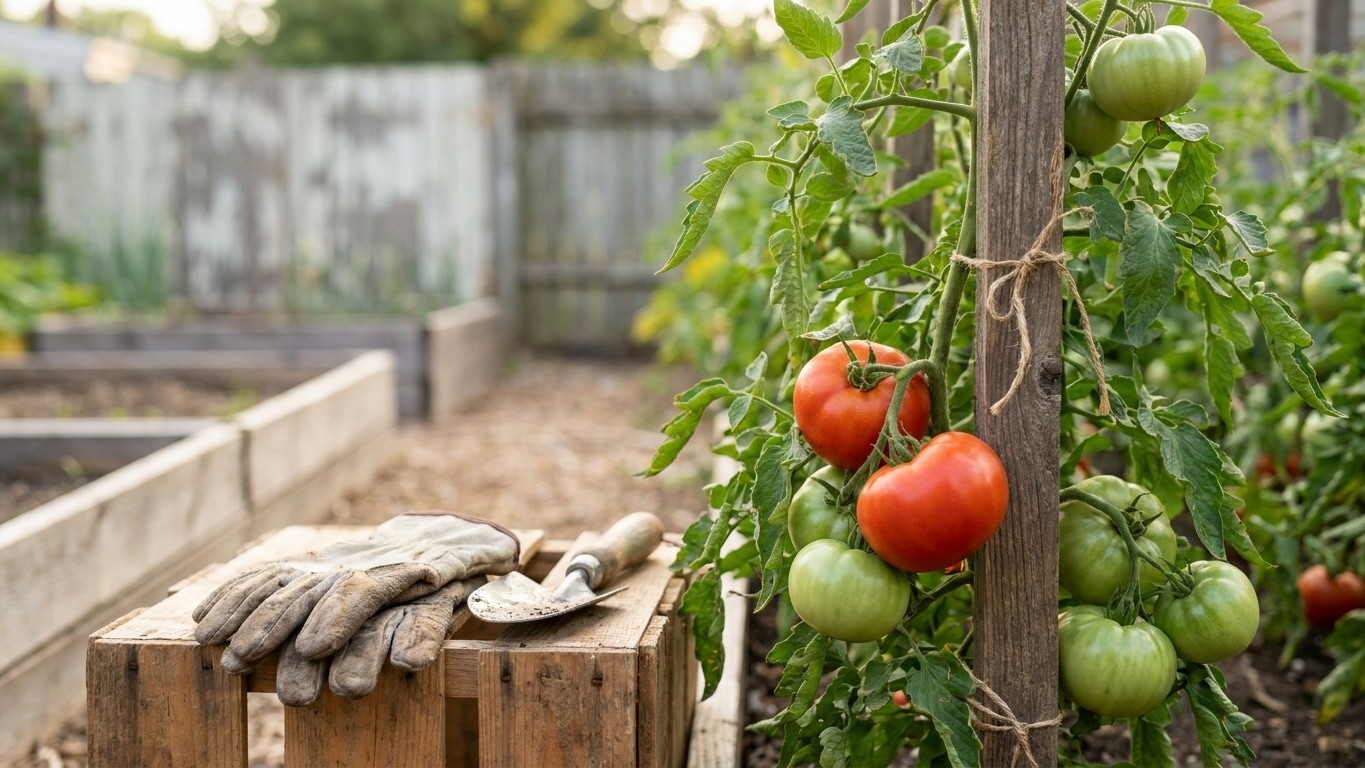

Jolene is a full-size beefsteak tomato bred for slicing, and seed catalogues list it at around 79 days from transplant to first ripe fruit, not from the day the seed went into the tray. That is a long season for a beefsteak, and it means the plant only finishes reliably where the frost-free window has real room to spare. Before you set out transplants, check your county’s average frost dates through NOAA or your state extension service, and count backward from there.
What Jolene actually is

Jolene is grown for the plate next to a sandwich, not for canning or sauce. Seed catalogues put its days to maturity at around 79 days from transplant, and that count starts the day a seedling goes into the garden, not the day it was sown indoors weeks earlier. Catalogue figures also shift by a week or two either way depending on how warm the season runs, so treat 80 to 85 as a working range rather than a fixed date.
The plant is indeterminate, meaning it keeps growing, flowering and setting fruit until frost or disease stops it, rather than stopping at a set height and ripening in one flush the way a determinate bush does. That habit demands a sturdy stake or cage from the day of transplant, because a vine carrying beefsteak-size fruit will snap unsupported in the first summer storm. It also means the plant is still opening new flowers in late summer, which is exactly why some fruit is still green when frost arrives.
The fruit is large, round to slightly flattened, and matures to deep red with the dense, meaty flesh and small seed cavities typical of a slicing beefsteak. A long maturity window paired with an indeterminate habit is what makes the frost-margin arithmetic matter so much more for Jolene than for an early, determinate variety. For a full comparison of maturity dates and disease packages across the crop, the Tomato Varieties roundup is worth a look before committing a bed to one long-season beefsteak.
What Jolene is good for
Jolene’s value comes from its shape and structure, not from any claimed flavor. A large, flattened beefsteak fruit cuts into wide, even slices that reach the edges of a sandwich or burger bun in one pass, so there’s little trimming and no small end pieces left over. That’s the practical reason beefsteaks dominate the slicing category in the first place: the geometry does the work.
The dense, meaty flesh and small seed cavities matter here too, but for a different reason than they would in a sauce pot. On a plate or in a sandwich, that structure means the slice holds its shape under a knife and doesn’t collapse into juice and seeds when you bite into it. Less gel and fewer loose seeds also means less liquid soaking through bread, which is exactly what a sandwich tomato needs to do and exactly what a paste tomato, with even less water to begin with, does better still for a reduced sauce.
That same density and comparatively lower water content, relative to a watery slicing hybrid, is why a raw Jolene slice tastes fuller in the mouth than it looks: there’s more solid tissue per bite and less water diluting it. But it is still a fresh-eating fruit built around a lot of moisture compared to a paste tomato, so it will never reduce down efficiently on a stove the way a Roma or San Marzano does; asking it to do that job just means a longer sim
Where it ripens in time, and where it is a gamble
Whether Jolene finishes at all comes down to one calculation. Take the frost-free window at your location, subtract the couple of weeks the soil needs to warm before a heat-loving transplant goes in, then subtract the 79 days Jolene needs to reach its first ripe fruit. What is left over is the margin, the gap between that first ripe tomato and the first fall frost. Under thirty days of margin means one flush of ripe fruit before frost, and a cool year can take even that.
Reading the margin, place by place
| Territory | Reference station | Set out | First ripe | Margin |
|---|---|---|---|---|
| Yukon | Whitehorse | mid June | early September | -12 days |
| Nunavut | Rankin Inlet | early July | mid September | -7 days |
| Northwest Territories | Yellowknife | early June | late August | 23 days |
| Alberta | Calgary | early June | late August | 25 days |
| Manitoba | Winnipeg | early June | late August | 29 days |
| Saskatchewan | Saskatoon | early June | mid August | 30 days |
| Washington | Seattle | mid March to early April | mid June | 147 days |
| Louisiana | New Orleans | early to late February | mid May | 219 days |
At the tight end, Yukon‘s Whitehorse station shows a frost-free season ending about twelve days before Jolene would ripen its first fruit, which is why outdoor growing there is not realistic without a greenhouse or high tunnel. Nunavut‘s Rankin Inlet is short by about a week on the same math, and both places also fall well below the season’s accumulated warmth, so extending the frost-free window with row cover alone would not close the gap.
In Northwest Territories, at Yellowknife, and in Alberta, at Calgary, the frost-free window runs long enough on paper. Setting transplants out in early June and counting 79 days forward lands the first ripe fruit in late August, leaving three to four weeks before the average first fall frost. That is enough for one real flush of fruit, but a cool August can erase the margin, which is why both are graded as risky rather than safe.
Manitoba‘s Winnipeg station and Saskatchewan‘s Saskatoon station sit at the same edge, where the earliest transplant date the local frost calendar allows, combined with black plastic mulch to warm the soil faster, makes the difference between a crop and a loss.
The picture changes completely by the time you reach Washington‘s Seattle station, where a season with 147 days of room beyond first ripe fruit turns Jolene’s long maturity from a liability into a non-issue, and Louisiana‘s New Orleans station, where the margin runs to 219 days. In both places the question stops being whether the plant finishes and becomes when in the season the fruit tastes best, since heat brings its own limit, covered next.
The two ways a season goes wrong
A long frost-free window is not the same as a warm one, and a warm one is not the same as a survivable one at the height of summer. Two limits sit underneath the margin numbers above, and neither shows up on a simple frost-date map.
In the north, the problem is accumulated warmth rather than the calendar. Northwest Territories‘s Yellowknife station and Alberta‘s Calgary station both show a frost-free window wide enough to fit Jolene’s maturity on paper, yet the total heat those places accumulate over a season runs short of what a beefsteak needs to actually build sugar and ripen rather than just survive. Nights that stay below 50°F also stop pollen from setting well, so a run of cold nights early in summer can erase weeks of calendar margin before frost is even the issue. For a variety with an 80 to 79 day maturity, this cold-side limit matters more than the frost date itself in the coldest territories above, because the plant can run out of usable warmth long before it runs out of days on the calendar. Gardeners in these risky margins who want to sidestep the one-flush gamble sometimes plant Siletz instead, a determinate slicer bred to ripen its whole crop in one earlier window rather than trickle fruit in over a long season.
In the south, the limit runs the other way. Once daytime temperatures climb past roughly 86°F, tomato pollen turns sterile and flowers drop without setting fruit, which is why South Carolina‘s Charleston station, Florida‘s Jacksonville station, Texas‘s Houston station, Nevada‘s Las Vegas station and Louisiana‘s New Orleans station effectively run two tomato seasons, a spring crop and a fall crop, rather than one continuous one. For Jolene, the wide margins in those places mean the spring-set crop still has time to ripen before the heat shuts pollination down, so the practical effect of the summer gap is a pause in new fruit set rather than a lost season.
What it resists, and what it does not
Jolene carries high resistance to Verticillium Wilt and high resistance to Fusarium Crown and Root Rot, both graded high rather than intermediate on the seed packet. High resistance means the plant can grow in soil carrying either pathogen and still produce a normal crop most years, which matters since both fungi persist in soil for years with no chemical cure once a plant is infected.
High is not the same as immune. Soil that has carried repeated tomato crops can still build up enough Fusarium or Verticillium pressure to slow even a resistant plant in a bad year. Rotating tomatoes, peppers, eggplant and potatoes out of the same bed for a few years still helps, resistance or not. Gardeners in the risky northern margins above who want a similar high-resistance package on a shorter countdown often compare Jolene to Big Beef, which reaches its first fruit well ahead of Jolene’s 80 to 79 day count.
The catalogue listing does not credit Jolene with resistance to early blight, late blight, septoria leaf spot, or root knot nematodes, and nothing in the frost-margin data above changes that. That gap matters most in the warm, humid margins of the map, where foliar disease pressure builds fast once a canopy stays wet overnight. A grower in one of the comfortable southern zones gets a long enough season to outrun the frost, but still needs a fungicide rotation or resistant companion planting once early blight or septoria shows up on the lower leaves, since Jolene’s genetics offer no backup there.
Growing it without the usual mistakes
Because Jolene is indeterminate, it needs a support system built for the whole season, not just the seedling stage. A single stake driven in at transplant time and left there will not hold a mature plant carrying multiple pound-plus Beefsteaks by late summer. Set a sturdy stake, a cattle-panel trellis, or a heavy-gauge cage at planting time, and tie the main stem up every week or two rather than trying to add support after the plant has sprawled.
Space plants further apart than a compact determinate variety needs. A full-season indeterminate beefsteak needs airflow around its lower leaves, and tight spacing is exactly what lets early blight and septoria build up in the humid margins described above.
Feeding is where this variety’s timing causes the most trouble. Because Jolene keeps flowering into late summer, it is tempting to keep pushing nitrogen right through the season. That habit produces a plant still setting new flowers in the weeks before frost, flowers with no realistic chance of becoming ripe fruit given the 80 to 79 day countdown each one starts on the day it sets. Cut back on nitrogen once the plant is carrying a full load of fruit, and let it put energy into ripening what is already there instead of starting more that will not finish.
- Staking after the plant has sprawled instead of at transplant
- Spacing tight enough that lower leaves stay wet overnight
- Feeding nitrogen through late summer instead of easing off once fruit has set
That is where the green Beefsteaks in the title come from. In every one of the risky, one-flush territories above, and in most gardens further south once the first frost warning goes out, some fruit will still be green on the vine. Pick full-size green fruit before a hard freeze and ripen it indoors in a paper bag or a single layer out of direct sun, or use it as it is, sliced and fried, or diced into green tomato relish, both traditional uses for a beefsteak that ran out of season before it ran out of fruit.
Common questions
Is Jolene tomato a hybrid or an heirloom?
That detail is not something to guess at, since it changes whether saved seed will grow true. Check the seed packet or the catalogue listing you bought from, since hybrid and open-pollinated status is printed there and is not the same across every seed source.
Can I grow Jolene in a container if I don’t have a garden bed?
It can be done, but only in a container large enough to support a full-season indeterminate vine, closer to the largest half-barrel size sold at garden centers than a small patio pot. A cramped root zone on a plant with an 80 to 79 day countdown to first fruit tends to stall growth right when the plant needs to be racing the season, not slowing down.
Why are my Jolene tomatoes cracking around the top?
Cracking on a beefsteak this size is almost always uneven watering, a dry spell followed by a heavy soak that swells the fruit faster than the skin can stretch. Consistent watering and a layer of mulch to even out soil moisture cuts this down, though a few cracked fruit after a big rainstorm is normal on any large-fruited variety.
Do I need to prune suckers on Jolene like other indeterminate tomatoes?
Most growers do, since an unpruned indeterminate beefsteak turns into a tangle that shades its own lower fruit and slows ripening further. Pruning to one or two main stems and tying them up as they grow keeps the plant manageable and lets more light reach the fruit that actually has time to finish before frost.