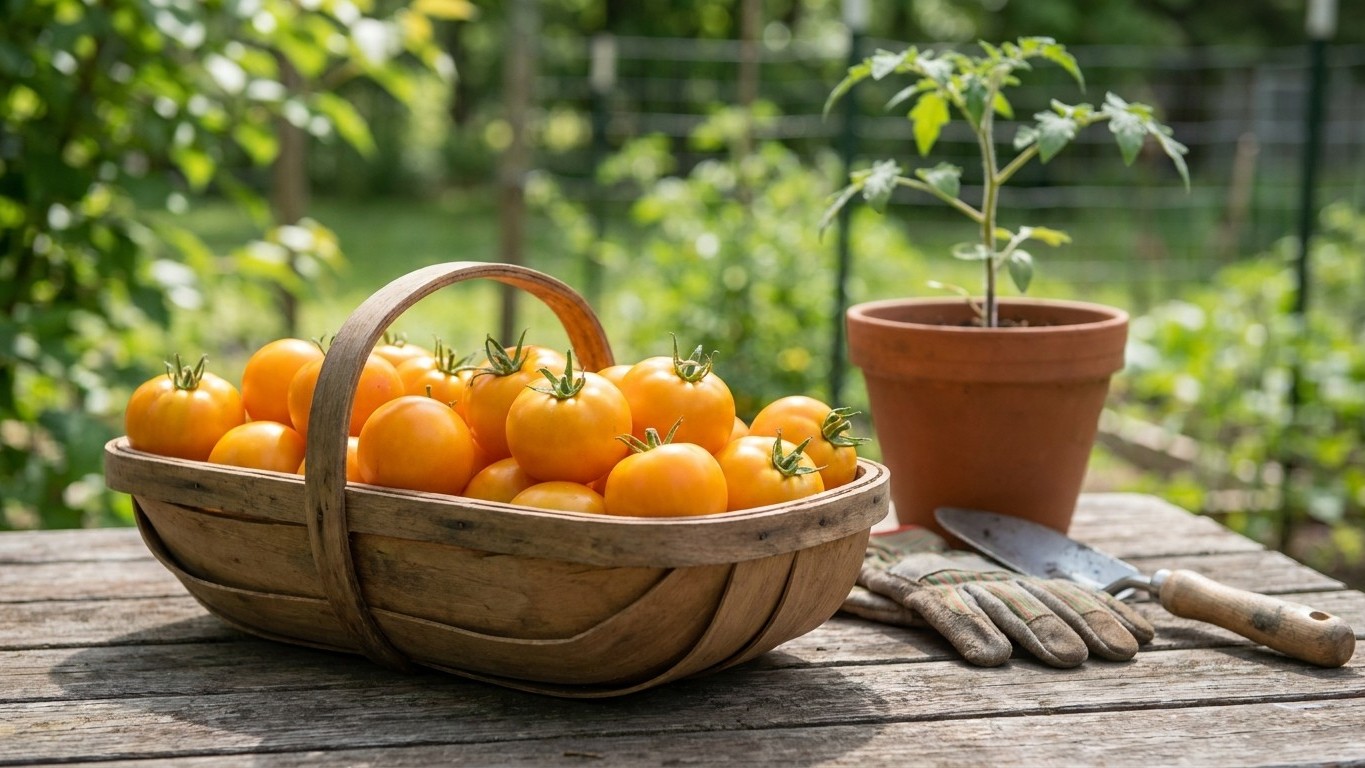

Harvest Moon is an indeterminate golden beefsteak tomato grown for slicing, and seed catalogues put it at roughly 75 days from transplant to first ripe fruit, not from the day you start seed indoors. That maturity places it among the slower tomatoes you can plant, so the question that decides everything else is whether your local frost-free window, checked at your nearest official weather station, can clear that stretch after the soil has warmed enough to set the plant out. If it can’t with room to spare, plan on a greenhouse, a tunnel, or a shorter variety instead.
What Harvest Moon actually is

Harvest Moon is a golden-orange beefsteak, large and slightly flattened, with the low-acid, sweet flavor typical of yellow tomatoes bred for fresh eating rather than canning. The vine is indeterminate, meaning it keeps growing and setting new trusses until frost or disease stops it, rather than ripening in one flush like a determinate bush type. That habit decides most of the growing decisions: it needs a permanent stake or cage installed at planting, not added after the fact, and it will keep producing right through the season if the climate lets it.
The 80 to 75 day figure printed on the seed packet is measured from the day you transplant a started seedling into the garden, not from the day you sow. Catalogue figures also assume average conditions and can run a week or two longer in a cool season or a week shorter in a hot one, so treat the number as a planning range rather than a fixed date. If you haven’t settled on a variety yet, the full list of tomato varieties is a good place to compare maturity lengths before you commit a whole season to one plant.
What Harvest Moon is good for
The flattened beefsteak shape is the point here: a wide, broad fruit cuts into large, round slices that cover a burger patty or a slice of bread edge to edge, which is exactly what a slicing tomato is bred to do. That same shape and the open, juicy interior work against it in a saucepan — the flesh carries a lot of water and breaks down into liquid rather than body, so a pot of it needs a long simmer to cook off the water before it thickens into anything resembling a sauce. If you want tomatoes that collapse into paste in twenty minutes, this isn’t that plant; it’s built for the cutting board, not the stockpot.
The red blush showing through the gold flesh is mostly a plate consideration rather than a flavor one — it makes for a striking cross-section on a sandwich or a caprese-style plate, sliced and layered raw so the color actually shows. Because the variety is bred low-acid and sweet, it also reads well eaten uncooked, without the sharp bite some red tomatoes have; that mildness is better suited to fresh applications than to canning, where acidity is part of what makes home-canned tomatoes shelf-stable. If preserving the harvest matters to you, budget for added acid or plan to freeze or dehydrate slices instead of water-bath canning them as-is.
Being classed as a specialty tomato mainly signals that it was bred for appearance and fresh eating rather than for uniform size, disease resistance package, or processing yield — the traits a commercial paste or canning variety would be selected for instead. Beyond the slicing use, sweetness, and color already covered, there isn’t published detail on how it performs dried, roasted, or juiced, so treat those as untested rather than ruled out.
Where it ripens in time, and where it is a gamble
The number that matters isn’t the length of your frost-free season by itself. It’s what’s left after you subtract the two to three weeks the soil needs to warm before a tomato can go in the ground, and then subtract Harvest Moon’s 80-plus days of growth from what remains. Whatever is left over is your margin, the days between the first ripe fruit and the first fall frost. Under thirty days of margin means you get one flush of fruit and a cool year takes even that.
Where the season runs out before the fruit does
At the reference station in Whitehorse, Yukon, growers would set plants out in mid June and see first ripe fruit in early September, which lands about eight days after the average first frost. The season simply isn’t long enough, and no amount of care changes that arithmetic. Rankin Inlet, the reference station for Nunavut, comes up three days short on the same math. In both places, a heated greenhouse or a plastic tunnel with supplemental warmth is not optional if you want Harvest Moon specifically, since the growing-degree total for the whole year runs far below what a long-season tomato needs to finish.
Yellowknife, the reference point for the Northwest Territories, and Calgary, for Alberta, both clear the frost date with a margin in the high twenties: 27 days and 29 days respectively. That’s enough for one real harvest window, but a single cold snap or a late spring can erase it, so growers there are working with no buffer for a bad year.
Where a greenhouse start turns risk into reliability
Saskatoon, the reference station for Saskatchewan, and Winnipeg, for Manitoba, both land in the low thirties for margin, comfortable enough for a full harvest most years but still tight for a variety that runs 80-plus days. Starting Harvest Moon under cover and setting out a larger, further-along transplant, combined with black plastic mulch to hold soil heat, is what turns a marginal number into a dependable one in those two provinces.
Further south the numbers stop being a constraint at all. Seattle, the reference station for Washington, shows a 151-day margin. Houston, for Texas, and Jacksonville, for Florida, run well over 150 days each. In those climates the limiting factor isn’t frost at either end of the season, it’s the mid-summer heat covered next.
| Territory | Reference station | Verdict | Margin (days) |
|---|---|---|---|
| Yukon | Whitehorse | Impossible outdoors | -8 |
| Nunavut | Rankin Inlet | Impossible outdoors | -3 |
| Northwest Territories | Yellowknife | Risky, one flush | 27 |
| Alberta | Calgary | Risky, one flush | 29 |
| Saskatchewan | Saskatoon | Start under cover | 34 |
| Manitoba | Winnipeg | Start under cover | 33 |
| Washington | Seattle | Comfortable | 151 |
| Texas | Houston | Comfortable | 186 |
The two ways a season goes wrong
A long frost-free window on paper does not guarantee a good crop, and two separate limits explain why.
Cold climates: the days can be there and the heat still isn’t
A frost-free count only tells you how many days pass without a freeze. It says nothing about how warm those days actually are, and a tomato needs accumulated warmth, not just calendar time, to move from flower to ripe fruit. Saskatoon’s growing season adds up to roughly 1,549 accumulated warmth units across the year and Winnipeg’s to roughly 1,832, figures that are workable for Harvest Moon but leave no slack. Yellowknife and Calgary run lower still, at roughly 905 and 1,171 respectively, which is short of what an 80-plus day tomato needs regardless of how many frost-free days show up on the calendar. On top of that, tomato flowers generally won’t set fruit once nights drop below 50°F, so a cool snap in a short northern summer can blank out a whole truss even without frost.
Hot climates: pollen stops working above 86°F
The opposite failure shows up in the deep South. Once daytime temperatures push past roughly 86°F, tomato pollen becomes sterile and flowers drop without setting fruit at all. In Charleston, South Carolina, Jacksonville, Florida, Houston, Texas, New Orleans, Louisiana, and Las Vegas, Nevada, that stretch runs for most of the summer, so growers there plant a spring crop, let it fruit before the heat locks in, and then plant again for an autumn crop rather than expecting one continuous harvest.
For Harvest Moon specifically, the cold-climate limit is the one that matters. Its 80-plus day maturity already consumes most of a short northern season before accounting for lost warmth, while gardeners in the hot South have so much margin on either side of summer that a mid-season pause barely dents the total harvest.
What it resists, and what it does not
What high resistance means, and what’s missing
Harvest Moon carries high resistance to Late Blight, the disease that can collapse a planting in days during cool, wet weather. High resistance means the plant can be exposed to the pathogen and largely shrug it off, which is a meaningfully stronger claim than intermediate resistance, a grade that only slows an infection rather than stopping it. If you’ve grown a variety rated intermediate before and watched it get blight anyway in a wet year, that’s the distinction at work.
Beyond late blight, the catalogue lists no other resistance codes for this variety. That means Harvest Moon has no built-in protection against early blight, Septoria leaf spot, fusarium wilt, or verticillium wilt, all of which are common in home gardens regardless of region. Treat it as susceptible to those the same way you would an heirloom with no resistance package at all: rotate tomatoes out of the same bed for a few years where you can, mulch to keep soil-borne spores from splashing onto lower leaves, and prune the bottom foot of foliage once the plant is established. None of that is specific to Harvest Moon, but skipping it undoes the one resistance the variety does bring to the garden.
Growing it without the usual mistakes
Staking, spacing and pruning
Because Harvest Moon is indeterminate and produces large beefsteak fruit, a flimsy tomato cage bought off a garden center shelf will not hold it by mid-season. Drive a sturdy stake or install a cattle-panel trellis at transplant time, before the root system fills in, and tie the main stem up as it grows rather than trying to wrangle a sprawling plant later. Prune to two or three main leaders to concentrate the plant’s energy into fewer, larger fruit, which also opens the canopy enough for air to move through and keeps foliar disease pressure down. Space plants further apart than you would a compact determinate variety, since this vine will fill more room over a full season.
Feeding, watering and timing the harvest
Feed at transplant and again when the first fruit sets, then back off nitrogen once the plant is fruiting heavily, since too much late nitrogen pushes leafy growth at the expense of ripening fruit. Keep watering even through the season, since large beefsteak types like this one crack readily when a dry spell is followed by a heavy watering or a rainstorm. Given the long maturity window, start seed indoors early enough that the transplant is a sturdy, several-week-old seedling by the time your local soil has warmed, rather than setting out a young start and hoping it catches up. If your climate can’t support an 80-plus day tomato at all, an early, determinate variety suited to a single flush is a better match than trying to rush this one.
If gold slicers aren’t quite what you’re after, the Jolene tomato ripens green rather than gold and holds its color even when fully ripe, which confuses a lot of first-time growers expecting a color change that never comes. And if what you actually want is a plant that keeps producing sauce tomatoes right up until frost rather than one big beefsteak harvest, the San Marzano tomato is built for exactly that.
Common questions
Can I grow Harvest Moon in a pot?
You can, but it needs a large container, generally 20 gallons or more, because it’s an indeterminate vine that keeps growing all season rather than staying compact. A sturdy stake or cage anchored in the container is not optional, since the plant will get top-heavy once fruit sets.
Why isn’t my Harvest Moon turning a deep color like my other tomatoes?
Gold and yellow tomatoes ripen by softening and by a shift toward translucent gold at the blossom end, not by the dramatic red color change you get on standard slicers. Check by gently twisting the fruit and feeling for slight give rather than waiting for a color that this variety isn’t going to produce.
Can I save seed from Harvest Moon and replant it next year?
Check the seed packet or the seller’s listing before you count on it. Open-pollinated varieties will grow true from saved seed, but if Harvest Moon is sold as a hybrid, plants grown from its saved seed won’t reliably match the parent, so it’s worth confirming which it is before you skip buying seed next season.
My frost date is close to Harvest Moon’s maturity length. Should I still try it?
If your margin between first ripe fruit and first frost runs under about thirty days, you’re looking at one flush of fruit at best, and a cool year can wipe that out entirely. Starting larger transplants under cover, using black plastic mulch to hold soil heat, or switching to a shorter-season variety are all better bets than pushing a marginal climate.