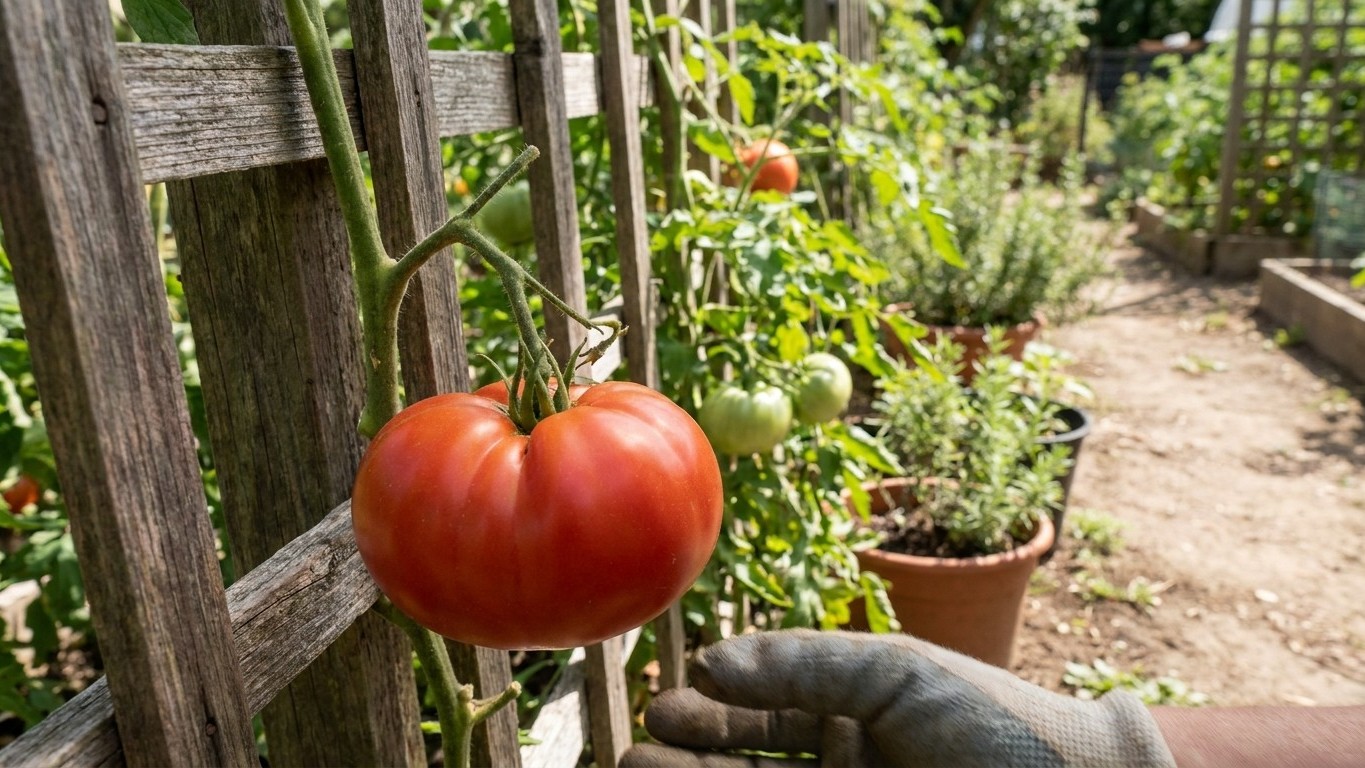

When will Big Beef Plus actually turn red for you, and is your yard even in the running? It needs about 72 days after you set out the transplant, not from seed, so a short growing season can shut the door before the vine ever gets going. Before you buy the packet, count the frost-free days your yard typically gets and check that number against those 72 days — that comparison, done now, tells you whether this tomato is a yes or a gamble for your soil.
What Big Beef Plus actually is

Big Beef Plus is a hybrid slicing tomato built for the home garden and the farm stand alike, producing large red beefsteak fruit on an indeterminate vine that keeps growing, flowering and setting fruit until frost or disease stops it. Most seed catalogs list it at about 72 days from transplant, and that figure matters more than it looks: it is counted from the day you set out a started plant, not from the day you sow seed. Add the several weeks of indoor growing time before that if you are starting from seed rather than buying transplants.
The fruit itself runs large for a home garden slicer, commonly in the 10 to 12 ounce range per most catalog descriptions, with the meaty, multi-chambered flesh typical of a beefsteak. That size and texture make it a slicing and sandwich tomato first, not a canning or sauce tomato. If the goal is jars of sauce rather than a summer BLT, a paste variety bred to ripen its whole crop in a narrow window, like the Amalfi tomato, suits that job better than a beefsteak ever will.
Because it is indeterminate, Big Beef Plus needs a tall cage or stake system and a full season of care, not a one-and-done harvest. That habit is the trade-off for a steady supply of fruit from midsummer through fall, and it is the detail that most changes how to plant and support it, covered further down. Anyone comparing it against other tomato varieties should weigh that season-long commitment against a determinate type’s single, heavier flush.
What Big Beef Plus is good for
A beefsteak’s interior is the reason it belongs on a sandwich rather than in a saucepan. The fruit is built from a few large, irregular locules packed with jelly and juice, surrounded by thick walls of solid flesh. Cut a slice and that structure holds together: a round of tomato an inch thick that stays flat, doesn’t collapse into seeds and liquid, and covers a full piece of bread. That same anatomy works against it on the stove. Because so much of the fruit’s volume is water held in those big seed cavities, cooking it down means boiling off that water first, before any sauce actually thickens. A paste tomato skips that step almost entirely, its flesh is dense and its seed cavities small, so it collapses into sauce with little more than heat. Big Beef Plus, like any beefsteak, will make sauce if pushed, but it takes longer at the stove and gives back less per pound than a tomato bred for that job.
What it’s suited for instead is anything eaten raw or barely cooked, where that dense, juicy flesh is the point rather than the obstacle: sliced onto a burger, layered into a BLT, fanned out with mozzarella and basil. The red color and large size that already carry the description into “classic slicer” territory reinforce that role rather than adding anything new to it.
On flavor, the plant is described as an improvement on an already well-regarded beefsteak, with better color and adaptability bred in alongside it. What that means in terms of sweetness, acidity, or balance on the tongue isn’t spelled out anywhere in the available material, so nothing more specific than “a well-liked beefsteak” can honestly be said here.
Where it ripens in time, and where it is a gamble
The arithmetic behind every ripe tomato is the same everywhere: take the frost-free window, subtract the fortnight the soil needs to warm before a tomato transplant can go in without stalling, then subtract the 72 days Big Beef Plus needs to set and ripen its first fruit. What is left over is picking time, the margin between the first red tomato and the first fall frost. Under thirty days of that margin, one flush of fruit is all a garden gets, and a cool year can erase even that.
At the tight end, Yukon‘s reference station in Whitehorse shows a margin of -5 days for this variety. Growers there would set out in mid June and see first ripe fruit in late August, but Whitehorse’s first frost arrives before that fruit is ready, so the math never closes without protection. Nunavut‘s Rankin Inlet station is barely better, at 0 days of margin, with plants set out in early July ripening by mid September, right at the frost line, where a single cool week erases the harvest.
Across the Canadian Prairies, the frost-free window itself is workable but still tight for a 73 to 72 day variety. Alberta‘s Calgary station gives 32 days of margin on plants set out in early June with first fruit by mid August, and Saskatchewan‘s Saskatoon station gives 37 days on the same early-June planting. Both are graded for greenhouse growing in the underlying data, because the days themselves are not the limiting factor there. The season’s accumulated heat is, and the next section explains why.
The other end of the map has room to spare. Washington‘s Seattle station shows 154 days of margin on a mid March to early April transplant date, and by Texas‘s Houston station and Louisiana‘s New Orleans station, margins run to 189 and 226 days on transplant dates as early as mid February. That is far more time than a 73 to 72 day tomato needs to finish, which shifts the risk in those states away from frost and toward the summer heat covered next.
| Territory | Reference station | Set out | First ripe | Margin to first frost |
|---|---|---|---|---|
| Yukon | Whitehorse | Mid June | Late August | -5 days |
| Nunavut | Rankin Inlet | Early July | Mid September | 0 days |
| Alberta | Calgary | Early June | Mid August | 32 days |
| Saskatchewan | Saskatoon | Early June | Mid August | 37 days |
| Washington | Seattle | Mid March to early April | Mid June | 154 days |
| Louisiana | Early to late February | Early to late February | Early May | 226 days |
The two ways a season goes wrong
A long frost-free window does not guarantee a ripe tomato, and a short one does not always rule it out. Two separate limits sit underneath the frost date, and a table of first and last frost dates hides both of them.
Not enough heat, even with enough days
In the north, the problem is often accumulated warmth rather than the calendar. Yukon‘s Whitehorse station accumulates only about 600 growing degree days in a typical year, and Nunavut‘s Rankin Inlet station about 159, numbers so low that a tomato’s flowering and fruit set struggle regardless of how many frost-free days sit on the calendar. Further south but still short of what a tomato wants, Northwest Territories‘s Yellowknife station accumulates roughly 905 growing degree days, Alberta‘s Calgary station about 1171, and even Manitoba‘s Winnipeg and Saskatchewan‘s Saskatoon stations sit at roughly 1832 and 1549. Sustained warmth is what pushes a tomato through flowering and fruit set, and nights that fall below 50°F stall that process regardless of the date on the calendar, which is why every one of those Territories is graded for greenhouse or high tunnel growing rather than the open garden, whatever their frost-free margin shows.
Too much heat, in the other direction
Farther south, the limit flips. Above roughly 86°F, tomato pollen goes sterile and flowers drop without setting fruit, which is why South Carolina, Florida, Texas, Nevada and Louisiana all run two separate tomato seasons, a spring crop and an autumn crop, rather than one long one. The 150 to 226 days of margin those states show is real, but the middle of it, roughly the hottest stretch of summer depending on the state, is often a dead zone for new fruit set.
For a variety with Big Beef Plus’s 73 to 72 day maturity, the northern heat deficit is the harder limit of the two. A 73-day tomato started in the brief, cool Prairie or northern window struggles to accumulate the warmth it needs even inside a season nominally long enough on paper, which is why those territories are marked for protected growing rather than open ground. In the southern heat-sterility states, the same 72 days fits comfortably into either the spring or the autumn window on its own, so growers there manage around the summer gap rather than around the tomato’s own maturity.
What it resists, and what it does not
Big Beef Plus carries high resistance to Fusarium wilt races 1 and 2 and to Fusarium crown and root rot, both soilborne fungal diseases that build up in soil planted to tomatoes year after year. High resistance means the plant strongly suppresses the pathogen rather than eliminating the risk outright. It is not the same as immunity, and a heavily infested bed can still show some symptoms in a hot, stressed summer.
What the catalog resistance package does not cover matters just as much. It says nothing about the foliar diseases that show up in a humid, rainy season, things like Septoria leaf spot and early blight, which spread by splashing water onto lower leaves and work their way up the plant regardless of a variety’s Fusarium genetics. Those diseases are managed with spacing, mulch and fungicide timing, not by variety choice, so a Big Beef Plus planting in a wet climate still needs the same foliar disease program any other tomato would.
Nematodes, Verticillium wilt and tobacco mosaic virus, common targets of resistance breeding in other tomato lines, are not part of the resistance codes listed for Big Beef Plus. Gardens with a known history of any of those problems should treat this variety as no more protected against them than an unbred heirloom. Check the seed packet or catalog listing for the current resistance code before buying, since breeders do occasionally update a line’s disease package between seasons.
Growing it without the usual mistakes
Because Big Beef Plus is indeterminate, it needs a support system built for the whole season, not just the first month. A single wire cage sized for a determinate patio tomato will not hold a vine that keeps adding trusses into fall. Stake it to a post at least six feet tall, or run it up a string in a trellis system, and keep tying the leader as it climbs rather than waiting until it flops.
Spacing and pruning
Give each plant more room than a compact variety needs, since the vine keeps producing side shoots all season. Suckering to one or two main stems keeps the plant manageable and improves airflow around the lower leaves, which matters more here than on a determinate variety because Big Beef Plus stays in the ground, and exposed to disease pressure, for months longer.
Feeding and the late-season mistake
The mistake this variety’s long season invites is feeding it like a short one. Growers who fertilize hard at planting and then stop, the way they would for a fast early tomato, end up with a vine that runs out of steam by midsummer just as the plant should be settling into its heaviest production. Feed on a steady schedule through the growing season instead of front-loading it, and back off nitrogen once fruit is setting heavily, since excess nitrogen late in the season pushes leafy growth at the expense of the fruit the plant is supposed to be finishing.
Watering matters more here too. An indeterminate beefsteak carrying fruit at several stages of ripeness at once is more prone to blossom end rot and cracking from uneven watering than a variety that ripens all at once and is done. Keep soil moisture even with mulch and a consistent watering schedule rather than letting the bed dry out and then soaking it, which is the same swing that cracks a fruit close to ripe. Growers moving from a small-fruited variety like the Amai tomato, which ripens quickly into 15 to 20 gram grape-sized fruit, to a season-long beefsteak often underestimate how much longer the watering discipline needs to hold.
Common questions
Can I grow Big Beef Plus in a container?
Yes, but size the container to the vine’s full-season growth, not to the transplant it starts as. An indeterminate beefsteak like this one needs a container in the 15 to 20 gallon range and a stake or cage tall enough to support six feet or more of vine, not the smaller pots that work for a determinate patio variety.
Why are my Big Beef Plus flowers dropping without setting fruit?
Check the overnight and daytime temperatures first. Tomato flowers stop setting fruit reliably when nights fall below 50°F or when daytime highs push past roughly 86°F for a stretch, and either end of that range can hit a Big Beef Plus planting depending on when it was set out and where it is growing.
Is Big Beef Plus the same as the original Big Beef?
No. Big Beef Plus is a separate hybrid release, not a rename, and the two can carry different disease resistance codes even though they share a name and a similar fruit type. Check the current seed packet rather than assuming the older variety’s resistance package carries over.
How many tomatoes will one plant actually produce?
Catalog yield estimates vary by grower and by season, and there is no single reliable figure that holds across climates. What is consistent is the pattern: an indeterminate variety like this one produces steadily over a long window rather than dumping a single heavy flush, so a lower per-week count over more weeks is normal, not a sign of a problem.