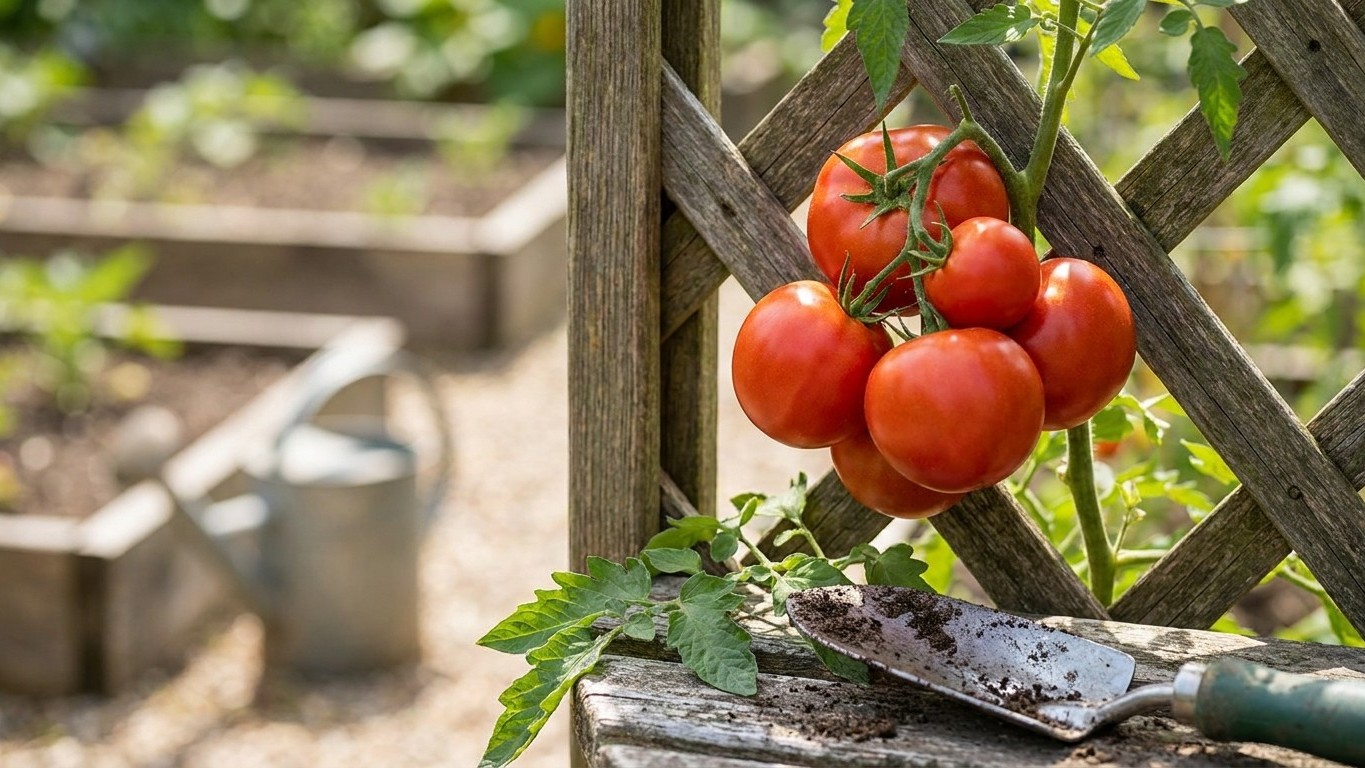

Estiva is a semi-determinate slicing tomato bred in France, grown for a heavy, early crop of round red fruit sized for sandwiches and salads, and it ripens in about 70 days from transplant according to catalogue listings for the variety. That figure is counted from the day you set a started plant in the ground, not from the day you sow seed indoors. The single thing to check before you order it: your region’s frost-free window against that 70-day clock, plus the fortnight the soil needs to warm before roots take hold.
What Estiva actually is

Estiva sits between a determinate and a full-size indeterminate tomato. Catalogue descriptions list it at about 70 days from transplant, which means a plant set out already hardened off and a few weeks old, not a seed dropped into a tray. Sow-to-transplant time typically runs another five to seven weeks depending on your indoor setup, so the total time from seed to first ripe fruit is closer to four months than to seventy days. That distinction matters more with Estiva than with a fast cherry tomato, because a grower who counts from seed instead of transplant will order it thinking they have three extra weeks of margin they do not actually have.
The plant’s semi-determinate habit means it grows to a fixed, moderate size rather than climbing indefinitely, but it keeps setting new trusses over several weeks instead of ripening all at once like a true determinate. Practically, that means a cage or a single stake handles it, but you cannot skip support the way you might with a compact patio variety. The fruit itself is a classic red slicer, round, smooth-skinned, sized for a sandwich rather than a paste job, and the plant is bred for a productive early-to-mid season crop rather than for a single dramatic flush. If you’re comparing it against other tomato varieties for a small garden, its habit is the deciding factor over its flavor profile.
What Estiva is good for
Estiva is a slicing tomato, and that classification tells you more than a flavor adjective would. A slicer holds its water in open, gel-filled locules rather than concentrating flesh into dense walls, so a raw cross-section stays juicy and separates cleanly into rounds. That structure is exactly what a sandwich or a burger needs: a slice that holds together on the bread but still releases juice when you bite it. It is also why this is not the tomato to reach for when you want a sauce that reduces quickly in the pan. A paste tomato has thick flesh and little internal moisture, so it collapses into sauce with almost no added cooking time. Push a fruit built like Estiva through that same process and you will be simmering off far more water before it thickens, and the payoff in flavor concentration won’t match what a paste variety gives you for the same effort.
The catalog description promises high production and premium flavor in a mid-size fruit, which is worth taking at face value as a yield and size claim, but it does not specify whether the flavor leans sweet, acidic, or balanced. Nothing more granular than that is documented, so treat the taste itself as an open question you’ll answer at harvest rather than one this variety’s paperwork settles for you.
Where it clearly earns its place is on the cutting board: sliced for a BLT, layered into a burger, fanned onto a plate with salt and oil. It’s mid-size, so a single fruit reasonably covers a sandwich without the excess you’d fight with a beefsteak. It’s not bred for the cherry-tomato habit of disappearing in the garden before it reaches the kitchen, and it’s not going to substitute well for a can of San Marzanos in a marinara.
Where it ripens in time, and where it is a gamble
The arithmetic behind this section is simple even where the numbers are not in your favor: take the frost-free window at your reference station, subtract the two weeks your soil needs to warm before you can safely set out a tomato, subtract Estiva’s roughly 70-day clock, and what remains is your picking window. Where that remainder drops under thirty days, you are looking at one flush of fruit, and a cool summer can take even that.
Where the margin runs out
At Whitehorse, the reference station for Yukon, the numbers land at negative three days of margin: transplants go out in mid June, the 70-day clock points to first ripe fruit in late August, and the average first frost arrives before that fruit color turns. In Nunavut, Rankin Inlet’s figures leave just two days of margin between first ripe fruit in mid September and the first frost, which is not a season, it is a single roll of the dice against an early cold snap.
Move south into the prairie provinces and the picture improves but does not become easy. Saskatoon’s figures for Saskatchewan give 39 days of margin, Calgary’s for Alberta give 34, and Winnipeg’s for Manitoba give 38, all landing in the same category: workable only under a low tunnel or greenhouse, and only with black plastic mulch to push soil temperature up faster than open ground allows. Northwest Territories, using Yellowknife’s figures, comes in at 32 days for the same reason.
Where margin stops being the limit
Once you cross into states with frost-free windows measured in months rather than weeks, Estiva’s 70-day clock stops being the constraint. Seattle’s figures for Washington put the margin at 156 days, Houston’s for Texas at 191, and Las Vegas’s for Nevada at 226. In those places the question shifts from “will it ripen at all” to “how many crops can I get out of one growing season,” which the next section covers.
| Territory | Reference station | Set out | First ripe | Margin | Verdict |
|---|---|---|---|---|---|
| Yukon | Whitehorse | mid June | late August | -3 days | impossible outdoors |
| Nunavut | Rankin Inlet | early July | mid September | 2 days | risky, one flush |
| Saskatchewan | Saskatoon | early June | early August | 39 days | greenhouse or tunnel |
| Washington | Seattle | mid March to early April | early June | 156 days | comfortable |
| Texas | Houston | mid February to mid March | late May | 191 days | comfortable |
| Nevada | Las Vegas | late January to mid February | late April | 226 days | comfortable |
The two ways a season goes wrong
A long frost-free window on paper does not guarantee a good crop, and Estiva runs into both failure modes depending on where you garden. In the far north, the problem is not frost timing at all, it is accumulated warmth. Whitehorse’s figures show only 600 growing degree-days across the whole year, and Rankin Inlet’s a mere 159. Even in a year with no early frost, a tomato plant simply does not receive enough cumulative heat to push fruit through bloom, set, and ripening on schedule. Fruit set also stalls outright once nights fall consistently below 50F, which happens routinely in these regions even during the nominal frost-free window. No amount of season-extension trickery fixes a heat deficit that size. A greenhouse or a heated tunnel is not an upgrade in these Territories, it is the only path to a ripe fruit at all.
In the deep south, the limit runs the other way. Once daytime temperatures push past roughly 86F, tomato pollen goes sterile and flowers drop without setting fruit no matter how healthy the plant looks. Charleston’s figures for South Carolina, Houston’s for Texas, and Las Vegas’s for Nevada all carry this note across their summer months, which is why growers in those regions run a spring crop and a separate autumn crop rather than one continuous season. Given Estiva’s 70-day clock, the practical move in a hot state is to time the spring transplant so ripening finishes before the sterile window opens, then start a second round of transplants in mid to late summer aimed at an autumn harvest once temperatures drop back under that threshold. For this variety specifically, the heat-sterility limit matters more than the cold-margin one almost everywhere it is grown in the US, since most of the country clears the frost-margin question comfortably.
What it resists, and what it does not
Estiva carries two named disease resistances and it is worth being exact about what they mean. It is graded High resistance to Verticillium Wilt and to Fusarium Wilt races 1 and 2. High resistance means the plant strongly suppresses the pathogen and rarely shows symptoms even in infected soil, which is a real advantage if you garden in ground that has grown tomatoes for years and built up soilborne fusarium or verticillium populations.
What Estiva’s catalogue listing does not carry is any resistance grading against late blight, early blight, tobacco mosaic virus, nematodes, or bacterial spot and speck. That absence is not a minor footnote. Late blight in particular can move through a planting in days under humid conditions, and a resistance rating for two soilborne wilts does nothing to slow it. Growers in regions where late blight shows up reliably each season should treat Estiva the same as any unprotected variety on that front: rotate away from fungicide-only reliance, keep foliage dry when possible, and watch for the dark, water-soaked lesions that mark early infection. Don’t assume the wilt resistance buys you protection against a disease it was never bred to fight.
Growing it without the usual mistakes
Support and spacing
Because Estiva is semi-determinate rather than a sprawling indeterminate, it does not need the aggressive weekly pruning and re-tying that a full-size beefsteak demands. A single sturdy stake or a standard tomato cage is usually enough, but skipping support entirely, on the assumption that a “compact” plant can stand on its own once loaded with fruit, is the most common mistake growers make with this habit type. Space plants with normal tomato spacing rather than the tighter spacing used for true determinate bush varieties, since Estiva still puts on meaningful side growth over its cropping period.
Feeding and timing
Stop nitrogen-heavy feeding once the first trusses have set fruit. Estiva’s productive window is shorter than an indeterminate’s, and pushing leafy growth late in the season steals energy from ripening fruit rather than adding to yield. Because its whole crop is compressed into a shorter run than a season-long producer, the timing of transplant matters more than it would for a variety you can coast with. Missing the early part of your local set-out window by even a week or two eats directly into the picking days calculated in the section above, in a way it would not for a slower, longer-cropping variety like the ones covered in the guide to Juliet tomatoes, which keep producing steadily until frost regardless of a slightly late start.
If you’re weighing Estiva against a big, ribbed heirloom slicer for the same bed, remember the two plants ask for different things from the calendar as much as from the soil. The Black Krim tomato runs a longer maturity clock and rewards a grower with a wide frost-free margin, while Estiva’s shorter clock is the better bet where that margin is tight but not impossible, such as the greenhouse-and-tunnel territories described above.
Common questions
Is Estiva the same as Estiva F1?
Yes, seed listings sometimes drop the F1 designation in casual use, but it is a hybrid variety, not an open-pollinated one. Saved seed from Estiva fruit will not grow true to type the following year.
Can I grow Estiva in a container?
It will grow in a large container, but its semi-determinate habit still puts on enough top growth that a small pot will stunt it and cut yield hard. Use a container in the 15 to 20 gallon range and keep it staked the same as you would in open ground.
Why did my Estiva plants stop setting fruit in midsummer?
In most of the country this points to the heat-sterility problem described above, where daytime temperatures above roughly 86F cause flowers to drop without setting. Check your local daytime highs against that threshold before assuming a disease or nutrient problem.
Does Estiva need a second variety nearby to pollinate?
No, tomatoes including Estiva are self-fertile and set fruit from their own pollen. Poor fruit set is almost always a temperature or watering problem rather than a pollination one.