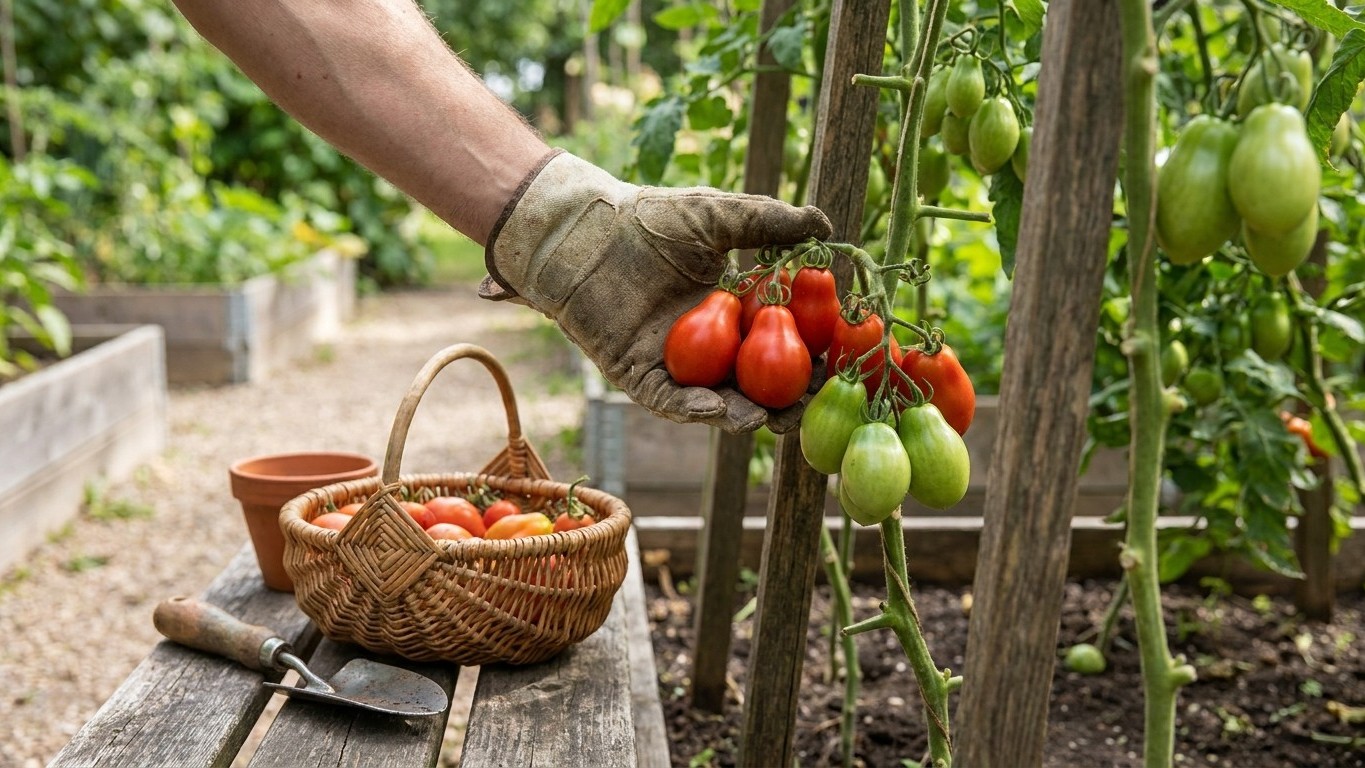

Tiren is a paste tomato bred for sauce and canning, and its defining trait is that it ripens to a translucent yellow-green skin instead of red, which means the usual color cue for picking time does not apply here. Seed catalogues list it at roughly 75 days to maturity, counted from the day you set transplants in the ground, not from the day you sowed seed indoors. Check your local frost-free window against that 80-day span before you commit a spot in the garden, and if the math is tight, start it under cover rather than direct in open ground.
What Tiren actually is

Tiren belongs to the paste category alongside familiar names like San Marzano and Roma, grown for meaty, low-moisture flesh that cooks down into sauce without watering it out. The fruit is oval to plum-shaped, and instead of coloring red as it ripens, it turns from deep green to a lighter, almost translucent yellow-green. That is a genuine catalogue trait, not a sign of an unripe or diseased plant, and it is the reason this variety trips up growers who are used to judging paste tomatoes like Granadero by color alone.
The vine habit is indeterminate, meaning it keeps growing and setting new trusses until frost stops it, rather than setting one flush of fruit and stopping like a determinate paste type. That changes the whole season’s workload: you are staking and pruning through summer, not harvesting once and pulling the plant. Days to maturity is listed at around 75 days from transplant by seed catalogues, and because germination and hardening off before transplant typically takes five to seven weeks on top of that, the total time from seed packet to first ripe fruit runs closer to four months. That figure is the same everywhere the seed is sold. Where it lands on your calendar depends entirely on your local frost dates, which is the arithmetic covered next.
What Tiren is good for
Paste tomatoes earn their keep through what they lack: water. Tiren’s flesh is dense and its seed cavities are small, so when you cut it open there is little of the watery gel that fills a slicing tomato. Put it in a pan and it breaks down into thickened sauce on its own, without an hour of simmering to drive off liquid. That same low moisture that makes a good sauce base is also why Tiren is the wrong tomato for a salad or a sandwich — sliced raw, it eats dry and mealy, with none of the juice a beefsteak sheds onto a plate.
The same qualities carry over into canning. Firm walls hold their shape through processing instead of collapsing into mush, and the low water content means jars pack more solid fruit and less liquid, which matters if you’re canning whole or halved rather than crushed. This is the same reason home canners reach for San Marzano or Roma: the category, not any single variety, is what makes canning practical.
Because Tiren is indeterminate, fruit doesn’t all ripen in one block the way it would on a determinate paste plant. Instead it comes in over the season as new trusses set, a few pounds at a time rather than one harvest heavy enough to fill a canner in a single day. If your goal is a big one-time batch of sauce or a full canning run, you may need to hold fruit in the refrigerator until you have enough, or run several smaller batches across the season.
Beyond sauce and canning, nothing about flavor, sweetness, or acidity is documented for this variety. Where a catalogue is silent, the honest answer is that it’s silent — the category tells you what the tomato is built to do in the kitchen, not what it tastes like on its own.
Where it ripens in time, and where it is a gamble
An 80-day indeterminate paste tomato needs a frost-free window comfortably longer than 75 days, because you lose roughly two weeks at the start waiting for soil to warm enough for transplants to take, and you want weeks of harvest afterward rather than a single close call before the first freeze. The margin that matters is what is left between the date the first fruit actually ripens and the date of the first fall frost. Under thirty days of margin, a single flush is all you get, and a cooler-than-average year erases even that.
The arithmetic, region by region
In Yukon, where Whitehorse’s growing season forces transplant in mid June and Tiren’s 75 days puts first ripe fruit in early September, the numbers run negative: fruit would ripen about eight days after Whitehorse’s typical first frost, so the season simply is not long enough outdoors, and Whitehorse also accumulates too few heat units across the year for this to change with a longer window. Nunavut‘s Rankin Inlet station comes out only slightly better, three days short, for the same reason.
Moving south, Alberta‘s Calgary station allows transplant in early June and puts first ripe fruit in mid August, which leaves 29 days before frost. That is enough for one real harvest window but not much slack, so a cold snap in late August takes most of the crop with it. Manitoba and Saskatchewan post slightly wider margins from their Winnipeg and Saskatoon stations, but both are graded for greenhouse or tunnel growing rather than open ground, because their season’s accumulated heat units run marginal even when the frost-free calendar looks adequate. A row cover or plastic mulch to bank extra warmth is what tips these from failure to a workable crop.
Contrast that with Houston’s station data for Texas, where transplant can go in from mid February to mid March and first ripe fruit shows up by late May, leaving on the order of 186 days before frost becomes a concern at all. New Orleans, representing Louisiana, runs even wider at roughly 223 days of margin. In both places frost is not the limiting factor for Tiren. What limits the season there is heat, which the next section covers.
| Territory | Reference station | Set out | First ripe | Margin to frost | Verdict |
|---|---|---|---|---|---|
| Yukon | Whitehorse | mid June | early September | -8 days | impossible outdoors |
| Nunavut | Rankin Inlet | early July | mid September | -3 days | impossible outdoors |
| Alberta | Calgary | early June | mid August | 29 days | risky, one flush |
| Manitoba | Winnipeg | early June | mid August | 33 days | greenhouse or tunnel |
| Washington | Seattle | mid March to early April | mid June | 151 days | comfortable |
| Texas | Houston | mid February to mid March | late May | 186 days | comfortable |
| Louisiana | New Orleans | early to late February | early May | 223 days | comfortable |
The two ways a season goes wrong
A long frost-free window on paper does not guarantee a good crop, and two limits explain most of the failures a frost table alone cannot predict. The first is a shortage of accumulated warmth. Tomato plants need sustained daytime and nighttime heat to move fruit through bloom, set, and ripening, and flowers generally fail to set fruit once nights drop below 50°F even if the calendar still shows weeks before frost. This is exactly what pushes Manitoba and Saskatchewan into greenhouse territory despite frost-free windows that look adequate on the surface. Northern nights simply do not carry enough sustained warmth for an 80-day indeterminate variety to keep setting new trusses reliably.
The second limit runs the opposite direction. Above roughly 86°F, tomato pollen goes sterile and flowers drop without ever setting fruit, regardless of how many months of frost-free season remain on the calendar. This is why growers in Texas, Louisiana, and other Gulf Coast climates plant a spring crop timed to finish before peak summer heat, then a second crop in early fall once temperatures ease, rather than counting on one continuous 200-day harvest. A vine can look healthy through the hottest stretch of summer and simply stop producing until the heat breaks.
For Tiren specifically, the northern heat deficit is the more serious constraint, because an 80-day indeterminate variety needs sustained warmth across a long stretch to keep cycling through blooms, not just a frost-free calendar. In the Deep South, the enormous margin to frost means splitting the season around the hot months is a manageable adjustment rather than a threat to the crop entirely, which is not true in the far north where the heat simply is not there to split around.
What it resists, and what it does not
Tiren carries catalogue resistance graded high against Verticillium Wilt and high against Fusarium Wilt race 1. High resistance means the plant strongly slows these soil-borne fungal diseases and often keeps producing where a susceptible variety would collapse, but it is not the same as immunity. A high rating still means occasional plants show symptoms under heavy soil pressure or prolonged wet conditions, so rotating tomato beds every few years remains worthwhile even with this resistance in place.
What the catalogue does not list matters just as much. Tiren has no published resistance to late blight, early blight, root-knot nematodes, or bacterial spot, so treat it as fully vulnerable to those and scout the same way you would for any unprotected variety. Watch for:
- Dark, water-soaked lesions spreading fast on leaves and stems, a sign of late blight
- Concentric brown rings on lower leaves working upward, typical of early blight
- Stunted, galled roots on plants pulled from suspect soil, indicating nematodes
- Sunken, leathery patches on the blossom end of fruit, which is blossom end rot from uneven calcium uptake rather than a pathogen at all
Because paste tomatoes carry a lot of fruit weight on relatively thin stems, blossom end rot in particular shows up more on Tiren than on smaller slicers, and it is a watering and calcium consistency problem, not something the plant’s disease resistance touches.
Growing it without the usual mistakes
Support and spacing
Because Tiren is indeterminate, it needs the same treatment as any tall-growing tomato that runs all season: a sturdy stake, cage, or trellis set at planting time, not added later once the vine is already sprawling. Give it more room than a compact determinate paste type like some bush Roma varieties, since it keeps throwing new growth and side shoots through the whole season. Pruning to two or three main leaders and tying them up as they grow keeps the fruit off the ground and improves airflow, which matters given the lack of blight resistance noted above.
Feeding and the color trap
Stop heavy nitrogen feeding once the first fruit sets. An indeterminate paste variety pushed hard with nitrogen keeps generating leafy growth at the expense of ripening the trusses already on the vine, and that delay is worse on Tiren than on a red-ripening variety because you cannot glance at the fruit and see it lagging by color the way you would with a normal paste tomato. Switch to a lower-nitrogen, higher-potassium feed once fruit is setting, the same shift recommended for most tomato varieties once they move from vegetative growth into fruiting.
The single biggest mistake growers make with Tiren is timing harvest by color, the same habit that works fine on a red slicer like Estiva but fails completely here. Learn the fruit by feel and by the shift from deep, opaque green to a lighter, slightly translucent yellow-green, and expect to pick a few days earlier than instinct says, since there is no bright red flag telling you that you waited too long.
Common questions
Why is my Tiren tomato still green when it should be ripe?
It is meant to stay green. Tiren ripens to a pale, translucent yellow-green rather than red, so check for slight softening at the shoulder and easy separation from the vine instead of waiting for a color change that will not happen.
Can I grow Tiren in a container on a patio?
You can, but its indeterminate habit means it will outgrow a small pot and need staking regardless. Use a large container, at least the size recommended for other tall indeterminate tomatoes, and plan on the same pruning and support work you would do in open ground.
Is Tiren the same thing as Green Zebra?
No. Green Zebra is a striped slicing tomato bred for fresh eating, while Tiren is an unstriped, plum-shaped paste type bred for sauce and canning. They share the green-when-ripe trait but belong to different use categories on the seed rack.
How many Tiren plants do I need for a batch of sauce?
There is no single number that holds everywhere, since yield depends on your season length and local growing conditions. Because it is indeterminate and keeps producing until frost rather than setting one bulk flush, growers often plant fewer Tiren vines than they would of a determinate paste variety to get a comparable total harvest. Check with your local extension office for yield estimates suited to your area.