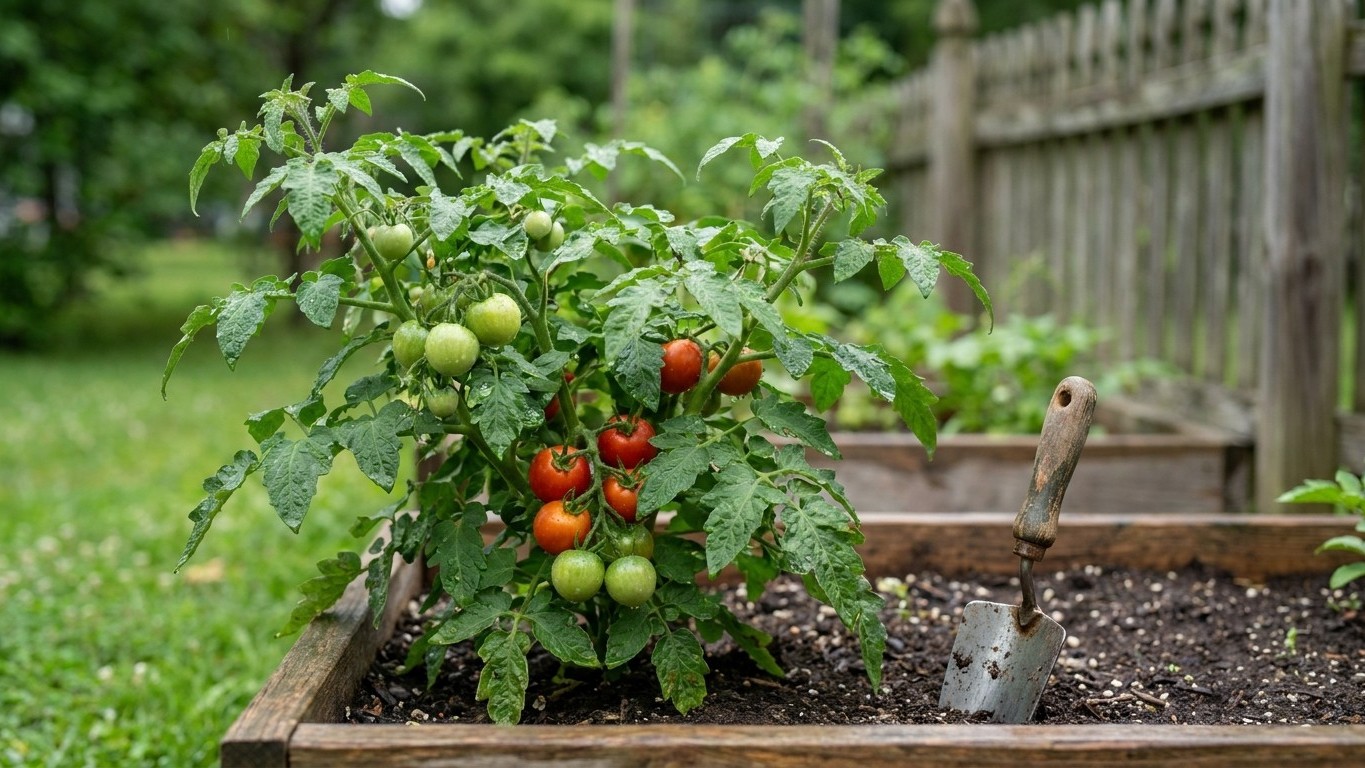

Defiant PhR is a determinate slicing tomato bred to shrug off late blight, and it matures in roughly 65 days from transplant according to its seed catalogue listing. That count starts the day a hardened-off seedling goes in the ground, not the day the seed was sown indoors. Because the plant sets nearly all its fruit in one concentrated flush rather than trickling slicers out all summer, the single thing to check before you plant is your area’s frost-free window against that 70-day clock, using your nearest weather station rather than a statewide average.
What Defiant PhR actually is

Defiant PhR is a determinate red slicing tomato, which means the plant grows to a set height, sets most of its flower clusters within a few weeks of each other, and then stops extending. The catalogue figure most sellers list is roughly 65 days from transplant to first ripe fruit, and that’s worth repeating because gardeners routinely confuse it with days from seed. Sow indoors, grow a stocky six-to-eight-week seedling, and only then does the 70-day clock start.
The habit changes how you stake it. A determinate plant rarely needs the tall stake-and-lean system that an indeterminate slicer such as the one described in our guide to Mortgage Lifter, a slicer that keeps producing until frost, demands. A single cage or a short stake set at transplant is usually enough, since the plant tops out at a modest height and does most of its growing before it starts to fruit.
Fruit runs medium to large for a determinate type, red-skinned, round, and firm enough to slice cleanly, with a meaty interior suited to sandwiches and canning rather than salads. Because the whole plant ripens together instead of stringing fruit out over months, a single Defiant PhR plant gives you a defined harvest window rather than a slow trickle, which is the detail that decides whether it suits a household eating tomatoes daily or one that prefers to can a batch and be done.
What Defiant PhR is good for
Slicing tomatoes carry more water in their flesh than a paste tomato, and that water sits inside distinct locular cavities separated by walls of firmer tissue. Cut a slice and those walls hold their shape instead of collapsing, which is why a round of Defiant PhR sits flat on a sandwich or under a burger patty without soaking through the bread in minutes. Push the same fruit through a saucepan and the opposite problem shows up: all that water has to boil off before the sauce thickens, so you end up simmering far longer than you would with a paste variety bred to be dense and low-moisture from the start. This is a tomato built to be eaten in slices, not reduced.
The determinate habit changes how that usefulness arrives. Because the plant sets and ripens its fruit in a compressed window rather than trickling it out over the season, you get a defined stretch of days where most of the crop is ready together. That timing matters more for canning than for fresh eating: a kitchen canning session needs a batch of ripe fruit on one day, not four tomatoes a week for
Where it ripens in time, and where it is a gamble
The maturity figure only means something once you set it against a frost-free window measured at a real weather station, because 65 days is a fixed distance and a growing season is not. Take the days between your area’s last spring freeze and first fall freeze, subtract roughly two weeks that the soil needs to warm before a tomato transplant will actually grow instead of sulk, then subtract Defiant PhR’s 65 days to first fruit. What’s left is the picking window, and if it comes out to under thirty days you’re down to one flush that a cool year can erase entirely.
Where the margin is thin
At the tight end, Yukon, tracked from the Whitehorse station, gives Defiant PhR just 2 days of margin between first ripe fruit and the first fall freeze, from a mid-June set-out to late-August fruit. That’s not a season with room for a cold snap. Nunavut, tracked from Rankin Inlet, is tighter still: 7 days of margin from an early-July set-out to early-September fruit. Both territories carry a second problem underneath the frost math. Whitehorse accumulates only around 600 growing degree-days across the year and Rankin Inlet closer to 159, and a 70-day tomato needs sustained warmth to reach that count, not just a frost-free calendar. In both places, a greenhouse or a poly tunnel is doing the real work, not the open ground.
Move to Northwest Territories, tracked from Yellowknife, and the frost-free window is friendlier: 37 days of margin from an early-June set-out to a mid-August first ripe fruit. Alberta, from the Calgary station, runs close behind at 39 days. Both still fall short on cumulative heat, Yellowknife around 905 degree-days and Calgary around 1171, and the catalogue verdict for both is the same: grow it under cover. Manitoba, tracked from Winnipeg, and Saskatchewan, from Saskatoon, post 43 and 44 days of margin and closer to 1800 and 1550 degree-days respectively, described as marginal rather than short. An early-maturing plant like Defiant PhR and a sheet of plastic mulch to warm soil sooner in spring can turn a marginal Prairie season into a working one.
Where the margin is wide
At the other end of the list, margin stops being the constraint at all. Washington, from the Seattle station, carries 161 days of margin from a mid-March to early-April set-out. South Carolina, tracked from Charleston, and Florida, from Jacksonville, run 169 and 185 days. Texas, from Houston, and Nevada, from Las Vegas, stretch to 196 and 231 days, and Louisiana, tracked from New Orleans, tops the list at 233 days with a set-out window running from early to late February. None of these gardens will lose Defiant PhR to frost. Their limit, covered next, is heat rather than cold.
| Territory (reference station) | Set-out window | First ripe fruit | Margin before frost |
|---|---|---|---|
| Yukon (Whitehorse) | mid June | late August | 2 days |
| Nunavut (Rankin Inlet) | early July | early September | 7 days |
| Manitoba (Winnipeg) | early June | early August | 43 days |
| Texas (Houston) | mid February to mid March | mid May | 196 days |
| Louisiana (New Orleans) | early to late February | late April | 233 days |
The two ways a season goes wrong
A long frost-free window is not the same thing as a season the plant can actually use, and two limits that never appear on a simple frost-date table can still cost the crop.
Cold without enough warmth
Tomato flowers stop setting fruit when night temperatures fall below 50F, and a plant can sit through weeks of mild days and still produce nothing if nights stay cold enough. That’s the trap in the northern territories above: a positive margin does not guarantee enough accumulated warmth to push a 70-day plant through bloom, fruit set and ripening on schedule. Yellowknife’s roughly 905 growing degree-days and Calgary’s roughly 1171 fall short of what a tomato needs regardless of how many frost-free days sit on the calendar, which is why the catalogue verdict for Northwest Territories and Alberta is grown-under-cover rather than in-the-open.
Heat that stops pollen
At the other end of the country, the limit flips. Above roughly 86F, tomato pollen becomes sterile and flowers drop without setting fruit, turning the hottest stretch of summer into dead time rather than peak season. In South Carolina, Florida, Texas, Nevada and Louisiana, that sterile stretch runs from late spring into early fall depending on the state, and growers there plant a spring crop timed to finish before the heat arrives, then a second crop after it breaks, rather than counting on one long season.
For a determinate variety maturing in roughly 65 days, the heat limit matters more in the deep South, the cold limit matters more on the Canadian side of this list. A 70-day plant is fast enough to slip a full crop into the spring window before southern heat shuts pollen down, an advantage a 90-day beefsteak doesn’t have. In the north, no amount of quick maturity fixes a shortage of accumulated heat, which is the real reason a tunnel or greenhouse shows up as the verdict rather than a later frost date.
What it resists, and what it does not
Defiant PhR was bred specifically around late blight, and its resistance to that disease is graded High, the reason the variety exists in most catalogues at all. It also carries high resistance to Verticillium wilt and to Fusarium wilt races 1 and 2, both soil-borne diseases that otherwise build up in a bed over years of repeat tomato planting.
Its resistance to early blight is graded Intermediate rather than High, and that distinction matters more than it looks. Intermediate resistance slows the disease, it does not stop it. A plant with intermediate early blight resistance can still develop the lower-leaf yellowing and dark concentric spots typical of the disease under wet, humid conditions, just more slowly and with less severity than a variety carrying no resistance gene at all. Treat the rating as a delay bought with good airflow and mulch, not a reason to skip fungicide rotation if the disease shows up in your area most years.
None of these four resistances touch septoria leaf spot, bacterial spot or spider mites, and the packet lists no claim against root-knot nematodes either. In a garden where any of those has been a recurring problem, Defiant PhR’s resistance package doesn’t cover you, and the usual sanitation and rotation practices still apply.
Growing it without the usual mistakes
Because Defiant PhR is determinate, the plant sets nearly all of its flower clusters within a few weeks and then commits its energy to filling out that fruit rather than continuing to grow taller and branch, the way an indeterminate slicer such as Tasmanian Chocolate, a chocolate-skinned slicer grown on a tall indeterminate vine, would. That changes two habits gardeners bring over from indeterminate varieties without thinking about it.
Don’t prune it like a vining tomato
Heavy suckering, the practice of pinching out every side shoot to force growth up a single leader, is standard advice for indeterminate tomatoes and a mistake here. Determinate plants like Defiant PhR carry a fixed number of flower clusters, and removing side shoots removes future fruit along with them rather than redirecting energy. Let the plant branch naturally inside a cage and skip the sucker removal entirely.
Stop feeding once fruit sets
Nitrogen pushed on after the plant sets its first fruit clusters buys a bushier plant and nothing else, because a determinate variety has already decided how many trusses it’s going to carry. Feed hard during the vegetative stage before flowering, then taper off once the first fruit swells, and put what a longer-season indeterminate would spend on months of continued growth toward potassium instead, which supports the fruit already on the vine.
Plan for a glut, not a trickle
The whole point of this variety’s timing is that it ripens together, which catches gardeners used to tomato varieties that trickle fruit out from midsummer to frost. Set out more than one or two plants and you’ll have far more ripe slicers than a household can eat fresh for a week or two, so line up the canner, the sauce pot or the neighbors before the harvest lands, not after.
Common questions
How many Defiant PhR plants do I need for canning?
There’s no fixed number that holds across regions, since yield per plant shifts with heat, water and soil. Start with a modest count, two or three plants for a household that cans a few batches, and adjust the next year once you’ve seen how one flush from your own garden fills a canner.
Can I direct-seed Defiant PhR instead of starting it indoors?
You can, but the 70-day maturity figure assumes a transplant, not a seed dropped straight in the ground. Direct-seeding pushes the harvest weeks later and, in a short-season area, can run the plant straight into fall frost. Start seed indoors and check your state extension service for the recommended timing before your last spring freeze.
My Defiant PhR has yellow lower leaves with dark rings, is that late blight?
Probably not, since the variety’s late blight resistance is graded High and that disease tends to show up as fast-spreading dark, water-soaked patches on leaves and stems rather than slow yellowing. Concentric dark rings on lower leaves that climb the plant over weeks look more like early blight, which Defiant PhR only slows rather than stops.
Is Defiant PhR a hybrid, and can I save the seed?
Yes, it’s bred as an F1 hybrid, which means seed saved from this year’s fruit won’t reliably grow into the same plant next year. The disease resistances in particular can scatter in the next generation, so buy fresh seed each season rather than saving your own.