
Mortgage Lifter is a large pink-red beefsteak heirloom, and seed catalogues list it at roughly 80 to 95 days from transplant to first ripe fruit, not from the day you sow the seed. That single number decides almost everything else on this page: whether your growing season has room for it, and whether you get a full season of fruit or one anxious flush before frost. Before you set plants out, pull your local frost-free window from NOAA’s climate normals or your state extension service and count backward from it using the arithmetic below.
What Mortgage Lifter actually is

Mortgage Lifter is an indeterminate heirloom tomato, which means the vine keeps growing and setting new trusses until frost or disease stops it, rather than ripening one flush and quitting. Catalogue listings put it at 80 to 95 days from transplant to first ripe fruit, and that figure assumes a healthy transplant going into warm soil, not a seed started from scratch. Sown from seed, add the six to eight weeks most gardeners spend growing a transplant indoors before that clock even starts.
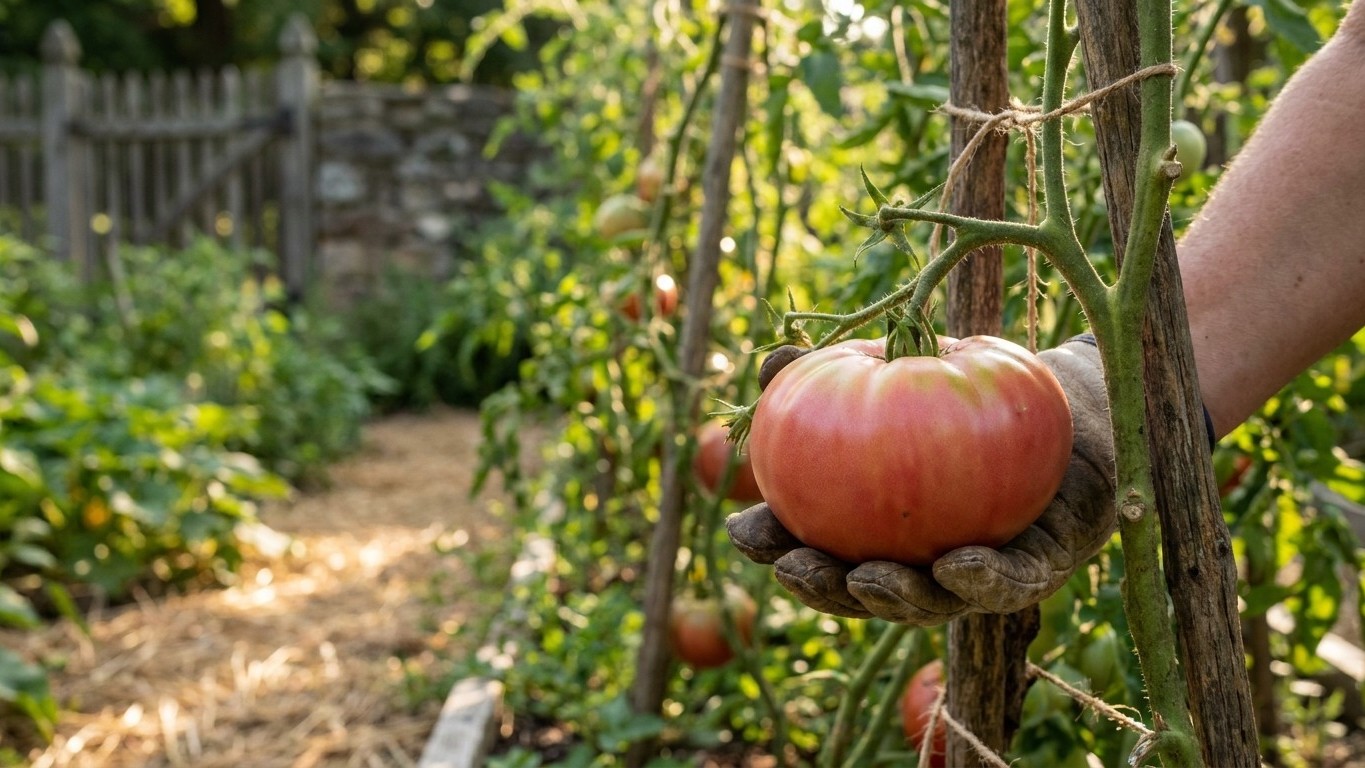
The fruit is the reason people grow it despite the wait. Mortgage Lifter produces large, meaty, pink-to-reddish Beefsteaks that commonly run a pound or more, with some reported well over two pounds, and a low seed count that makes them a slicing tomato first and a canning tomato a distant second. Because it is indeterminate and heavy-fruited, it needs a sturdy support structure from the start, not something added after the plant leans. If you’re weighing it against a shorter-season slicer, Oregon Spring ripens its whole crop in one earlier window instead of stretching across the season the way Mortgage Lifter does.
What Mortgage Lifter is good for
A slicing tomato carries more water in its flesh than a paste tomato, and that water has to go somewhere. Cook it down and it releases liquid into the pan, thinning a sauce instead of thickening it — you’d be simmering off water for a long time to get the paste-like body a Roma gives you almost for free. Slicers like Mortgage Lifter carry more water and less flesh than paste tomatoes, so they thin out a sauce and disappoint in the stockpot while that same juiciness is exactly what makes them satisfying on a sandwich. Mortgage Lifter, being a slicer, is built for the raw side of the kitchen rather than the stockpot.
What that means in practice is a knife and bread, not a pot. A fruit this size yields one or two slices wide enough to cover a piece of toast edge to edge, so a single tomato can carry a sandwich or a burger on its own instead of needing three smaller ones stacked to get coverage. The same size works against it in a mixed salad, where a tomato this large has to be cut down rather than halved or quartered like a smaller fruit would be — it’s a tomato you build a plate around, not one you toss into a bowl.
What is published is that the fruit is meaty and carries an heirloom character: dense flesh rather than a wall of juice, which is what makes it a tomato you slice onto a plate rather than one you cook down. What the category does support is texture: dense, low-seed flesh that holds together in a slice instead of collapsing into juice and seeds when you cut it, which is the trait that makes a tomato worth eating raw in the first place rather than a texture you’d only tolerate cooked down.
Where it ripens in time, and where it is a gamble
The arithmetic is the same everywhere, only the numbers change. Take your local frost-free window, subtract roughly two weeks for the soil to warm enough that a tomato transplant doesn’t just sit there, then subtract Mortgage Lifter’s 80 to 95 days to first fruit. What’s left is your picking margin, the days between first ripe fruit and the season’s end. Under thirty days of margin means one flush of fruit, and a cool year can take even that.
Where the margin runs thin
In Alberta, using Calgary as the reference station, growers set out around early June and see first ripe fruit near early September, leaving about 9 days of margin before frost closes the season. That’s a single wave of fruit at best, and Calgary’s roughly 1,171 accumulated degree-days for the year run short for a variety this size regardless of how long the frost-free stretch runs. In Northwest Territories, Yellowknife’s numbers work out to about 7 days of margin, essentially the same story: one harvest push, no room for a slow spring. Further into truly short seasons, Yukon (Whitehorse) and Nunavut (Rankin Inlet) run into negative margin entirely, meaning the first ripe fruit would land after the first frost even under the earliest realistic set-out date. That isn’t a scheduling problem a gardener can fix with better timing. It’s a shortfall in the season itself, and it calls for a greenhouse or high tunnel rather than an open bed.
Where the margin is generous
Contrast that with Texas, where Houston’s frost-free window is long enough to set out mid-February to mid-March and still see roughly 166 days of margin after first ripe fruit in mid-June. Nevada, using Las Vegas, runs even wider at about 201 days of margin from a late-January to mid-February set-out. In both cases the arithmetic isn’t tight at all. The frost date stops being the limiting factor, and a different problem takes over in mid-summer, which the next section covers.
| Territory | Reference station | Set out | First ripe | Margin | Verdict |
|---|---|---|---|---|---|
| Yukon | Whitehorse | mid June | late September | -28 days | impossible outdoors |
| Alberta | Calgary | early June | early September | 9 days | risky, one flush |
| Saskatchewan | Saskatoon | early June | early September | 14 days | risky, one flush |
| Washington | Seattle | mid March to early April | early July | 131 days | comfortable |
| Texas | Houston | mid February to mid March | mid June | 166 days | comfortable |
| Nevada | Las Vegas | late January to mid February | late May | 201 days | comfortable |
The two ways a season goes wrong
A long frost-free window is not the same thing as a good tomato season, and Mortgage Lifter exposes both failure modes because it needs so much from the season to begin with.
In the north, the problem is accumulated warmth, not just the count of frost-free days. A location can have enough calendar days between frosts on paper and still fall short on the heat units a large beefsteak needs to actually fill out, because tomato flowers stop setting fruit reliably once nights drop below 50°F, and cool nights are common at both ends of a short season. Calgary’s roughly 1,171 degree-days and Yellowknife’s roughly 905 degree-days are both on the short side for an 80-to-85-day beefsteak, which is why a plastic mulch to hold soil heat and the earliest realistic transplant date both matter more here than the frost date alone suggests.
In the south, the limiting factor flips entirely. Once temperatures climb above roughly 86°F, tomato pollen goes sterile and flowers drop without setting fruit, which is why growers in Texas, Florida and Louisiana effectively run two tomato seasons, a spring crop and an autumn crop, rather than one continuous run. For Mortgage Lifter this cuts harder than it does for a fast slicer, because 80 to 95 days to first fruit already eats most of a spring window before the heat shuts pollination down, leaving less margin to get a real harvest in before the plant goes into its summer stall.
Between the two, the heat limit is the one that actually matters for this variety in most of the country it’s grown in, since Mortgage Lifter’s long maturity window means it’s rarely planted in the shortest-season territories to begin with, but it’s planted constantly across the mid-South and warm South where the mid-summer sterility window is the real obstacle to a full crop.
What it resists, and what it does not
Mortgage Lifter carries no disease-resistance letter codes on seed packets or in catalogue listings, unlike modern hybrids bred with verticillium, fusarium or nematode resistance built in. That’s typical of heirloom varieties, which were selected for flavor and size long before resistance breeding existed, and it’s a real practical cost, not a footnote.
In the garden this means Mortgage Lifter is as susceptible as any unimproved heirloom to early blight and Septoria leaf spot, both of which show up as spotting on lower leaves working upward through a wet summer, and to soil-borne verticillium and fusarium wilts where those pathogens are already present in the ground. Its dense, sprawling indeterminate foliage also holds humidity around the lower canopy longer than a compact determinate plant would, which gives foliar disease more of a foothold once it starts.
None of this makes the variety a poor choice. It means the grower has to do the resistance breeding did not, through crop rotation, mulch to keep soil-borne spores from splashing onto leaves, and pruning the lower foliage for airflow. If disease pressure in your soil is already a known problem, that’s worth weighing before committing a season to a variety with no built-in defense, rather than after the first blighted leaves show up.
Growing it without the usual mistakes
Support and spacing
Because Mortgage Lifter is indeterminate and produces unusually heavy fruit, a tomato cage sized for an average slicer will not hold it past midsummer. A cattle panel trellis, a Florida weave on sturdy t-posts, or a stake-and-tie system built for real weight all work better than a standard cage. Give it more room than a compact variety, since the vine keeps extending and leafing out all season rather than settling into a fixed size early.
Feeding and timing
Stop nitrogen-heavy feeding once the plant is setting fruit well, since Mortgage Lifter’s tendency toward vigorous vine growth will keep pushing leaves at the expense of fruit if you keep feeding it as though it were still establishing. In regions with a genuinely long season, many growers top the plant, cutting the growing tip, several weeks before their expected first frost so the plant redirects energy into ripening the fruit already on the vine instead of setting new trusses that won’t have time to mature.
Watering and cracking
Large Beefsteaks crack more visibly than smaller fruit when watering is irregular, particularly after a dry spell followed by heavy rain or a big watering. Consistent soil moisture, helped by mulch, matters more for this variety than for a cherry type like Attracta, where smaller fruit tolerates swings in moisture without splitting. If you’re new to growing slicers at all, it’s worth reading a general primer on tomato varieties before committing bed space to one that demands this much structure and attention over a full season.
Common questions
Is Mortgage Lifter determinate or indeterminate?
It’s indeterminate. The vine keeps growing and setting new fruit clusters until frost or disease stops it, which is why it needs tall, sturdy support rather than a short cage, and why it keeps producing over a long stretch instead of ripening all at once.
Why are my Mortgage Lifter flowers dropping without setting fruit?
Blossom drop usually means temperatures outside the range tomatoes need to set fruit, either nights too cool in a short-season area or daytime heat pushing past the point where pollen goes sterile in warmer regions. Check which end of that range fits your recent weather before assuming disease or a nutrient problem.
How many tomatoes will one Mortgage Lifter plant produce?
Fruit count runs lower than a cherry or small slicer because each tomato is so large, often a pound or more, so the plant puts its energy into fewer, bigger fruit rather than a high count. Total yield depends heavily on how long your season lets the vine keep setting new trusses after first ripe fruit.
Can I grow Mortgage Lifter in a container?
Not easily. Its indeterminate habit and heavy fruit load want a deep root run and a sturdy in-ground trellis, and a container large enough to support that is impractical for most gardeners compared to a determinate variety bred for pot culture.