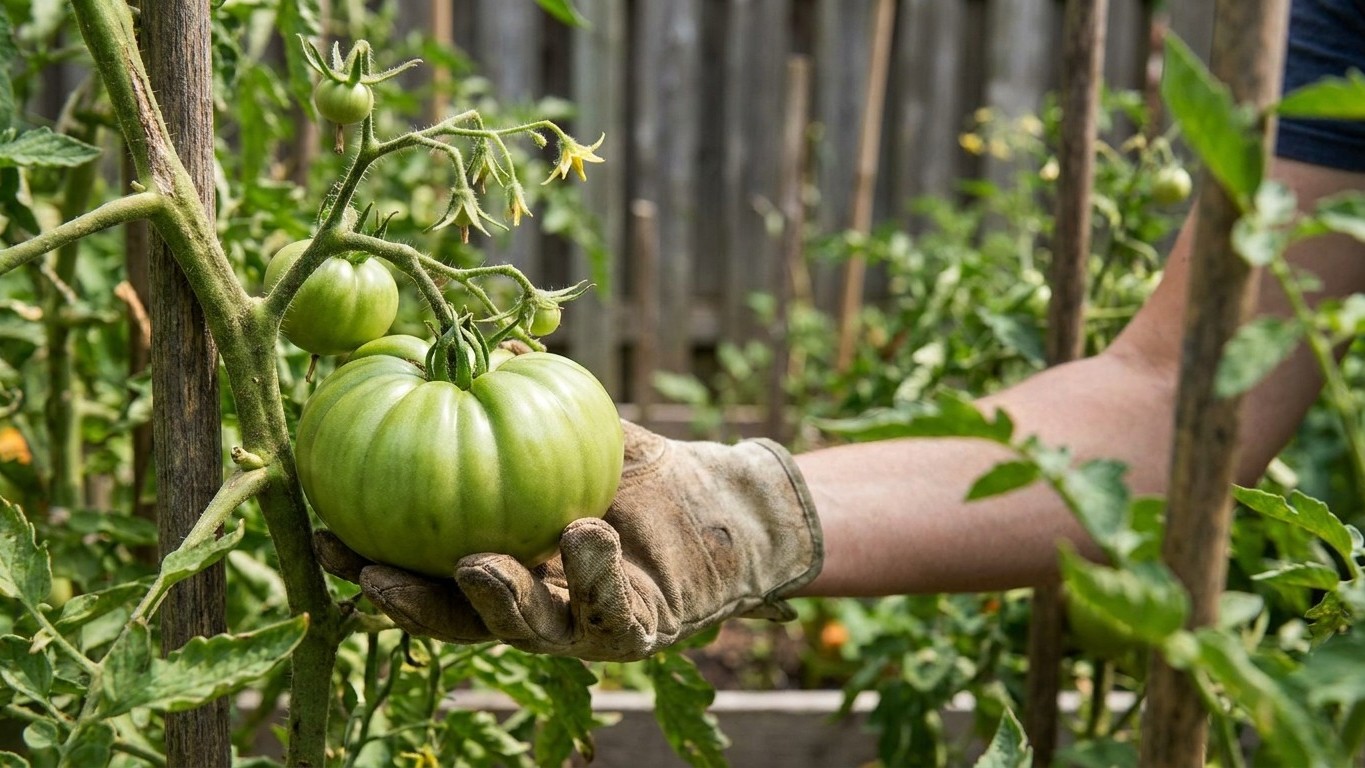

Eighty days sounds like a promise Unity doesn’t quite keep. That number on the seed packet starts counting only once a seedling goes into the ground, not when you sow it, so the plant’s real timeline to a ripe beefsteak stretches closer to three months. Unity is an indeterminate grower, too, meaning it never stops pushing new trusses of fruit until frost stops it for you — which is exactly why the green tomatoes at season’s end aren’t a failure, just unfinished business.
What Unity actually is

Unity is an indeterminate beefsteak tomato, bred to keep producing large slicing fruit until frost rather than dropping one big flush and quitting. Most seed catalogs list it at around 70 days from transplant, and that count starts the day you set a started plant into the garden, not the day you sowed the seed indoors. Add another four to six weeks for a seedling to reach transplant size and the real span from seed packet to first ripe tomato runs closer to three months.
The fruit itself is the reason most gardeners grow it: large, red, meaty beefsteak-type tomatoes with the dense flesh and small seed cavities that make a good sandwich slice or a sauce that does not run watery. Because the plant is indeterminate, it keeps growing a vine instead of stopping at a fixed height, and it keeps setting new trusses of fruit through the season as long as conditions allow. That habit is the whole story of this page: an indeterminate beefsteak with an 80-day clock needs both a long enough frost-free window and enough real heat to fill that window, and those two things do not always travel together. If Unity’s size and support needs do not fit a small garden, the broader list of tomato varieties includes more compact options bred for containers or short rows.
What Unity is good for
A beefsteak’s flattened shape packs its walls with wide slabs of solid flesh around a small core of seed gel. The fruit grows large and flattened, with wide walls of solid flesh around a small core of seed gel, so a cross-section is mostly meat rather than juice pockets. That is what makes it a slicing tomato: cut a thick round and it holds its shape on a sandwich or a burger instead of sliding off in a puddle, and a salad gets a piece with real bite instead of collapsing into seeds and water.
That same structure works against it in a stockpot. A paste tomato earns its name by carrying less water per gram of flesh, so a panful reduces to sauce on its own heat with little standing liquid to boil off. A beefsteak carries more water in that flesh, so a batch of Unity cooked down for sauce will throw off more liquid first and need a longer simmer to thicken, even though the dense walls mean less of that liquid comes from empty cavities than a watery slicer would produce. It can be sauced, but it is not shaped for it, and the plant was not bred for it either.
The indeterminate habit adds to the kitchen picture in its own way: rather than one heavy flush of fruit ripening together, which
Where it ripens in time, and where it is a gamble
An 80-day tomato needs its transplant date set early enough that the countback to frost still leaves picking time, and the gap between “technically frost-free” and “actually got 80 warm days” is where a lot of gardens lose a Unity crop. The arithmetic is simple to redo for your own address: take your area’s frost-free window, subtract the two or so weeks the soil usually needs after the last frost to warm enough for a tomato transplant to actually grow, then subtract the 70 days to maturity. Whatever days are left are the days you actually get to pick ripe fruit before the first fall frost.
Where the margin runs out
Frost data for Whitehorse, Yukon, puts Unity’s set-out around mid June with a first ripe date near late August, which leaves the fruit ripening about three days after the average first frost, a negative margin. That is not a slow season, it is a season that does not close in time at all, and the same station’s year totals only around 600 accumulated degree-days, well short of what an 80-day beefsteak needs regardless of frost. A greenhouse or high tunnel is the only route to a ripe Unity there. Rankin Inlet, Nunavut, is only marginally kinder: a set-out in early July and first ripe around mid September leave a two-day margin, meaning a single flush of fruit, and a cool year takes even that.
Move south into the prairie provinces and the picture improves but does not clear. Yellowknife, Northwest Territories, and Calgary, Alberta, both run margins in the low thirties of days, but both are flagged for greenhouse growing because the season’s total accumulated heat, not the calendar, is the limiting factor. Winnipeg, Manitoba, and Saskatoon, Saskatchewan, do a little better again, with margins in the high thirties, but the heat accumulation there is still described as marginal. An early-maturing companion variety and a sheet of plastic mulch to warm the root zone are the kind of changes that tip those results.
Where the margin is generous
Contrast that with Seattle, Washington, where the frost-free window is wide enough to set Unity out from mid March to early April and still see first ripe fruit by early June, a margin of about 156 days, plenty of room even for a slow beefsteak. Houston, Texas, Jacksonville, Florida, and New Orleans, Louisiana, all post margins well over six months, and Las Vegas, Nevada, over seven. In those places the frost clock is not the constraint at all. What limits Unity there is covered in the next section.
| Territory (reference station) | Set out | First ripe | Margin | Verdict |
|---|---|---|---|---|
| Yukon (Whitehorse) | mid June | late August | -3 days | Not viable outdoors |
| Nunavut (Rankin Inlet) | early July | mid September | 2 days | High risk, one flush |
| Saskatchewan (Saskatoon) | early June | early August | 39 days | Greenhouse recommended |
| Washington (Seattle) | mid March to early April | early June | 156 days | Comfortable |
| Texas (Houston) | mid February to mid March | late May | 191 days | Comfortable |
| Louisiana (New Orleans) | early February to late February | early May | 228 days | Comfortable |
Check your own frost dates against the closest official weather station’s climate record before locking in a set-out date, since a single city’s figures never cover a whole state evenly.
The two ways a season goes wrong
A frost-date table only measures one kind of risk. It tells you when the killing cold arrives, not whether the days in between actually did the work of ripening a tomato. Unity runs into both of the limits that a frost calendar cannot show, and they sit at opposite ends of the map.
Not enough heat, even with enough days
In the northern Territories, the frost-free window can look almost workable on paper, Alberta’s 34 days of margin or Manitoba’s 38, and still fail, because a tomato needs accumulated warmth, not just frost-free days, to actually push 70 days of growth to a ripe fruit. Nights below roughly 50°F stall pollination outright, and a string of them early in the season can cost a plant its first, biggest truss before it ever sets. That is the reason the greenhouse verdict shows up even where the calendar margin is not negative: the calendar has room, the thermometer does not.
Too much heat, in the middle of summer
In the Gulf Coast and desert states the opposite problem takes over. Once daytime temperatures push past about 86°F, tomato pollen goes sterile and flowers drop without setting fruit, which is why growers in Houston, Jacksonville, New Orleans and Las Vegas run a spring crop and a separate fall crop rather than one long summer season. Given Unity’s 80-day span, that pollen-drop window matters less to it than the northern heat deficit does. A grower there simply times the spring planting to finish before the sterile stretch begins and starts a second round of transplants once the worst of the heat has passed, the same trick used with a faster-maturing type like Indigo Cherry Drops to keep cherry tomatoes coming through a hot summer.
What it resists, and what it does not
Unity’s catalog listing credits it with high resistance to three diseases that end a tomato season early: late blight, verticillium wilt, and fusarium wilt race 1. High resistance means the plant slows or largely shrugs off infection under normal pressure, not that it is immune. A wet, cool season with heavy late blight pressure in the neighborhood can still put lesions on a Unity plant, just fewer and later than on a susceptible variety planted next to it.
| Disease | Resistance grade | What that means in the garden |
|---|---|---|
| Late blight | High | Fewer, later lesions under heavy pressure, not full protection |
| Verticillium wilt | High | Soil-borne wilt is suppressed, but rotate anyway since the fungus persists in soil for years |
| Fusarium wilt, race 1 | High | Protects only against race 1, not races 2 or 3 |
What the catalog does not list matters just as much. Unity carries no listed resistance to early blight, septoria leaf spot, or root-knot nematodes, three problems that show up in the same warm, humid conditions late blight likes. Fusarium resistance here covers only race 1, so a field with a history of race 2 or 3 fusarium wilt gets no benefit from this variety at all. Treat Unity’s resistance package as a head start against three specific, named problems, not as blanket protection, and keep the usual rotation, mulching and sanitation habits in place regardless.
Growing it without the usual mistakes
Because Unity is indeterminate, it needs a support structure built for a plant that keeps growing all season rather than stopping at a fixed size. A single stake will not hold a full-season vine loaded with beefsteak fruit. A sturdy cage, a Florida weave, or a trellis with regular tying is the realistic choice, and it needs to go up at planting time rather than get added after the vine has sprawled.
Feed it early, stop feeding it on time
Indeterminate beefsteaks reward steady feeding through the first half of the season, but nitrogen kept up too late pushes new vine growth at the expense of ripening the fruit already set. Once the calendar shows about six to eight weeks left before the average first frost, cut back nitrogen and let the plant focus on finishing what it already has.
Handling the green fruit at the end
The timing mistake specific to an 80-day beefsteak like Unity is planting it where the season runs close to that length and then hoping the last trusses ripen anyway. They usually do not. About four weeks before your area’s expected first frost, top the plant, cutting off the growing tip and any new flower clusters, so it stops starting fruit it cannot finish and redirects that energy into the tomatoes already sizing up. When frost is close, pick every mature-green fruit, the ones that have reached full size and a pale, waxy sheen rather than a hard, dark green shine, and bring them inside.
- Ripen mature-green fruit in a single layer, out of direct sunlight, at room temperature, checking every few days.
- A paper bag with a ripe banana or apple speeds the process by concentrating the ethylene the fruit gives off.
- Fruit that is still hard and dark green rarely ripens well and is better used fried, pickled, or in green tomato relish.
For a warmer garden with room for a second beefsteak, pairing Unity with a variety like Big Beef Plus, which carries its own disease package and a slightly different schedule, spreads the risk if one crop runs into trouble.
Common questions
Can I grow Unity in a container?
Not comfortably. Unity’s indeterminate habit means a full-size vine that runs several feet and keeps growing all season, so it needs a large, deep container with a sturdy cage rather than a hanging basket or small pot. If container growing is the plan, a bushier determinate type is a better fit.
Is Unity a hybrid, and can I save the seed?
Check your seed packet, but a resistance package this specific, high grades against three named diseases, is typical of an F1 hybrid rather than an open-pollinated variety. Seed saved from a hybrid tomato will not grow true to type the following year, so buy fresh seed or transplants each season if Unity is what you want to repeat.
Why did my Unity plant stop setting fruit in mid-summer?
Most likely heat, not disease. Once daytime temperatures climb past the mid-80s Fahrenheit for a stretch, tomato pollen goes sterile and flowers drop without forming fruit, a normal seasonal pause rather than a plant problem. Fruit set usually resumes once nights cool back down.
My Unity beefsteaks are splitting on the vine. What’s wrong?
Cracking on a beefsteak like this is almost always uneven watering rather than a disease or a variety flaw. A dry stretch followed by a heavy soak or rain makes the fruit swell faster than the skin can stretch. Consistent watering and a layer of mulch to even out soil moisture cuts down on it considerably.