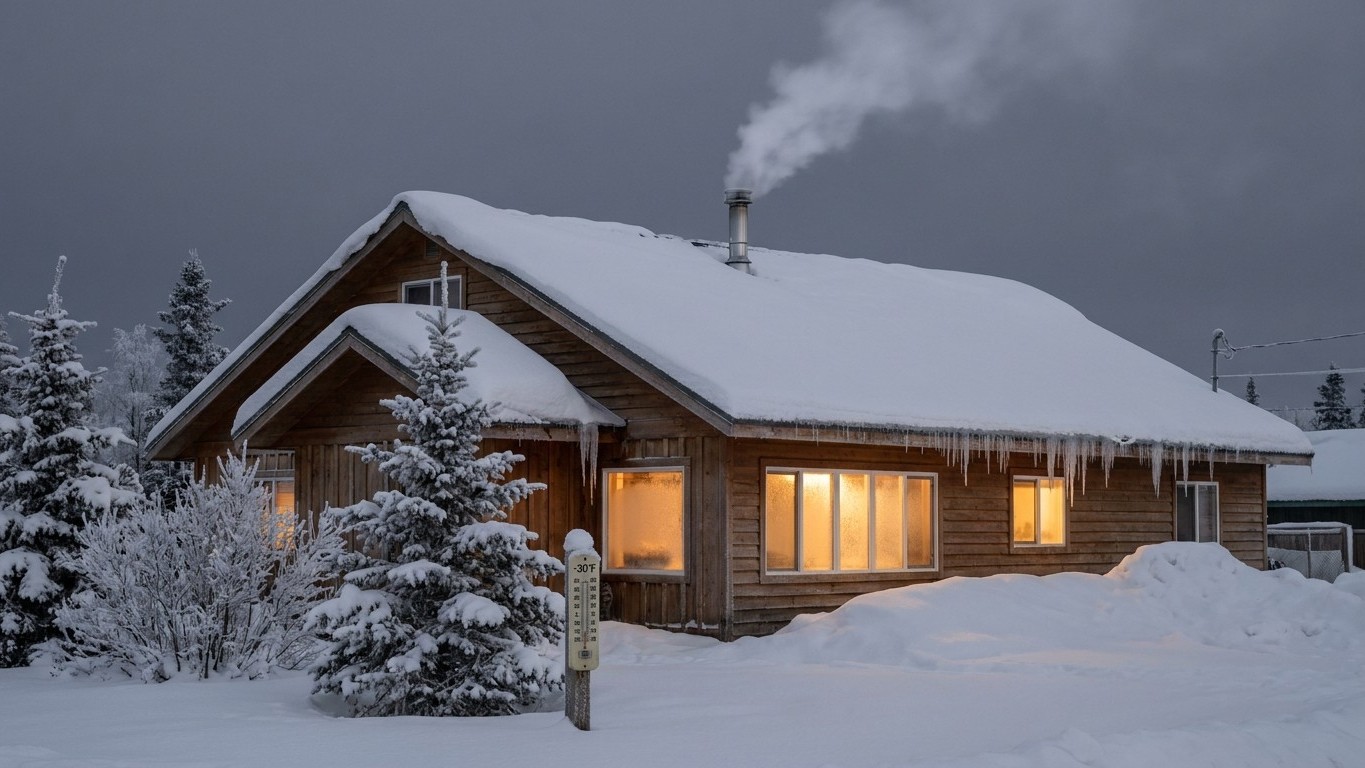

Anchorage’s coldest month has an average daily minimum of 11°F. That single number explains why heating this state runs so different from heating a home almost anywhere else in the country: it’s not just about how low the mercury goes, it’s about how long it stays down there and how hard your system has to work through the whole stretch.
How cold it gets, and for how long

Eleven degrees isn’t the record low for Anchorage, and it isn’t some blended average that flattens the picture. It’s the mean daily minimum for the coldest month, per NOAA’s 1991-2020 Climate Normals. That means on a typical night in that month, the temperature is dropping to around 11°F as a matter of course, not as some rare cold snap. Half the nights in that stretch will run colder than that.
What that does to a house is straightforward: the heating season here isn’t a six-week inconvenience, it’s a five- or six-month commitment. When Does the Heating Season Start in Alaska? The answer, in most southern parts of the state, is October, when a furnace or wood stove stops cycling on for the occasional cold week and starts running hard, day after day, through March or later depending on elevation and how exposed the site is to wind.
Compare that to a place where the coldest month bottoms out in the mid-20s. That’s a milder problem on paper, and it looks similar if you only glance at the number. But the difference between 25°F and 11°F isn’t 14 degrees of inconvenience. It’s the gap between a heating system that occasionally struggles and one that has to be sized, insulated, and fed correctly or it simply won’t keep a house livable. Pipes need deeper protection. Attics and crawl spaces need real air-sealing, not the token weatherstripping that works in a milder climate. And any wood-burning setup needs to produce serious, sustained heat output, because there’s no room for a stove that only handles the shoulder season, a factor worth weighing when figuring out When Can You Turn the Heat Off in Alaska?
This is also why heating costs in Alaska get compared less to seasonal totals and more to raw duration. A household here isn’t asking “how many cold nights will I have this year.” It’s asking “how many months will the furnace run essentially every day,” and the answer, given an 11°F coldest-month minimum, tends to be most of them.
What a cord of wood is worth here
If wood heat is part of the plan, the first thing to get straight is what you’re actually buying. A cord is a volume, not a weight: a stack measuring 4 feet by 4 feet by 8 feet, or 128 cubic feet total. That’s it. Nothing in that definition says what species is in the stack or how dry it is, which is exactly how buyers get shorted. A cord of dense hardwood and a cord of soft, punky wood take up the same space on the ground, but they don’t deliver anywhere near the same heat.
Michigan State University Extension puts a number on well-seasoned hardwood: about 20 million BTU per cord. To make that concrete, MSU frames it against fuel oil and propane. One cord of good seasoned hardwood is roughly equivalent to 145 gallons of #2 fuel oil, or 215 gallons of LP gas. That’s a useful yardstick for anyone trying to figure out how many cords a long Alaska heating season is actually going to eat through, especially once you know that season is running five-plus months rather than eight or ten weeks.
None of that 20 million BTU figure holds if the wood is wet. That’s the part that trips people up. Wood fresh off the tree, “green,” can carry over 60 percent moisture. Before that wood gives you a single BTU of usable heat, it has to boil off all that water, and boiling water takes energy, specifically the energy you were trying to burn for heat. So a cord of green wood isn’t a slightly weaker version of a cord of seasoned wood. It’s a cord that spends much of its potential heat drying itself out in your firebox, leaving less for your house.
That’s why seasoning time matters as much as the species you buy, maybe more, and it’s worth understanding before you order a cord for an Alaska winter rather than after.
How long wood takes to dry in Alaska
The target, according to MSU Extension, is 20 percent moisture or less. Below that, wood burns clean and hot. Above it, you’re fighting the water problem described above, and the losses scale with how wet the wood still is.
Getting from green (over 60 percent moisture) down to that 20 percent target generally takes one full summer, provided the wood is split and stacked so air can move through the pile. That last part isn’t optional. Rounds left whole, or wood piled in a solid heap with no airflow, will still be wet well after a summer has passed. Splitting exposes more surface area and stacking with gaps lets air do the drying work; skip either step and the clock basically resets.
There’s a named exception worth knowing if it’s available in your area: red oak. MSU flags it specifically because its cell structure holds moisture longer than other species, so it needs more time than a single summer to get down to burnable moisture. If red oak is part of a wood supply, treat “one summer” as a floor, not a guarantee.
Burn wood before it’s actually seasoned and you don’t just get a weaker fire. You get less usable heat for the same amount of wood burned, which in a state where the heating season already runs long means buying and hauling more cords than necessary. And the moisture doesn’t just vanish quietly. Wet wood burns cooler and produces more creosote, the tarry residue that builds up inside a flue. More creosote means a chimney that needs sweeping sooner, and a higher risk profile for chimney fires if that maintenance gets put off. None of this is exotic; it’s the direct, mechanical consequence of trying to burn water along with wood.
Where to check before you buy
Everything above is anchored to Anchorage, the reference station behind the NOAA figures used here. Alaska spans an enormous range of elevation, coastal exposure, and interior continental cold, and a homestead a few hundred miles away, or a few thousand feet higher, can face a meaningfully different winter than the one described by that single reference point.
Species availability also shifts by region: what’s common firewood near a coastal town isn’t necessarily what’s stacked in an interior valley, and seasoning behavior can vary with local humidity and summer heat, not just the species itself.
On top of that, burn restrictions are a real factor in parts of the state, particularly where wood smoke and air quality intersect during winter inversions. Those rules are set locally, and they change from year to year, so a restriction that applied last winter isn’t a safe assumption for this one.
For both of those questions, species availability and current burn guidance, the right first stop is the University of Alaska Fairbanks Cooperative Extension Service. It’s the state’s land-grant extension resource, and it’s built specifically to answer the local version of the questions this article covers in general terms.
What each heat source costs to run in Alaska
At Alaska’s average residential prices, this is what one million Btu of heat delivered into the house costs with each system. It compares fuels on the same unit: it is not a yearly bill, and it leaves out the price of the equipment.
| System | Cost per million Btu delivered |
|---|---|
| Electric resistance (baseboard, 100% efficient) | $79.40 |
| Heat pump at 8.1 HSPF2 (seasonal COP about 2.4) | $33.44 |
| Natural gas furnace at 97% AFUE | $12.88 |
Cheapest to run in Alaska: natural gas furnace, $20.56 less per million Btu than the heat pump.
Prices: U.S. Energy Information Administration (EIA), average residential prices. Efficiencies: ENERGY STAR criteria. A heat pump’s figure is a seasonal average; in the coldest weather its efficiency drops.