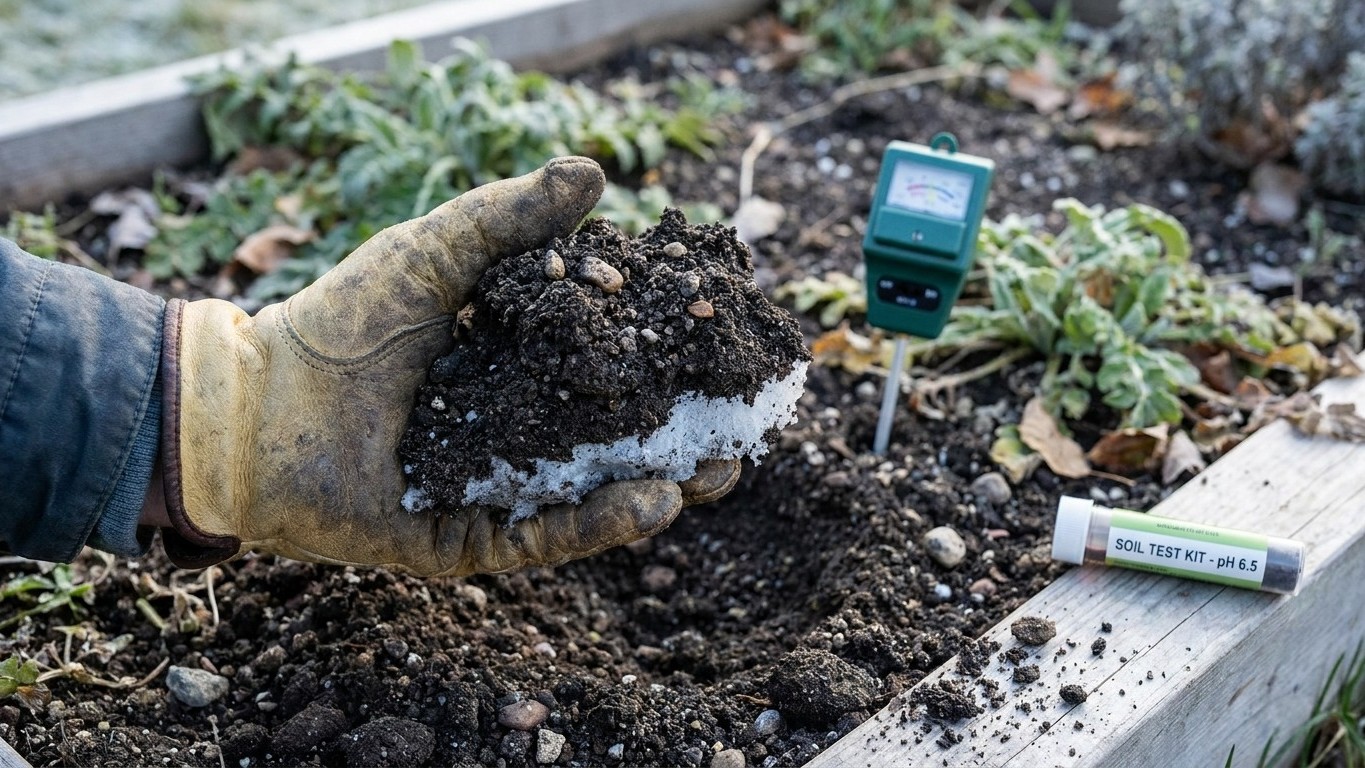

Northwest Territories garden soil is almost always a Cryosol: a loam-to-silt mix sitting over permafrost, well drained at the surface but shallow in the season it actually lets roots work. No official median pH exists for this ground, which means the only honest starting point is a test, not an assumption borrowed from softer climates farther south.
What is under your garden

Across the mapped agricultural surface of the territory, the dominant soil order is Cryosol, covering 99 percent of the mapped surface, with Regosolic soils making up the rest. A Cryosol is defined by permafrost sitting somewhere within the profile. The ground above it thaws each summer into a shallow active layer, and that thin working zone is where every root, every earthworm, and every bit of fertilizer you apply has to do its job before the cold reclaims it.
The measured texture of that surface layer runs 55 percent sand, 6 percent clay, and 39 percent silt, which puts it in the loam-to-silt family. Organic matter sits around 2.4 percent, and the drainage class is well drained. No median surface pH is published for this soil, unlike many other regions where a single number gets quoted for the whole province.
Treat all of this as a description of the province’s agricultural belt, not a promise about your yard. The survey behind these figures covers the farming regions of the territory; the far north, where most of the land mass actually sits, isn’t represented at all. River bottoms run wetter and heavier. Muskeg is its own animal entirely. And any lot where a builder scraped topsoil or trucked in fill has a profile that owes nothing to the numbers above.
Reading your own ground in five minutes
Pull a handful of moist soil from six inches down, squeeze it between thumb and forefinger, and push it upward into a ribbon. Sandy loam like the territorial average will barely hold a ribbon an inch long before it breaks. A soil that ribbons two inches or more carries more clay than the regional figures suggest, and that changes how you water and dig.
The second check takes overnight. Fill a clear jar about a third full of soil, top it off with water, shake hard, then let it sit. Sand drops within a minute or two, forming the bottom layer. Silt settles by morning as a middle band. Clay stays suspended longest and forms the thinnest top layer once it finally clears. Compare the bands to 55, 6, and 39 percent, and you’ll know within an evening whether your garden matches the territorial pattern or breaks from it.
Testing before you amend
Eyeballing soil tells you texture and maybe drainage. It tells you nothing about pH, phosphorus, potassium, or the trace minerals a crop actually pulls from the ground. Gardeners who skip the test and add lime or fertilizer on a hunch routinely push a nutrient further out of balance rather than closer to it, and in a territory where the growing window is already short, that’s a mistake you don’t get to redo the same season.
A representative sample means several cores, not one shovelful. Walk the bed and pull soil from six to eight spots, going down to the depth where roots actually feed (roughly six to eight inches for most vegetables), then mix all of it together in a clean bucket before bagging a sample. One dig from one corner tells you about that corner and nothing else.
The results come back with a pH reading and nutrient levels, usually flagged as low, adequate, or high, sometimes with a specific lime or fertilizer recommendation attached. Because no median pH is published for the mapped soil of this territory, there’s nothing regional to expect going in. Some agricultural pockets run acid, others closer to neutral, and only the lab result tells you which side of that line your own bed sits on. Expecting a number and knowing one are not the same thing, and here the gap matters more than usual.
Amending it
Because the published data for this territory stops short of a median pH, any amendment advice has to start with a test rather than an assumption. That’s not a dodge. It’s the honest reflection of what the record actually contains. What a test will hand back falls into one of two situations, and the fix looks different depending on which one you land in.
If your result comes back acid, below roughly 5.5, lime is the tool and sulfur has no business in that bed. Acid ground locks up phosphorus so plants can’t reach it and makes life hard on brassicas like cabbage and broccoli, which want a more neutral range. Lime doesn’t work overnight. Worked into the top six inches, it needs a season or two of rain and freeze-thaw cycles to fully react and shift the number, so apply it in fall if you can and let winter do part of the work.
If the result comes back alkaline, above roughly 7.3, lime should never go anywhere near that soil again. The slower, honest route is elemental sulfur combined with steady additions of organic matter, both of which nudge pH down over multiple seasons rather than one. High pH also locks iron out of reach of plant roots, and if you’ve seen leaves that stay yellow between dark green veins, that’s iron deficiency talking, not a watering problem.
Working with the texture you actually have
The clay figure here is low, just 6 percent, so this isn’t heavy clay ground that needs breaking up. The bigger lever is the organic matter number, sitting at 2.4 percent, which is on the modest side. Compost, aged manure, and leaf mold worked into the top layer improve both ends of the moisture problem at once: they help sandy stretches hold water longer between rains, and they keep silty stretches from sealing over into a crust after a downpour.
Never work sand into a clay-heavy pocket hoping to lighten it; that combination tends to set up like poor concrete. And never work any of this soil while it’s wet, since compressing wet silt or clay collapses the pore spaces you’re trying to build. Organic matter changes soil structure within a single season of steady addition. A pH swing, whether up or down, takes several seasons of patient, repeated correction to hold.
Drainage and compaction
The mapped surface soil here carries a well drained rating, which sounds reassuring until you remember what sits underneath it. Permafrost acts like a frozen floor. Water that would normally continue percolating down in a temperate soil hits that floor and has nowhere to go, so even a soil that drains well at the surface can leave a garden standing in water after a hard rain if the active layer is thin that particular summer.
A percolation test tells you what’s happening in your specific bed. Dig a hole about a foot deep, fill it with water, let it drain once, then fill it again and time how fast the second fill drops. Water disappearing at less than an inch an hour points to a perched water table or compacted subsoil. One to three inches an hour is the range most vegetables are comfortable in. Anything faster than six inches an hour means water is moving through too quickly to be much use to roots.
When a raised bed beats three years of patience
Foot traffic and machinery compress soil pore spaces from above, and double digging, once the standard fix, has fallen out of favor because it disturbs soil biology for a payoff that rarely lasts more than a season. In a territory where the active layer above permafrost is already shallow, spending three years amending in place to gain a few more inches of usable root zone is a poor trade. A raised bed filled with a proper mix gives you that depth immediately, warms faster in spring than ground sitting over frozen subsoil, and sidesteps the perched-water problem entirely. On this particular ground, the bed is very often the better bet from day one.
Local help
The Department of Industry, Tourism and Investment runs the territory’s agriculture services and is the place to start for soil testing guidance and local growing advice. Reach their program through the Northwest Territories agriculture services page. Costs for testing aren’t published territory-wide, so contact the office directly, and expect staff to walk through your results with you rather than just mail back a number.
Common questions
Can you actually grow vegetables in Northwest Territories soil?
Yes, within the shallow active layer above permafrost. Cold-hardy crops with shorter days to maturity, like leafy greens, root vegetables, and peas, tend to do best given the compressed growing window.
Does permafrost mean I shouldn’t dig deep beds?
Digging deep into permafrost itself is a bad idea since it disturbs the frozen layer and can create drainage and heaving problems. Raised beds built up rather than dug down avoid that entirely.
Why doesn’t the territory have a published soil pH like other regions?
The agricultural survey data for the Northwest Territories doesn’t include a median pH figure for the mapped surface, likely reflecting the smaller and more varied agricultural footprint compared to larger farming provinces. A soil test remains the only way to get your actual number.
Is the 2.4 percent organic matter figure low?
It’s on the modest end for productive vegetable growing. Regular additions of compost or aged manure over a few seasons will raise it and improve both water retention in sandy patches and structure in silty ones.