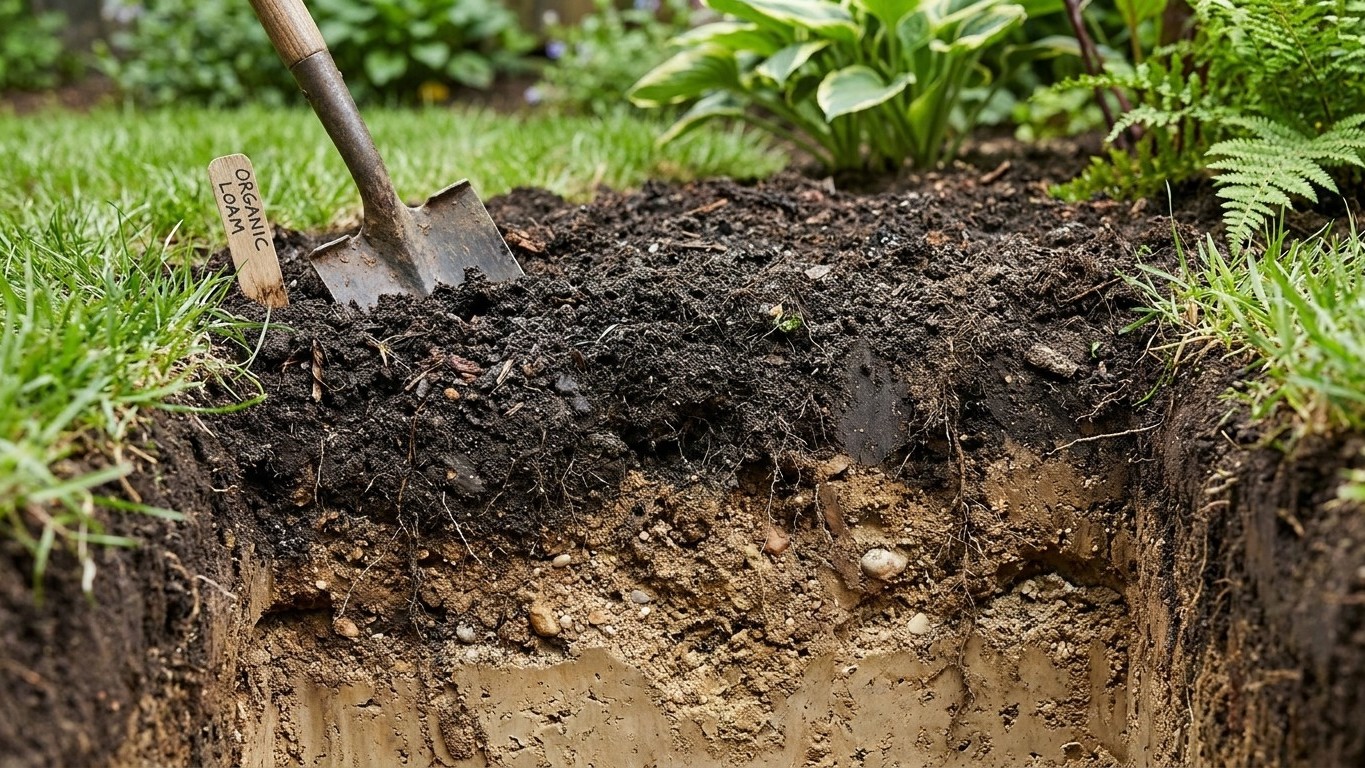

British Columbia’s dominant surface soil is mildly acid, loam-textured, and well drained on paper. But “on paper” covers ground from the Fraser Valley to the Okanagan bench, and your own dirt may have almost nothing in common with the province-wide number. Here’s what the survey actually shows, and how to check your own patch in five minutes.
What is under your garden

The soil that shows up most often across British Columbia’s mapped agricultural surface is a Brunisol, accounting for 33 percent of that mapped surface, with Podzolic soils coming in next. A Brunisol is a young soil. Its horizons, the visible layers you’d see if you cut a wall down into it, are only starting to separate from each other, which usually points to recent or coarse parent material, glacial deposits, river-laid sediment, that sort of thing. It’s not a soil with a long, deeply developed profile. It’s still forming.
The numbers from the surface horizon, taken across 2,593 mapped soil components: a median pH of about 5.8, which is slightly acid. Texture runs loam to silt, with 52 percent sand, 10 percent clay, and 38 percent silt. Organic matter sits around 5.0 percent. Drainage is classed as well drained. Those figures come straight from the Canadian Soil Information Service’s Soil Name and Soil Layer tables, and they’re not rounded or softened here on purpose.
Why this number isn’t your number
Canada doesn’t designate an official provincial soil the way American states sometimes do. What you’re reading is the most common profile among agricultural soils that have actually been surveyed, the median of thousands of samples, not a single representative plot. The far north of the province barely shows up in this data at all, since the survey focuses on agricultural regions. And if a builder scraped, graded, or filled your lot before your house went up, you’re gardening in disturbed subsoil that has nothing to do with any provincial average, Brunisol or otherwise. River bottoms and muskeg soils will read completely differently too.
So use the provincial figure as a starting expectation, not an answer. Two tests will tell you what’s actually under your boots.
The ribbon test takes under a minute: wet a small handful of soil until it holds together like putty, then squeeze it out between thumb and forefinger, letting it fall over the edge. If it won’t ribbon at all and feels gritty, you’re sandy. A ribbon of an inch or two before it breaks means loam. A ribbon that stretches past two inches and feels slick tells you clay dominates.
The jar test takes overnight. Fill a clear jar about a third full of soil, top it with water, shake hard, then let it sit undisturbed for 24 hours. Sand drops out within minutes and settles at the bottom. Silt follows over a few hours, forming a middle layer. Clay stays suspended longest and caps the layers on top, sometimes taking a full day to clear. Measure each band and you’ve got a rough texture percentage for your own yard, not the province’s.
Testing before you amend
Guessing at soil amendments is one of the more expensive habits in gardening. Lime, sulfur, and fertilizer all cost money and time to apply, and applying the wrong one, or the right one at the wrong rate, can set a bed back a full season. A lab test costs a few dollars and tells you what your eyes and the ribbon test cannot: exact pH, available phosphorus and potassium, and often organic matter percentage.
A representative sample matters more than most gardeners think. Pulling one scoop from one spot and calling it done skews the result toward whatever happened in that exact square foot, a dog’s favorite patch, an old compost pile, a spot where a downspout drains. Instead, take eight to ten cores from across the bed or lawn area, using a trowel or soil probe, at the depth where roots actually feed, roughly 6 to 8 inches for vegetable beds and lawns. Mix those cores together in a clean bucket, remove rocks and roots, and pull about a pint of the blended soil for the sample bag.
When results come back, the pH number is the one to read first, since it governs how available every other nutrient is to plant roots. Given that British Columbia’s agricultural soils run a median pH of about 5.8 provincewide, you can reasonably expect your own test to land somewhere in the mildly acid range too, especially if your property sits on similar glacial or riverine parent material. But expecting isn’t knowing. Local pockets shift with parent rock, drainage history, and decades of past fertilizer or lime use. The only way to know your actual number is to send in the sample.
Amending it
A median pH of 5.8 sits close to the sweet spot most vegetables and ornamentals want, which runs roughly 6.0 to 7.0. That’s the good news: if your test comes back near that provincial median, you’re not fighting the soil, you’re fine-tuning it. A light application of lime, applied according to your test’s recommendation, can nudge things up slightly and benefit pH-sensitive crops like asparagus and most brassicas, which prefer the higher end of that range. But this isn’t the aggressive lime correction that truly acid soils, those testing well below 5.5, require. Skip sulfur here entirely; there’s no reason to push pH lower when it’s already sitting in a workable zone.
If your own test comes back meaningfully lower than the provincial figure, treat it the way genuinely acid ground demands: lime is the tool, sulfur is the wrong direction entirely. Acid soil locks up phosphorus and makes it harder for roots to reach, and it stresses brassicas in particular, which struggle with both nutrient lockup and increased clubroot risk in low pH conditions. Lime works slowly, over seasons rather than weeks, since it has to react with soil moisture and dissolve gradually through the root zone. Don’t expect a fall application to fix a spring planting.
On the flip side, if a test comes back above roughly 7.3, alkaline, never apply lime. That would push the problem further in the wrong direction. Elemental sulfur and steady additions of organic matter are the honest, slow route back toward neutral, and honest means measured in years, not one growing season. High pH locks iron out of reach of plant roots, which is exactly what’s behind the yellow leaves with dark green veins you sometimes see on blueberries, azaleas, or other acid-loving plants stuck in alkaline soil.
Working with the texture you have
The province’s dominant texture, 52 percent sand, 10 percent clay, 38 percent silt, is loam leaning toward silt loam, which is genuinely good garden ground. Low clay content means it’s unlikely to compact into the brick-hard mess that heavier soils develop. If your own soil test or ribbon test reveals something heavier, closer to true clay, the fix is organic matter worked in over repeated seasons, never sand. Mixing sand into clay is a well-documented way to create something closer to concrete than garden soil. And never work clay while it’s wet; you’ll compress it into clods that take a full season to break back down.
If your ground leans sandier than the provincial figure, water runs through fast and nutrients wash out with it. Organic matter helps here too, holding moisture and nutrients longer, but you’ll also want to shorten your watering intervals and water more often in smaller amounts rather than one deep soak a week. Organic matter additions show results within a season. Fundamental texture, sand-to-clay ratio, doesn’t really change on any practical timeline; you’re managing it, not fixing it.
Drainage and compaction
The provincial figure classes this dominant soil as well drained, which in plain terms means water moves through the profile at a reasonable pace rather than pooling on the surface or vanishing instantly past the root zone. Standing water in your garden more than a day after a normal rain is a sign your particular ground isn’t behaving like the provincial median, likely due to a denser subsoil layer, compaction, or simple topography funneling runoff your way.
A percolation test settles the question directly. Dig a hole about a foot deep and a foot across, fill it completely with water, and let it drain once to pre-soak the surrounding soil. Fill it a second time and time how fast the water level drops. A rate of an inch or more per hour points to reasonably good drainage. Anything under half an inch per hour signals a real drainage problem, one that raised beds solve far more reliably than years of soil amendment ever will.
Compaction is a separate issue from drainage, though the two often travel together. Repeated foot traffic on garden beds, tiller or mower passes on wet ground, even kids’ games on the same patch of lawn, all press soil particles closer together and squeeze out the air pockets roots need. Double digging, once the standard fix, has fallen out of favor because it disturbs soil biology and structure that took years to build, often creating a temporary loose layer that recompacts within a season or two anyway. Adding organic matter to the surface and letting earthworms and roots do the mixing works better over time.
Some ground, though, isn’t worth three years of patient amendment. If a percolation test comes back slow and a subsoil layer of dense clay or hardpan sits within the top foot, a raised bed filled with good loam is simply the better bet. It sidesteps the drainage problem entirely instead of trying to slowly out-argue it.
Local help
The BC Ministry of Agriculture and Food is the province’s resource for soil testing guidance and agricultural extension support. A local office can walk through your test results with you, translate the lab numbers into an actual amendment plan for your specific plot, and point you toward the right lab if you haven’t sampled yet.
Common questions
Is British Columbia’s soil generally acidic?
The province’s dominant agricultural soil runs a median surface pH of about 5.8, which is mildly acid, not strongly so. Your own garden could sit higher or lower depending on parent material and local drainage.
Do I need to lime my garden every year in British Columbia?
Not automatically. Lime only makes sense once a soil test confirms your pH is low enough to need correcting, and its effects build over multiple seasons, so annual heavy applications without retesting can push pH too high.
Why is my soil clumping when I dig it, even though the province is supposed to be loam?
The provincial figure is a median across thousands of samples, not a promise about any one yard. Fill dirt, compacted subsoil, or a naturally heavier local deposit can all produce clay-like clumping regardless of the broader provincial texture.
How often should I retest my soil?
Every two to three years for an established garden bed is reasonable, and sooner if you’ve made a major amendment, like a heavy lime application, and want to confirm it worked as intended.
Related guides
- Alberta Soil: What You Are Digging Into, and How to Improve It
- Yukon Soil: What You Are Digging Into, and How to Improve It
- Manitoba Soil: What You Are Digging Into, and How to Improve It
- Will Carrots Fork in British Columbia Soil
- Growing Summer Squash in British Columbia
- Pepper Varieties That Ripen in a British Columbia Season
- Ontario Soil: What You Are Digging Into, and How to Improve It