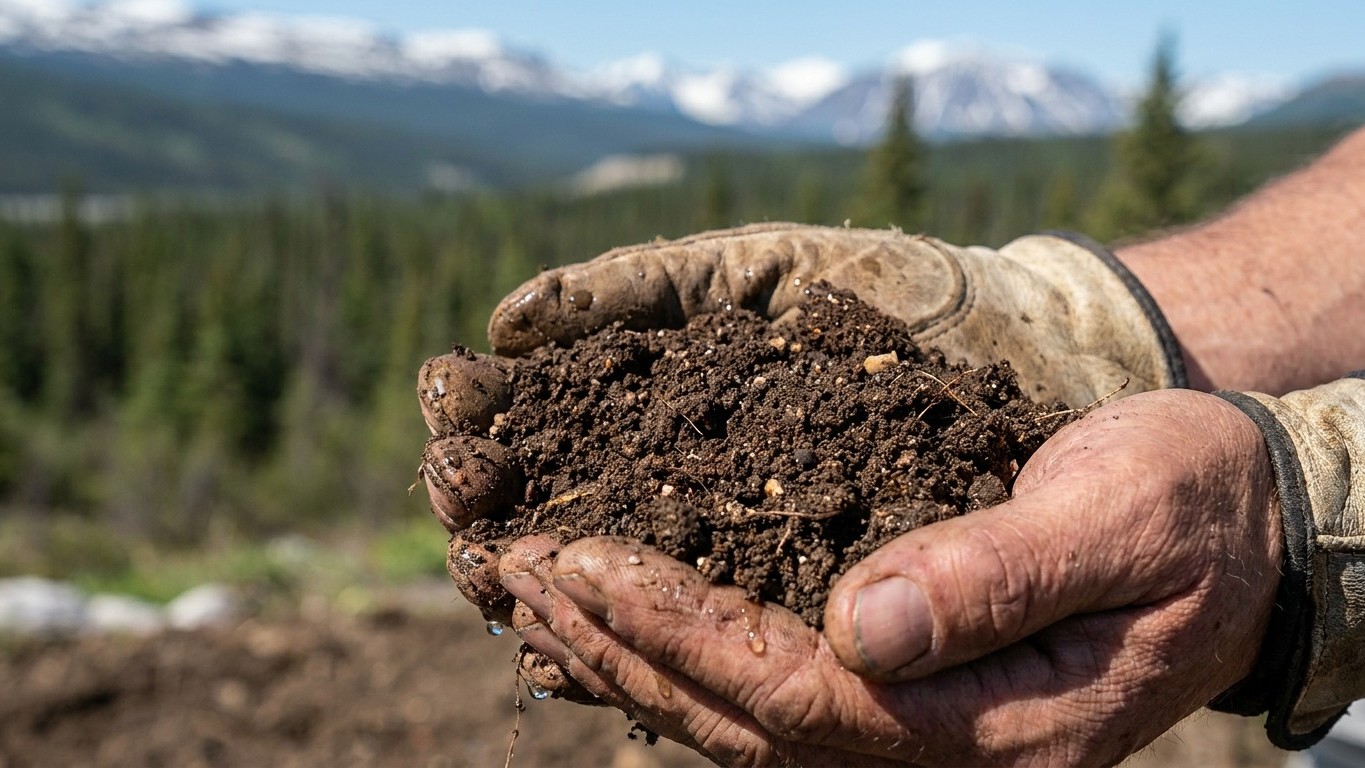

Under most Yukon gardens sits a Brunisol: a young soil whose layers are still sorting themselves out, running near neutral at a median pH of 6.8, textured like a loam-to-silt blend, and carrying an organic matter count high enough to surprise gardeners used to reading about depleted, tired dirt further south.
What is under your garden

The Canadian Soil Information Service maps the agricultural stretches of Yukon and finds Brunisol as the dominant order, covering 41 percent of the mapped surface. Gleysolic soils come in second. A Brunisol is a young soil. Its horizons, the distinct layers a soil develops as it ages, are only beginning to separate. That’s typical of ground built on recent or coarse parent material, the kind left behind by retreating glaciers, river gravel, or slopes that haven’t had thousands of years to weather into something more layered and complex.
The numbers, taken from the surface horizons of the mapped soil components (n=100, read August 29, 2026): median surface pH about 6.8, close enough to neutral that most vegetables won’t flinch. Texture runs 47 percent sand, 15 percent clay, 38 percent silt, which lands the soil in loam-to-silt territory. Organic matter measures about 12.0 percent, estimated from carbon content using the standard conversion. Drainage is classed as imperfectly drained, meaning water lingers longer than a gardener might like.
None of that is your soil, necessarily. It’s the median of soils mapped across Yukon’s agricultural regions, which leaves out the far north entirely. A garden built on river bottom silt, a patch of muskeg, or a yard where a contractor scraped the topsoil and trucked in fill will read completely differently under a shovel. The number tells you what the region tends toward. Your own patch of ground tells you what it actually is.
Read your own dirt in five minutes
Grab a handful of moist soil from a few inches down and squeeze it between thumb and forefinger, pushing it out into a ribbon. A ribbon shorter than an inch before it breaks points to loam or sandy loam. A ribbon that stretches two inches or more means real clay content. Feels gritty, it’s sandy. Feels slick and soapy, that’s silt or clay talking.
For a longer read, fill a clear jar about a third with soil, top it with water, shake hard, and let it sit overnight undisturbed. Sand drops first and settles at the bottom within minutes. Silt follows, forming a middle layer over the next hour or so. Clay stays suspended longest and settles as a fine layer on top, sometimes taking a full day. The relative thickness of each band gives you a rough texture reading you can compare against the regional 47-15-38 split.
Testing before you amend
Guessing at soil amendments wastes money and, worse, can push a soil further from where you want it. A pH meter from a hardware store tells you almost nothing reliable. A lab test tells you the actual pH, the available phosphorus and potassium, and often organic matter content, numbers your eyes and hands simply can’t produce no matter how much dirt you’ve moved.
Taking a sample correctly matters more than people think. Pull six to eight cores from around the bed or garden, not just one hole by the fence, and pull them from the depth roots actually live in, roughly the top six to eight inches for vegetables. Mix those cores together in a clean bucket, and send in a scoop of that blend rather than soil from a single spot. One core tells you about one square foot. A mixed sample tells you about the bed.
Given the regional median of 6.8, a Yukon gardener can reasonably expect their soil to land somewhere close to neutral, not screaming acid, not aggressively alkaline. Expecting isn’t knowing, though. Local variation runs wide across a territory this size, and a test result of 5.4 or 7.6 on your own plot wouldn’t be shocking. The regional number sets an expectation. The lab result settles it.
Amending it
A median pH of 6.8 doesn’t call for the drastic corrections that soils at the extremes need. This isn’t ground crying out for lime the way strongly acid soil does, and it isn’t ground where a single bag of the wrong product locks up iron and leaves your blueberries yellow between green veins. Most vegetables, from tomatoes to beans to brassicas, do their best work between 6.0 and 7.0, so a soil sitting at 6.8 is, on paper, close to ideal. The catch is that “on paper” means the regional median, not your backyard, so this is where that soil test earns its keep before you buy anything.
If your own test comes back meaningfully lower, say below 5.5, lime becomes the tool, applied a season ahead of planting because it works slowly through the soil over months, not days. Sulfur has no business going on ground that’s already acid. If your test comes back well above 7.3, lime should never touch that soil again, and the fix runs through elemental sulfur and steady organic matter additions instead, both of which work over seasons rather than weeks. High pH is also where iron becomes chemically unavailable to plants, which shows up as yellowing leaves with the veins staying stubbornly green.
The texture numbers matter just as much as pH, maybe more day to day. At 47 percent sand and 15 percent clay, this is a soil that leans sandy-silty rather than heavy. That’s good news for working it, since sandy-silty ground rarely turns into the brick-hard clods that heavy clay does when you dig too soon in spring. The tradeoff is that water and nutrients move through faster, so the same compost or aged manure that would tighten up a clay soil elsewhere does double duty here: it slows drainage just enough to hold moisture, and it feeds the biology that keeps a loose soil from blowing away.
Organic matter at 12.0 percent is genuinely high for a mineral soil, likely a product of Yukon’s short, cold growing season, which slows the microbial breakdown that would otherwise chew through that carbon faster in a warmer climate. That’s an asset worth protecting rather than a problem needing correction. Structural fixes, working in compost, avoiding wet-soil digging, show up within a single growing season. Real texture change, shifting a soil meaningfully away from its sand-silt-clay ratio, doesn’t happen in one year or three. It’s closer to a decade of steady organic matter additions before the feel of the ground under your boots actually changes.
Drainage and compaction
Imperfectly drained is the classification the survey gives Yukon’s dominant soil, and it means water doesn’t move through cleanly. Rain or snowmelt sits longer than it would in a well-drained soil, sometimes forming a perched water table where a denser layer underneath blocks the downward path. Stand in the garden a day after a heavy rain and if you’re leaving boot prints that fill with water, that’s imperfect drainage announcing itself.
A percolation test settles the question with numbers instead of guesswork. Dig a hole about a foot deep and a foot wide, fill it with water, and let it drain completely once to saturate the surrounding soil. Fill it again and time how far the water level drops in an hour. Faster than an inch an hour and drainage runs slow, the kind that calls for raised beds or amended organic matter to open up pore space. Two to three inches an hour is generally workable for most vegetables. Faster than that and the concern flips toward soil drying out too quickly instead.
Compaction compounds a drainage problem fast. Repeated foot traffic on garden beds, or driving equipment across a yard while the soil is wet, presses out the pore space water and roots both depend on. Double digging, the old practice of turning soil two shovel-depths deep, has fallen out of favor because it disturbs soil structure and biology more than it helps, and the benefit rarely outlasts a season. On imperfectly drained ground like the Yukon median, a raised bed is often the more honest answer than years of amendment. Building up six to twelve inches of good soil above grade sidesteps the slow-draining subsoil entirely, and for a short growing season, that head start on warmer, faster-draining soil in spring is worth more than the lumber costs.
Local help
Soil testing support in Yukon runs through Agriculture and Agri-Food Canada, the federal department that also compiles the soil survey data behind these regional numbers. Local agriculture offices in the territory work with growers directly on interpreting results, since a lab printout full of numbers means little without someone to walk through what they mean for your particular bed and your particular crops.
Common questions
Does Yukon soil need lime? Not as a rule. The regional median pH of 6.8 sits close to neutral, which is where most vegetables prefer to be. Lime only makes sense if your own soil test comes back meaningfully acid, below roughly 5.5.
reelyWhy is organic matter so high in Yukon soils? At about 12.0 percent, organic matter runs higher than in many warmer regions, likely because Yukon’s short, cold growing season slows the microbial activity that normally breaks carbon down faster.
What is a Brunisol? It’s a young soil order in the Canadian System of Soil Classification, one where the horizons, or layers, haven’t had enough time to fully develop. Brunisols form on recent or coarse parent material and cover 41 percent of Yukon’s mapped agricultural surface.
Can I garden in permafrost areas? The soil survey behind these figures covers Yukon’s agricultural regions, not the far north where permafrost is more widespread. Gardening on or near permafrost calls for raised beds and careful drainage planning, since the frozen layer underneath behaves nothing like the imperfectly drained but unfrozen ground the regional median describes.