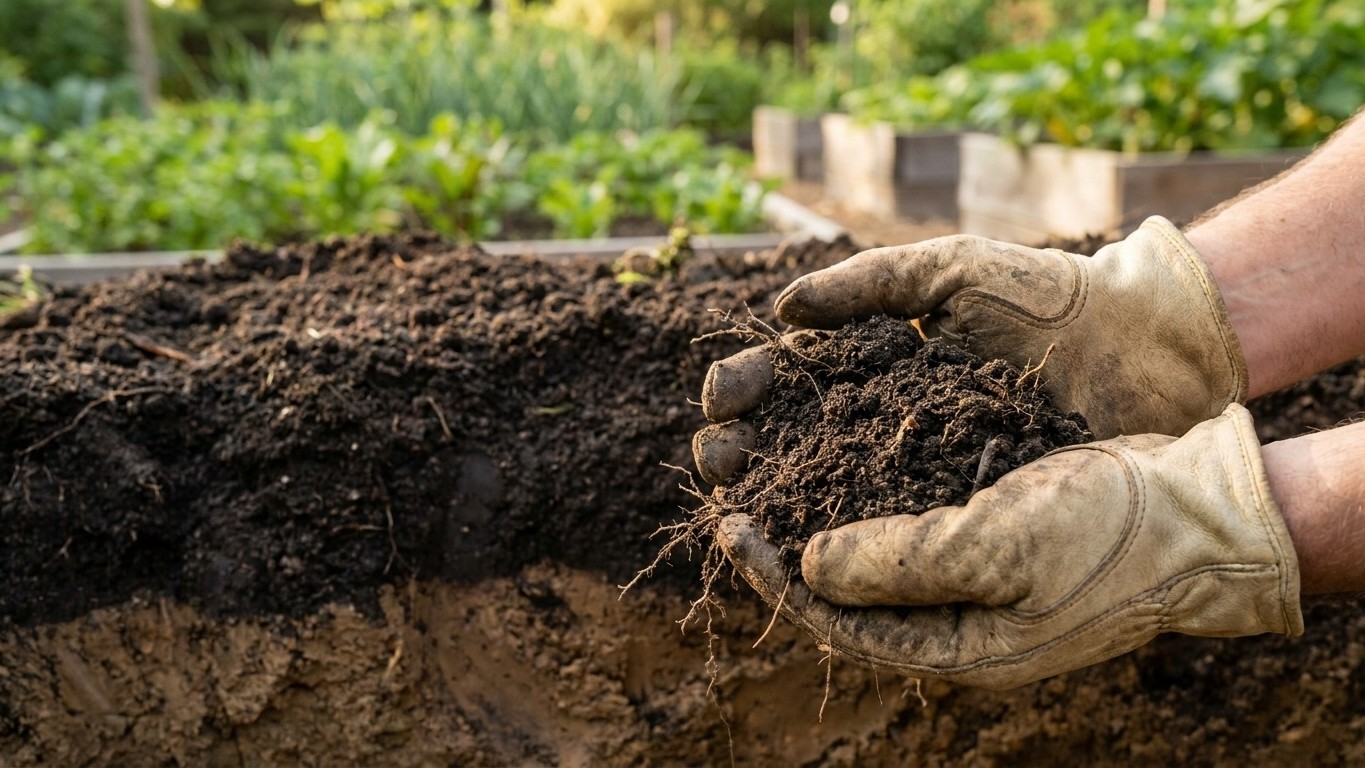

Most gardens across Alberta’s farmed and settled regions sit on some version of Chernozem, the dark, humus-rich soil that built the province’s grain economy. It runs slightly acid, loamy, and naturally fertile. But the soil under a specific yard depends on where a house was built, what got scraped away, and what got trucked in. Here is what the province’s soil actually measures, and how to read your own patch of it.
What is under your garden

The Canadian Soil Information Service maps Alberta’s agricultural land and finds Chernozem as the leading soil order, covering 40 percent of the mapped surface, with Luvisolic soils next in line. Chernozem is grassland soil: centuries of prairie grass roots dying back each year built up a deep, dark topsoil loaded with organic matter. That is why so much of Alberta grows wheat, canola, and backyard vegetables without much fuss.
The numbers behind that reputation are specific. Across the mapped surface horizons of the province, the median surface pH runs about 6.5, which counts as slightly acid. The texture leans loam to silt: 37 percent sand, 21 percent clay, and 42 percent silt. Organic matter sits around 5.2 percent, which is a healthy number, well above what most gardeners find in worn-out urban lots. Drainage is classed as well drained. Those figures come from Agriculture and Agri-Food Canada’s soil component data, sampled at the surface across more than two thousand mapped soil units.
None of that describes your yard specifically. This is a median drawn from farmland soils across a huge province, and the survey itself doesn’t reach the far north, where different ground rules apply entirely. A subdivision built on scraped or graded land, a low spot that collects runoff, an old riverbank lot: these can sit nowhere near that median. Builders routinely strip topsoil and sell it, then backfill with subsoil that has almost none of the organic matter Chernozem is known for.
Read your own soil in five minutes
Two quick checks tell you more about your yard than any provincial average.
- The ribbon test: wet a small handful of soil until it holds together, then squeeze it between thumb and forefinger, pushing it upward into a ribbon. Clay-heavy soil forms a long, slick ribbon over 2 inches. Loam breaks off after an inch or so. Sandy soil won’t ribbon at all; it just crumbles.
- The jar test: fill a clear jar about a third full of soil, top it with water, shake it hard, and let it sit overnight. Sand settles first and sits on the bottom, silt layers above it, and clay stays suspended longest, settling into the top layer last. The proportions of each layer give you a rough texture reading you can compare against the province’s 37-21-42 split.
Run both tests and you’ll know, in plain terms, what you’re digging into before you spend a dollar on amendments.
Testing before you amend
Guessing at soil chemistry wastes money twice: once on the wrong amendment, and again buying the right one later. A soil test measures what your eyes can’t, actual pH, phosphorus, potassium, and organic matter levels, rather than what a province-wide median suggests they might be.
Take the sample properly or the result won’t mean much. Pull five or six small cores from different spots in the bed, all at the depth where roots actually live, generally 4 to 6 inches down for vegetable beds. Mix those cores together in a clean bucket, remove rocks and roots, and send in that combined sample rather than a single scoop from one corner of the yard.
When results come back, the pH number tells you which direction to correct, and the nutrient readings tell you whether you actually need more phosphorus or potassium, or whether you’d just be feeding a garden that has plenty already. Given that the provincial median sits at 6.5, a slightly acid reading close to that is a reasonable expectation for many Alberta yards. But expecting is not knowing. Soils near old shelterbelts, gravel fill, or construction debris regularly test well outside that range, sometimes sharply alkaline, sometimes patchy from one bed to the next.
Amending it
Correcting Alberta soil starts with the number your own test gives you, not the provincial median. A reading close to 6.5 needs little intervention for most vegetables and lawns, which generally prefer a range from about 6.0 to 7.0. Where a test comes back lower, into the range below about 5.5, lime is the tool that works: it raises pH gradually and unlocks phosphorus that acid soil otherwise locks away, which matters for brassicas especially, since cabbage and broccoli struggle hardest in sour ground. Sulphur would be the wrong move here; it pushes pH the opposite direction. Lime works over seasons, applied and worked in months ahead of planting, not as a quick fix days before.
Where a test comes back high, above about 7.3, the rule flips completely: lime should never go anywhere near that soil. Elemental sulphur and steady additions of organic matter are the slow, honest route to bringing pH down, and it takes patience measured in years, not weeks. High pH also locks iron out of reach for plant roots, which is exactly what’s behind yellow leaves with green veins on shrubs and fruit trees, a classic sign of iron chlorosis rather than a watering problem.
Texture correction runs on its own timeline, separate from pH. The province’s loam-leaning median, 37 percent sand and 21 percent clay, means most Alberta gardens aren’t fighting the extremes. But plenty of individual yards are.
| Soil type | What it needs | What to avoid | Timeline |
|---|---|---|---|
| Heavy clay | Compost and organic matter worked in yearly | Never add sand to clay; never work it wet | Three seasons or more |
| Sandy soil | Organic matter, shorter and more frequent watering | Assuming one heavy watering will hold | One season for noticeable change |
Sandy soil responds fast because organic matter binds it and holds water almost immediately. Clay takes longer because structural change happens slowly, one season of organic matter at a time, and working wet clay compacts it worse than leaving it alone.
Drainage and compaction
The province’s mapped soils carry a well-drained classification, meaning water generally moves through the profile without pooling for long. But that classification describes farmland averages, not the compacted subsoil under a driveway-adjacent flower bed or the low corner of a backyard where snowmelt collects every spring.
A percolation test settles the question for your own yard. Dig a hole about a foot deep, fill it with water, let it drain once, then fill it again and time how fast the water level drops. A drop of 1 to 3 inches per hour is normal for good garden drainage. Faster than that, and the soil is likely too sandy to hold moisture and nutrients well. Slower, especially anything under half an inch an hour, points to compacted or heavy clay ground that needs help before anything roots well in it.
Compaction from foot traffic, parked equipment, or repeated tilling packs soil particles together and squeezes out the air pockets roots and water both need. Double digging, the old practice of turning soil two spade-depths down, has fallen out of favor among extension agronomists because it disrupts soil structure and biology more than it helps, and the compaction often returns within a season or two anyway.
When a percolation test comes back slow and a yard has a documented history of fill or heavy equipment use, a raised bed is the honest answer rather than three years of amendment that may never fully catch up. Building up 10 to 12 inches of good growing mix over compacted native soil sidesteps the problem entirely instead of fighting it season after season. On genuinely poor ground, that’s simply the better bet.
Local help
Alberta gardeners can reach soil testing and agronomy guidance through the province’s Alberta Agriculture and Irrigation service. Staff there can point growers toward accredited soil testing labs and help interpret results alongside local growing conditions, rather than leaving a gardener to decode a lab report alone.
Common questions
Is Alberta soil naturally acidic or alkaline?
The province’s mapped median surface pH runs about 6.5, which is slightly acid. Individual yards vary, especially where fill, gravel, or construction debris changed the original profile.
What is Chernozem soil good for?
Chernozem is the dark, organic-rich grassland soil covering the largest share of Alberta’s mapped agricultural land. Its high organic matter, around 5.2 percent at the surface, makes it naturally fertile for vegetables, grains, and lawns alike.
Why does my Alberta yard drain poorly if the soil is classed well drained?
The well-drained classification describes the province’s farmland soils generally. Compaction from construction, foot traffic, or heavy clay pockets in a specific yard can produce much slower drainage than the regional average suggests.
Should I add lime to my garden soil in Alberta?
Only if a soil test shows pH below about 5.5. Given the provincial median sits near 6.5, many yards don’t need it, and adding lime to soil that already tests above 7.3 will make alkalinity problems worse, not better.