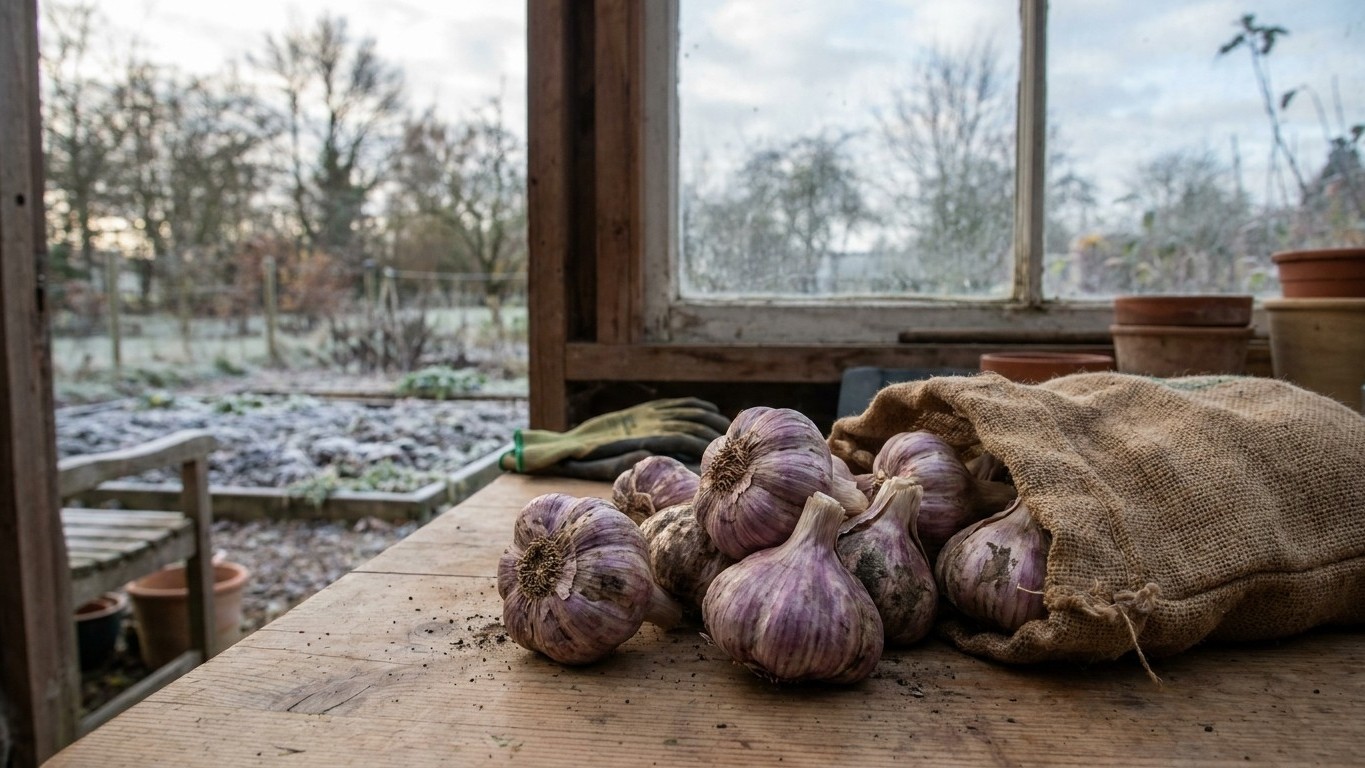

Bavarian Purple is a hardneck Rocambole garlic, the type known among growers for the biggest, easiest-to-peel cloves and the strongest, spiciest flavor of any garlic family. It needs a real winter to form a proper head of cloves rather than one round bulb. If you garden somewhere with cold, snowy winters, plant it in fall as usual. If you garden somewhere mild, check the cold math below before you order it.
What Bavarian Purple actually is

Bavarian Purple belongs to the Rocambole family, one of the hardneck subtypes, distinguished from Porcelain and Purple Stripe garlics by a looser, thinner wrapper and a habit of forming just eight to ten cloves per bulb, each one large and set in a single ring. No flavor note is published for this variety, and none is invented here. What holds for every garlic is the mechanism: a raw clove bites, that bite fades with heat, and a long roast turns any garlic soft and spreadable.
Like other hardnecks, it sends up a stiff central stalk called a scape, which curls and must be cut off before it fully matures so the plant puts its energy into the bulb rather than the top growth. That is worth knowing before you plant it: this is not a set-and-forget crop, it asks for one extra step mid-season that softneck types skip entirely.
The tradeoff for those big, easy-peel cloves is storage life. Seed catalog descriptions consistently put Rocambole types at the short end of the garlic shelf life range, keeping well for only a few months in a cool, dry pantry before the cloves start to soften or sprout. If you want garlic that lasts from harvest through the following spring, a Rocambole is not the type to build a whole year’s supply around. It is a garlic to grow for flavor and eat first, not to stash in the back of the cupboard.
What Bavarian Purple tastes like, and what to do with it
The heat in a raw clove comes from enzymes that activate the instant garlic tissue is cut or crushed, and that reaction is strongest in hardneck types like this rocambole, which is why the raw bite is described as rich and full-bodied rather than mild. That sharpness is a property of the uncooked clove specifically. Heat, once it hits a pan or an oven, breaks down the same compounds that produce the bite, so the same garlic that stings raw turns rounder and sweeter as soon as it’s sautéed, and turns sweeter still with long, low roasting. This isn’t unique to Bavarian Purple — it’s true of garlic generally — but it matters more here because the variety’s reputation for pungency is built on raw performance, and that reputation won’t hold in a dish where the garlic spends twenty minutes over heat.
Practically, that means Bavarian Purple earns its keep in places where the raw clove is the point: minced into a vinaigrette, crushed into aioli, stirred into salsa or a finishing sauce added off the heat. Those are the preparations where the rich, hot character actually shows up on the plate. Once it’s roasted whole, browned in oil, or simmered into a braise for any length of time, expect the same mellow sweetness you’d get from a milder variety — the intensity doesn’t carry through prolonged cooking, and no garlic’s does.
Beyond that raw-versus-cooked mechanism, there isn’t published detail on how Bavarian Purple performs in specific dishes — nothing on how it dries for powder, how it fares fermented, or how its flavor compares side by side with other rocamboles. What can be said comes from the category: rocamboles are grown for exactly this kind of complex, assertive raw flavor, and Bavarian Purple’s description fits that family trait rather than departing from it.
Will it get the cold it needs where you are
This is the question that decides whether Bavarian Purple is worth planting at all, and it is the one most generic garlic guides skip. Garlic cloves need a sustained run of cold weather after planting, roughly six weeks with temperatures hovering near 40°F, before they will split into a head of individual cloves. Skip that chill and the plant grows a single round bulb instead of a garlic head, no matter how well you water or feed it. Rocambole garlics like this one carry the heaviest chill requirement of any hardneck type, which makes the calculation less forgiving than it is for a softneck.
Where the cold falls short
Run the numbers for a warm-winter city and the gap is stark. NOAA climate data used to build these regional profiles shows Los Angeles spending zero weeks with temperatures under 40°F in an average winter, against the roughly six weeks Rocambole garlic wants. Houston, Texas and Jacksonville, Florida sit in the same position: essentially no sustained sub-40°F stretch, even though both places are perfectly capable of Growing Garlic in general. If you garden in California, Texas, or similarly mild parts of Florida, Louisiana, Hawaii or Arizona, you have two real options rather than one flat no. Refrigerate the cloves for a stretch before planting to simulate the chill the ground will not provide, or plant a softneck instead, something in the Artichoke or Silverskin family, which asks for far less cold to begin with. A grower who wants the Rocambole flavor specifically and lives in one of these states should budget for the refrigeration step every single year, since it is not a one-time fix.
Where the cold is ample but the season is short
The opposite failure shows up at the cold end of the map, and it is easy to miss because the chilling requirement is clearly met. Alaska, Yukon and Nunavut all deliver more than enough cold for a Rocambole to divide properly. The limiting factor there is cumulative heat over the growing season, measured in growing degree-days. Yellowknife-area and Rankin Inlet growing seasons, per Northwest Territories and Nunavut agricultural data, land at 905 and 159 growing degree-days respectively, and Anchorage sits at 917. None of that is enough heat to size up a bulb reliably in the open ground, regardless of how long the frost-free window runs. Growers in Alaska, Yukon and Northwest Territories get better results from a greenhouse or a low tunnel that pushes the accumulated heat up over the growing season, not from planting earlier or later. If you are weighing a Rocambole against a Porcelain type like the one described in the Blue Music growing guide, both carry a similarly heavy cold requirement, so the same season-extension logic applies to either.
When to put the cloves in
Garlic is a fall-planted, summer-lifted crop everywhere it is grown, but the exact window shifts hard by climate, and it is anchored to the first fall frost, not a fixed calendar date. The goal is a clove that has time to grow roots before the ground freezes solid, but not enough time to push much leaf above ground, since top growth going into winter is more likely to get burned back by hard freezes.
Cold, mild and warm windows
In the coldest territories, planting happens weeks before frost is even a concern. Growers around Whitehorse in the Yukon set cloves out in early August, and those near Yellowknife in the Northwest Territories and Calgary in Alberta plant in late August, all well ahead of the season’s first hard freeze, so roots establish through a long, cool autumn. In warm Gulf climates the calendar runs in the opposite direction: growers around Houston plant in early to late November, and those near New Orleans wait until late November into mid December, since the ground stays too warm for root dormancy any earlier.
For anywhere between those extremes, your own first fall frost date is the number to work from, not a date copied off a national planting chart, and university extension offices disagree on exactly how many weeks before that frost to aim for. Check your state or county extension service for its specific recommendation, since the same six-week rule of thumb quoted nationally gets adjusted regionally in practice. Whatever general garlic-growing background you’re working from, the garlic varieties guide is worth a read first if you haven’t settled on a planting method yet.
Hardneck or Softneck: what this one asks of you
Bavarian Purple is firmly hardneck, and that fact drives almost every other decision about growing it. Hardneck garlics send up that central scape, which has to be cut once it curls so the plant’s energy goes into the bulb instead of into flowering structures. In exchange, you get fewer but noticeably larger cloves, typically eight to ten per bulb, that peel cleanly in one motion, unlike the fiddly, multi-layered cloves of a softneck.
| Trait | Hardneck (Bavarian Purple) | Softneck |
|---|---|---|
| Scape | Sends one up, must be cut | None |
| Cloves per bulb | Fewer, larger, single ring | More, smaller, multiple rings |
| Peeling | Easy, comes off in one piece | Fibrous, more effort |
| Storage life | Shorter, a few months | Longer, often to next spring |
| Cold requirement | High | Low to moderate |
| Braids for storage | No, stalk is too stiff | Yes |
That last row is the practical takeaway for climate matching. Long, cold winters favor the hardneck habit, since the plant gets the chill it needs and the shorter storage window matters less if you’re eating fresh through summer and fall. Mild winters favor softneck instead, both because the chill requirement is easier to meet and because the longer shelf life makes up for a growing season that never gave the bulb a proper winter to work with.
Growing and curing it without losing the crop
Plant cloves root-end down, about two inches deep and four to six inches apart, in rows roughly a foot apart, pointed tip just at or slightly below the soil surface. Mulch heavier for garlic than you would for most crops, since an overwintered planting is exposed to repeated freeze-thaw cycles that can heave shallow-rooted cloves right out of the ground before they’ve established. A few inches of straw or shredded leaves holds soil temperature steadier and suppresses spring weeds that would otherwise compete with the bulbs during the critical sizing-up weeks.
Reading the plant, Not the Calendar
Stop watering the bed a few weeks before you expect to lift, since wet soil right up to harvest encourages the wrapper to stain and rot in storage rather than cure cleanly. The plant itself tells you when it’s ready better than any date on a calendar:
- Bottom leaves have gone brown and dried back
- Roughly five to six leaves higher up are still green
- The stalk has begun to soften but hasn’t collapsed
- A test bulb pulled from the row shows well-formed cloves with tight wrappers
Lift too early and the wrappers are thin and the bulb won’t cure properly. Lift too late and the cloves split apart inside the wrapper, which ruins storage life almost immediately. Cure the pulled bulbs, tops and roots still attached, in a shaded, dry, well-ventilated spot out of direct sun for several weeks, until the outer wrapper is fully papery and the neck is tight and dry. Only then trim the roots and tops and move the bulbs to storage. A garlic crop lost to rot almost always traces back to one of those two mistakes: pulled too soon, or cured somewhere damp and still.
Common questions
Can I grow Bavarian Purple in a raised bed instead of the ground?
Yes, and a raised bed can actually help in marginal climates because it drains faster and warms and cools a bit ahead of the surrounding ground. It does not change the chilling math described above, since the bed still tracks local air temperature closely enough that a warm-winter region won’t deliver more cold just because the garlic is up on legs.
What happens if I plant it in spring instead of fall?
You can Plant Garlic in spring in a pinch, but a Rocambole like Bavarian Purple planted that way almost always produces small, undivided bulbs, because it never got the sustained cold period a fall planting provides naturally. Spring planting is a fallback for a missed fall window, not a strategy to plan around for this type.
My scapes never curled, did I do something wrong?
Not necessarily. Scape curling is more pronounced in some seasons and some sites than others, and a plant under heat or drought stress may send up a straighter scape. Cut it once it has clearly elongated above the leaves, whether or not it forms a tight curl, so the bulb keeps the energy instead.
Is Bavarian Purple the same as regular purple stripe garlic?
No. Purple Stripe is its own hardneck subtype with different clove structure and a different flavor profile, even though the name overlap causes confusion at seed sale time. Bavarian Purple is classified as a Rocambole, so check the catalog description for clove count and storage life rather than assuming from the name alone.