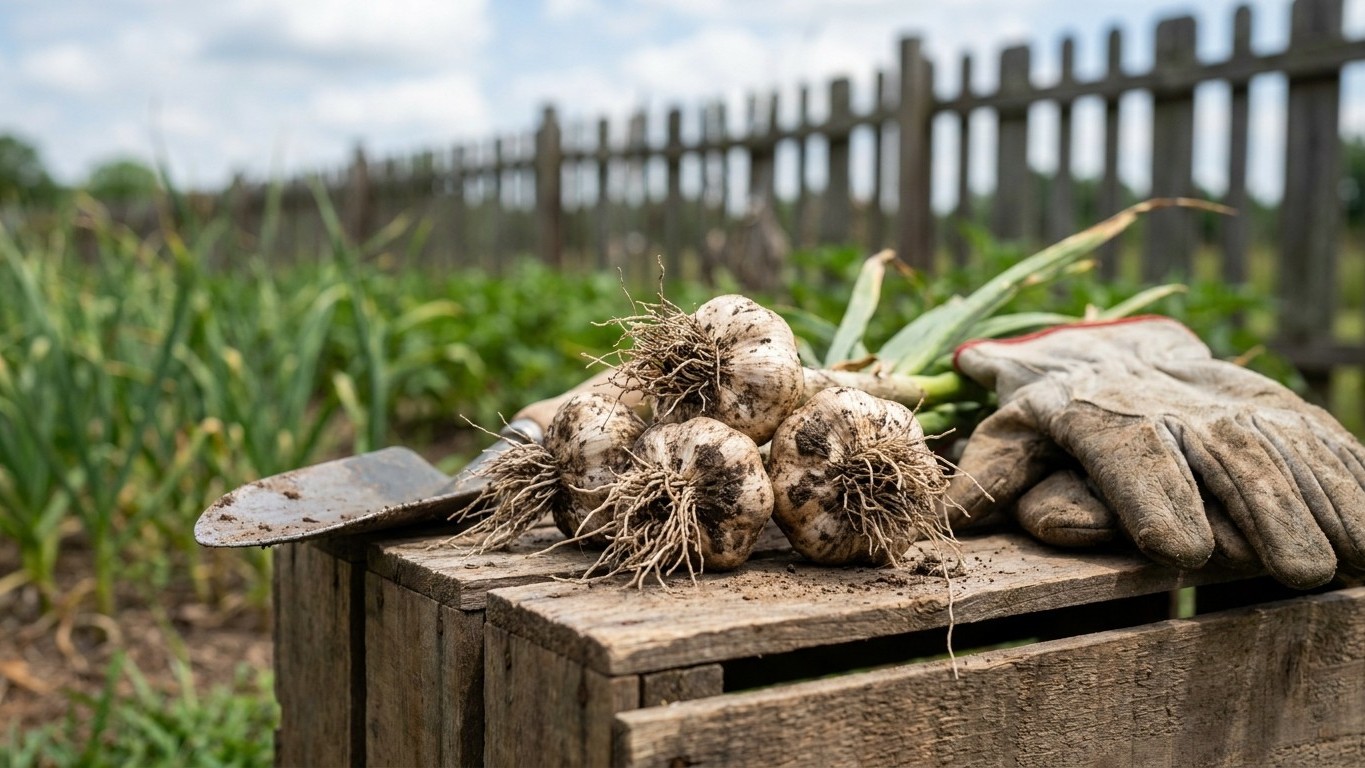

Mid-October to late-October is the window that matters here, and it holds whether you’re planting ‘Music’, ‘German White’, ‘Chesnok Red’, or any other hardneck on the shelf. Most planting charts tell you to count back from a cultivar’s catalog maturity date — that’s the rule everywhere else. Alabama doesn’t work that way. The clove doesn’t care what the seed packet promises; it cares when the ground turns cold. Huntsville’s average first fall freeze sets the pace, and every variety falls in line behind it.
The short answer for Alabama

Plant garlic in Alabama between mid-October and late-October. That window holds for every hardneck cultivar in common use here, including ‘Music’, ‘German White’, ‘Chesnok Red’, ‘Metechi’, ‘Duganski’, ‘Georgian Crystal’ and the rest of the hardneck lineup: none of them shifts the calendar much, because the driver is the coming frost, not the variety’s own catalog maturity figure. Set cloves out in that stretch and expect the first bulbs ready to lift the following summer, in early July.
| Cultivar | Type | Set out (Huntsville-area window) | First ripe |
|---|---|---|---|
| Music | Hardneck | Mid to late October | Early July |
| German White | Hardneck | Mid to late October | Early July |
| Chesnok Red | Hardneck | Mid to late October | Early July |
| Metechi | Hardneck | Mid to late October | Early July |
| Duganski | Hardneck | Mid to late October | Early July |
That mid-October to late-October window is anchored on frost data, not a fixed date on a calendar. NOAA’s National Centers for Environmental Information put the 1991-2020 average first fall freeze at Huntsville’s reference station somewhere between November 2 and November 16. That fifteen-day spread is itself a midpoint figure: in roughly one year out of two, the first freeze arrives after November 16, and in the other half it lands before November 2. Planting two to four weeks ahead of that range gives cloves time to push root growth into cooling soil before a hard freeze locks the ground, without pushing so much top growth that an early cold snap burns the leaves back. For the fuller picture of how this fits into the whole season, see Growing Garlic in Alabama.
Working it out for your own garden
Alabama is not one climate, and Huntsville’s frost data describes one station, not the state. If you garden somewhere else, the arithmetic still works, but you need your own starting range before you can run it.
Showing the arithmetic
Start from NOAA’s Huntsville range of November 2 to November 16 and subtract roughly two to four weeks of root-growing time. Two to four weeks before November 2 lands you in mid-October. Two to four weeks before November 16 lands you in late October, close to the start of November. That calculation is exactly why catalogs list mid-October to late-October as the set-out window for hardneck garlic in this territory: it sits just ahead of the frost range rather than on top of it, leaving enough time for roots to grow into soil that is cooling but not yet frozen.
What shifts it locally
Elevation adds cold. A garden on higher ground in northeast Alabama sits well above the Huntsville station’s elevation, and cold air pools in valleys and low pockets on clear nights, so frost can settle into a hollow while a ridge a mile away stays clear. A large body of water works the other way: it holds heat into the evening and delays frost near its shoreline. Coastal counties along the Gulf keep the growing season open longest, while inland river valleys moderate the swing more than open farmland a few miles off. None of that changes the underlying rule, only the date you plug into it.
What changes across Alabama
North Alabama, including the higher country around Sand Mountain and the ridges east of the Tennessee Valley, sits at greater elevation than the Huntsville reference station and tends to run ahead of it into fall cold, meaning frost risk can arrive before the low end of the November 2 to November 16 range. The Tennessee River itself softens that swing close to its banks, holding warmth a little longer than the surrounding farmland.
Central Alabama’s Black Belt prairie, with its heavy clay soils, does not shift the fall frost timing much on its own, but those soils cool and warm more slowly than sandy ground, which matters more for spring growth resumption than for the autumn planting decision. South Alabama and the Gulf Coast counties of Mobile and Baldwin run behind the Huntsville figure, since the Gulf’s moderating effect keeps warm air in place well past the point where north Alabama has already frozen. A grower near the coast working from Huntsville’s frost window alone risks planting earlier than the local climate actually calls for. Check your county’s local guidance before locking in a date, and see Garlic Varieties That Suit Alabama Winters for how these regional differences bear on cultivar choice.
The mistakes this climate punishes
Alabama’s mild, humid winters create a specific set of failure points that are different from what growers deal with further north.
- Planting too early: cloves set out well before mid-October can push top growth ahead of the first frost, and a hard freeze on exposed leaves wastes energy the plant needed for bulb sizing.
- Planting too late: cloves set out after the window closes may not build enough root system before soil temperatures drop, leaving them poorly anchored and slower to size up.
- Planting too shallow: repeated freeze-thaw cycles through an Alabama winter can heave a shallow-set clove partway out of the ground, exposing it to drying and rot.
- Skipping the chill question: hardneck garlic needs a sustained period of cold to divide properly into cloves, and a warm winter, especially toward the coast, can shortchange that requirement more than it would in a harder climate.
None of these are unique to Alabama in principle, but they show up here because the state’s frost window is late, its winters are mild by national standards, and both of those facts push growers toward either edge of the safe planting range rather than the middle of it.
Checking this against your county
Huntsville’s frost data is a reference point, not a guarantee for wherever you actually garden. The Alabama Cooperative Extension System, part of the USDA’s land-grant university extension network, maintains county-level offices with local planting guidance. Visit aces.edu and look up the office for your own county before finalizing a planting date, particularly if you garden well north, well south, or at meaningfully different elevation from the Huntsville station.
Common questions
Can I still plant garlic in November in Alabama?
You can, and it will likely still produce a crop, but you are cutting into the root-establishment time the mid-to-late-October window is built around. Late plantings tend to size up smaller by the following July because the cloves had less time to root before the ground cooled.
What happens if I plant garlic too early in a warm fall?
Cloves set out well ahead of the window can push top growth before winter, and a hard freeze on that exposed foliage burns it back and wastes stored energy. The bulb usually survives, but sizing suffers.
Does the same planting window apply to softneck garlic?
Softneck timing follows the same frost logic, but check variety-specific guidance before assuming an identical date.
How do I know if my garden is colder or warmer than the Huntsville figure?
Track your own first frost date for a season or two, or ask your county Extension office for local records, since elevation, nearby water, and even a low spot in your own yard can shift the date meaningfully from the reference station.
The Moon calendar is a separate, older custom: see when to plant garlic by the moon, written as tradition rather than fact.