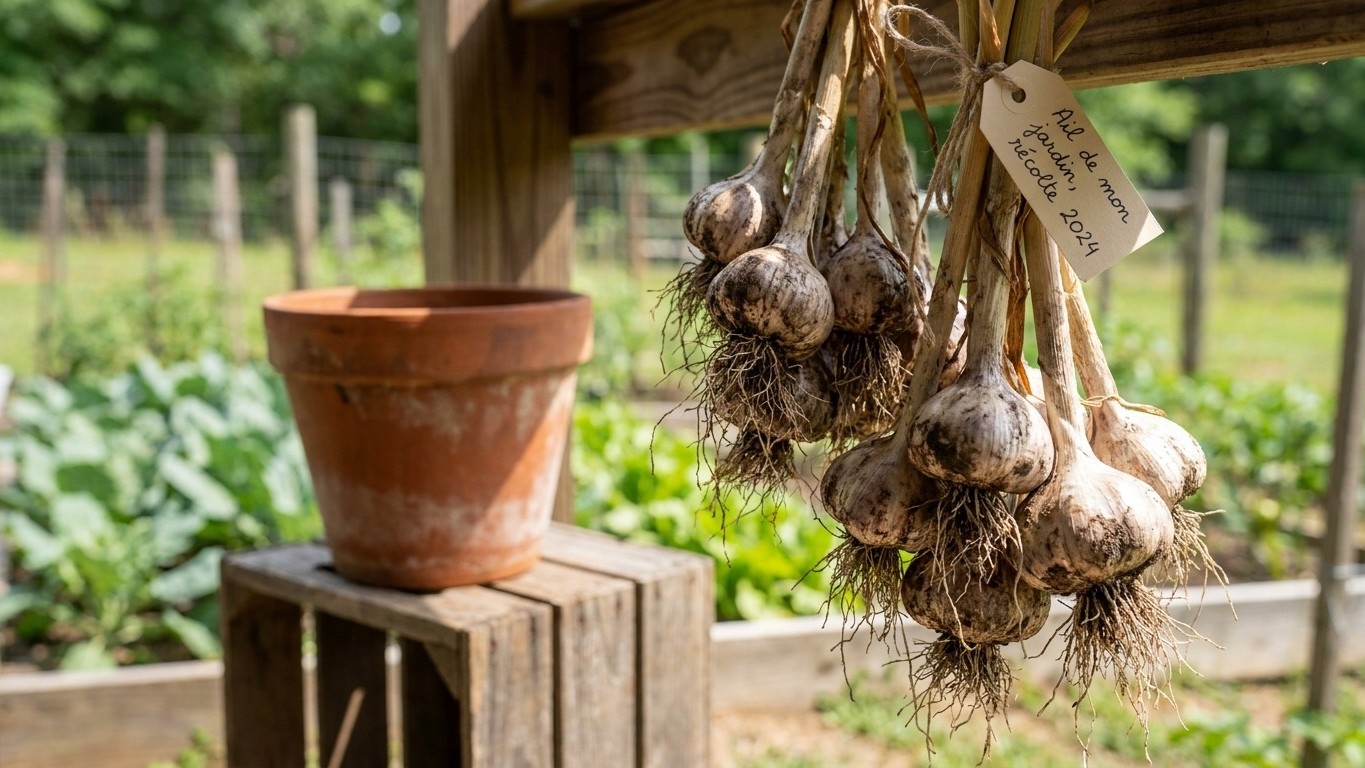

Six to eight weeks under 40°F is what turns a single garlic clove into a full bulb of cloves — the cold is the trigger, not the calendar date you planted it. Skip that stretch and you lift a round, undivided bulb come summer, no matter how well everything else went. North Alabama’s freezes arrive early enough, often by early November, to bank that chill in full. South of Birmingham, the winters run softer, and the math changes.
Will garlic get the cold it needs in Alabama

What the UGA chill rule requires
A garlic clove does not divide into a bulb of cloves just because you planted it. It needs a real stretch of cold first, the same signal that tells the plant it has passed a winter and can put its energy into building separate cloves rather than a single round mass. The University of Georgia Extension, in publication C854, sets that requirement at six to eight weeks with temperatures under 40°F after planting. Skip that stretch and the plant lifts a single round bulb at harvest, no cloves, regardless of how well the rest of the season went.
North Alabama, where the NOAA weather station behind these figures sits, gets a running start on that cold. NOAA’s 1991-2020 climate normals put Huntsville’s first fall freeze between November 2 and November 16, meaning nights below 32°F, and by extension nights below 40°F, arrive by early to mid November and continue well into winter. That gives north Alabama a genuine shot at the full six to eight weeks UGA Extension calls for, particularly in a garden planted according to garlic Planting dates Alabama in mid to late October.
Central and south Alabama are a different story, and the Huntsville figures do not describe them. Winters soften considerably moving toward the Gulf Coast, and a garden in the southern half of the state can go through a whole December without the sustained sub-40°F stretch that north Alabama sees as routine. If you garden south of the Tennessee Valley, do not assume you are getting the chill described above. Check your own county’s typical winter lows against the extension service before committing a whole bed to a hardneck variety.
Two fixes when the chill falls short
Two real options cover a shortfall in either direction, both worth weighing against the broader range of Garlic Varieties That Suit Alabama Winters that gardeners can choose from:
- Refrigerate seed cloves for four to eight weeks before planting, held at 35-40°F in a mesh bag away from fruit, since fruit gives off ethylene that can damage the germ inside a clove.
- Plant a softneck type instead, which needs less accumulated cold to divide and tolerates a mild winter far better than a hardneck does.
Neither fix is a downgrade. A gardener in the warmer third of the state who refrigerates cloves or chooses softneck stock gets a full head of cloves just as reliably as a north Alabama grower relying on a cold December. What does not work is planting hardneck seed garlic in a mild county and hoping the winter does the rest.
When to put the cloves in
Working back from first frost
Garlic wants to grow roots before the ground goes properly cold, but it should not push much top growth before winter sets in. NOAA’s 1991-2020 climate normals put Huntsville’s first fall freeze in a window between November 2 and November 16, with a 30 to 70 percent chance of that 32°F freeze happening in any given year across that range. The midpoint of that window, around November 9, is a useful anchor for the arithmetic, not a date to circle on a calendar. Real years land anywhere across those two weeks, and colder pockets can freeze earlier still.
Working back from that midpoint, garlic wants roughly three to four weeks of soil-warm rooting time before frost locks the ground down. That puts the planting window at mid-October to late October, which matches the set-out range given for every hardneck variety. Cloves planted in that window have time to send down roots and start pulling nutrients before the cold arrives, without enough warmth left to push a lot of leaf that would only get burned back by the first hard freeze.
What shifts the window
A handful of local factors nudge that window earlier or later. Elevation cools things down, so a garden on a ridge or in the higher country of northeast Alabama can see its first freeze arrive earlier than the Huntsville airport figure suggests, which argues for planting on the early side there. Large bodies of water do the opposite: gardens close to the Tennessee River reservoirs around Huntsville tend to hold heat a little longer into fall, which can push the first freeze back by several days.
Coastal Alabama has no comparable frost anchor in this data set at all. NOAA’s figures here come from the Huntsville station specifically, and growers along the Gulf Coast or in the state’s southern counties see frost arrive far later, if it arrives with any reliability at all in a given year. In that case, anchor your planting on the drop in soil temperature at spade depth and on what other gardeners in your county actually do, rather than a frost date that does not apply where you live. Do not plant garlic in spring in Alabama. This is an autumn crop everywhere in the state; the difference between counties is when in autumn, not whether.
Which types suit Alabama
Why hardneck fits here
Hardneck garlic is the default choice for Alabama gardens because it wants exactly the kind of hard winter the section above describes, and every variety here falls into that camp. A hardneck sends up a stiff central stalk called a scape, which you cut off in late spring so the plant’s energy goes into the bulb rather than the top, and it stores for a few months rather than a year. In exchange it delivers the stronger, more varied flavor gardeners associate with real garlic, and it is bred to expect a genuine cold season, the kind that colder growing regions such as New Brunswick or Alaska have in far greater supply than north Alabama does.
Named varieties and their harvest window
For a mid-October to late-October planting, every hardneck variety in this list shares the same catalog window: first-ripe garlic in early July, roughly eight and a half months after the clove goes into the ground. Catalog timing like this is typically counted from when the crop starts active growth in spring and can shift by a week or two either way depending on how the season runs, so treat early July as a target rather than a fixed date.
The named varieties worth looking for at a seed garlic supplier include Music, German White, German Red, Chesnok Red, Metechi, Duganski, Georgian Crystal, Georgian Fire, Bavarian Purple, Blue Music, Fall Festival, Ivan, Krandasger Red, and Mount Hood. Chesnok Red and Metechi come out of the porcelain and purple stripe groups respectively, hardneck lines that tend to hold their flavor well through cooking, which is part of why they show up in home gardens rather than just specialty catalogs. Music and German White are two of the more widely grown porcelain types and tend to produce large, easy-to-peel cloves, which matters if you plan to replant your own seed stock the following October.
If you need softneck instead
Softneck garlic is the type suited to a mild winter, and it is worth chasing down if you garden in the milder third of the state described above and cannot count on the chill a north Alabama winter provides. None of the varieties named here are softneck. If a mild winter describes your county, look for a softneck specifically at a local nursery or through the Alabama Cooperative Extension System rather than substituting one of the hardnecks named here.
Soil and bed preparation
Standing water kills a garlic bed faster than winter cold or any disease. Garlic sits in the same patch of ground from planting in October through harvest the following July, and cloves rot quickly in soil that stays saturated, especially through a wet Alabama winter. Fix drainage before you fix anything else. If water pools on the surface an hour after a hard rain, build a raised bed or raised rows at least eight inches high rather than planting at grade.
Work compost or well-rotted manure into the bed a few weeks before planting, aiming for loose, crumbly soil a foot deep. Garlic roots run shallow but wide, and a compacted subsoil layer under a nice-looking topsoil will still choke the crop even if drainage looks fine at the surface. Break that layer up with a broadfork or a deep pass with a digging fork rather than just tilling the top few inches.
Garlic prefers a soil pH in the slightly acidic to neutral range and responds well to a fairly rich bed, since it feeds through a long season with no fallow break. A soil test taken in late summer, ahead of an October planting, gives time to adjust pH or add nutrients before the cloves go in, rather than guessing.
Keep the bed weed-free for the last few weeks before planting. Garlic does not compete well with weeds early on, and a bed that goes into winter already carrying a crop of chickweed or henbit gives those weeds a head start that is hard to claw back once the ground turns too cold or too wet to hoe comfortably.
What the climate here favours, and What It Does not
Where the pressure is real
UC IPM’s Pest Management Guidelines for onion and garlic, UC ANR Publication 3453, publish the temperature ranges four major garlic diseases need to develop, and Alabama’s growing-season air temperatures spend real time inside two of those ranges. These published thresholds are soil temperatures, not air temperatures, and soil lags air by weeks and swings far less through any given day, so a month with a matching average air temperature is a tendency toward disease pressure, not a diagnosis.
White rot, caused by the fungus Sclerotium cepivorum, has a published range of 50 to 75°F. Mean air temperature across the Alabama growing season falls inside that range in six months, September, October, November, March, April and May, with two of those months landing at the fungus’s published optimum. Fusarium basal rot, caused by Fusarium oxysporum f. sp. cepae, has a wider published range of 59 to 90°F and lands inside it for the same count, six months, September, October, April, May, June and July, again with two months at optimum.
Pink root, caused by Setophoma terrestris, has a narrower published optimum of 75 to 85°F, and Alabama’s growing season sits inside that band for two months, June and July, both at the pathogen’s optimum.
Where it is not
Southern blight, caused by Sclerotium rolfsii, needs an 86 to 95°F optimum that no month of the Alabama growing season’s average air temperature reaches. That means the disease runs less active here through an ordinary season. It does not mean southern blight cannot occur, only that the climate does not push it toward its optimum the way it does white rot or Fusarium basal rot.
| Disease | Pathogen | Published range | Months in range (growing season) |
|---|---|---|---|
| White rot | Sclerotium cepivorum | 50-75°F | 6 (2 at optimum) |
| Fusarium basal rot | Fusarium oxysporum f. sp. cepae | 59-90°F | 6 (2 at optimum) |
| Pink root | Setophoma terrestris | 75-85°F (optimum) | 2 (2 at optimum) |
| Southern blight | Sclerotium rolfsii | 86-95°F (optimum) | 0 |
None of this makes white rot or Fusarium basal rot inevitable in an Alabama garden. Infected seed cloves and contaminated soil carry these fungi from one garden to the next regardless of climate, and a month’s worth of matching average air temperature only means the window is open, not that anything is walking through it. Buy clean seed garlic, and rotate away from onions and garlic in any bed that has grown either crop in the last three to four years.
Getting it through the winter
Mulch depth and timing
Mulch is what keeps a shallow-planted clove from heaving out of the ground during Alabama’s freeze-thaw winters, where a hard freeze at night and a mild afternoon are common in the same week. Set cloves about two inches deep, then lay four to six inches of straw or shredded leaves over the bed as soon as you finish planting, not weeks later. That mulch layer buffers the soil against the swings that push a clove up and out of the ground as it repeatedly freezes and thaws.
Do not skip mulch on the assumption that a mild Alabama winter does not need it. Heaving is actually worse in a climate that freezes and thaws repeatedly than in one that freezes hard once and stays frozen, because it is the freeze-thaw cycle itself, not the depth of cold, that lifts a clove. A garden in the Tennessee Valley that goes through a dozen freeze-thaw cycles over a winter is more at risk of heaving than a garden further north that freezes solid in December and stays that way until March.
Spring pull-back
Leave the mulch in place through the coldest months. Pull it back gradually in late winter once new green shoots are pushing up reliably through the straw, rather than stripping the bed bare at the first warm week, since a late cold snap on exposed new growth does more damage than the mulch delay costs you. In a wetter winter, rake the mulch a little thinner than usual, since a thick soggy layer sitting on cold, saturated soil invites rot at the base of the clove faster than it prevents heaving.
Check the bed after any hard freeze in the first few weeks after planting, before roots have had much time to grab hold. A clove sitting half out of the ground after a freeze-thaw cycle should be pressed back down and re-covered with mulch, since a re-frozen clove exposed to open air is far more likely to fail than one you catch and fix early.
Harvest and curing here
Reading the leaves
Read the Leaves, Not the Calendar. Garlic planted in mid to late October and tracking toward the early-July first-ripe window given for the varieties here is ready to lift when the lower third to half of the leaves have browned and dried back while the upper leaves are still green. Pull too early and the bulb has not filled out. Pull too late and the cloves split apart inside a papery wrapper that no longer protects them, or the head starts to loosen in the ground and individual cloves rot within weeks in a humid Alabama summer.
Loosen the soil with a garden fork before pulling, rather than yanking by the stalk, since a broken stalk on a bulb you still need to cure gives disease an open door right at the neck. Brush off loose soil but leave the roots and wrapper intact.
Curing in Alabama heat
Curing is where an Alabama summer works against you if you are not careful. A hot, humid July invites mold on bulbs curing in the open, so cure in a shaded, well-ventilated spot with airflow on all sides, not stacked in a pile or laid flat in full sun. A carport, a covered porch, or a shed with the doors open and a fan running all work better than curing directly outdoors. Hardneck varieties like the ones named earlier generally need three to four weeks hanging or laid out in that airflow before the outer wrappers are fully dry and papery.
Do not wash bulbs before curing. Brush off dirt while it is dry, and save any washing for right before you use a bulb in the kitchen. Wet garlic in a humid Alabama summer molds from the outside in before it ever finishes curing.
Local help
Frost dates, soil types and disease pressure all vary across a state as long as Alabama, and the Huntsville-based figures describe north Alabama best. For county-specific planting dates, a soil test, or help identifying a disease in your own garlic bed, contact the Alabama Cooperative Extension System. A local extension agent can tell you what your specific county’s soil and winter actually do.
Next: Figuring Out Your Exact Planting Date
Knowing that garlic grows in Alabama is only half the job — the other half is timing it right, and that’s where the details really matter. Every variety, every county, and every year’s weather shifts the window a little, which is why it helps to work backward from a fixed point rather than trust a generic chart. That’s the approach laid out in a guide to counting back from the first frost, which walks through why mid-October to late-October is the stretch that matters here, no matter whether you’re setting cloves of ‘Music’, ‘German White’, ‘Chesnok Red’, or whatever hardneck happens to be on your shelf this year. Instead of relying on a one-size-fits-all date, it shows how to anchor your planting to your own local frost timing, so the cloves go in with enough time to root before the ground turns cold but not so early that they push up green growth before winter arrives. If the varieties and cold-hardiness discussion above left you wondering exactly which week to get the trowel out, that’s the page that answers it.
Common questions
Can I plant garlic in the spring instead of fall in Alabama?
No. Garlic is an autumn-planted crop everywhere in the state because it needs a winter’s worth of cold before it can divide into a full bulb the following summer. A spring-planted clove skips that chilling and usually lifts as a single round bulb instead of a head of cloves.
What if I miss the mid-to-late October planting window?
Plant as soon as you can afterward, even into November, rather than waiting for next year. A late-planted clove gets less rooting time before the ground turns cold and will likely size up smaller by harvest, but it still beats skipping a season, especially if you mulch it right away to buy back some of that lost root time.
Can I just plant garlic from the grocery store?
You can, but it is a gamble. Grocery garlic is often treated to slow sprouting, and it is not screened for soil-borne diseases like white rot the way certified seed garlic is. A mistake in one bed can leave a pathogen in that soil for years, since white rot can persist in soil regardless of what is grown there afterward.
Do I need to cut the scapes on my hardneck garlic?
Yes, cut the curling scape off once it forms a loop or two, usually a few weeks before harvest. Leaving it on lets the plant put energy into the scape instead of the bulb, and every variety named here is a hardneck that will send one up.
Why did my garlic come up as one round clove instead of a head?
That almost always means the crop did not get enough cold before or during its growth, the same six-to-eight-week threshold below 40°F that University of Georgia Extension sets for proper clove division. It shows up most often in cloves planted too late in fall, planted in a warm microclimate, or grown from stock that never needed as much chill in the first place.