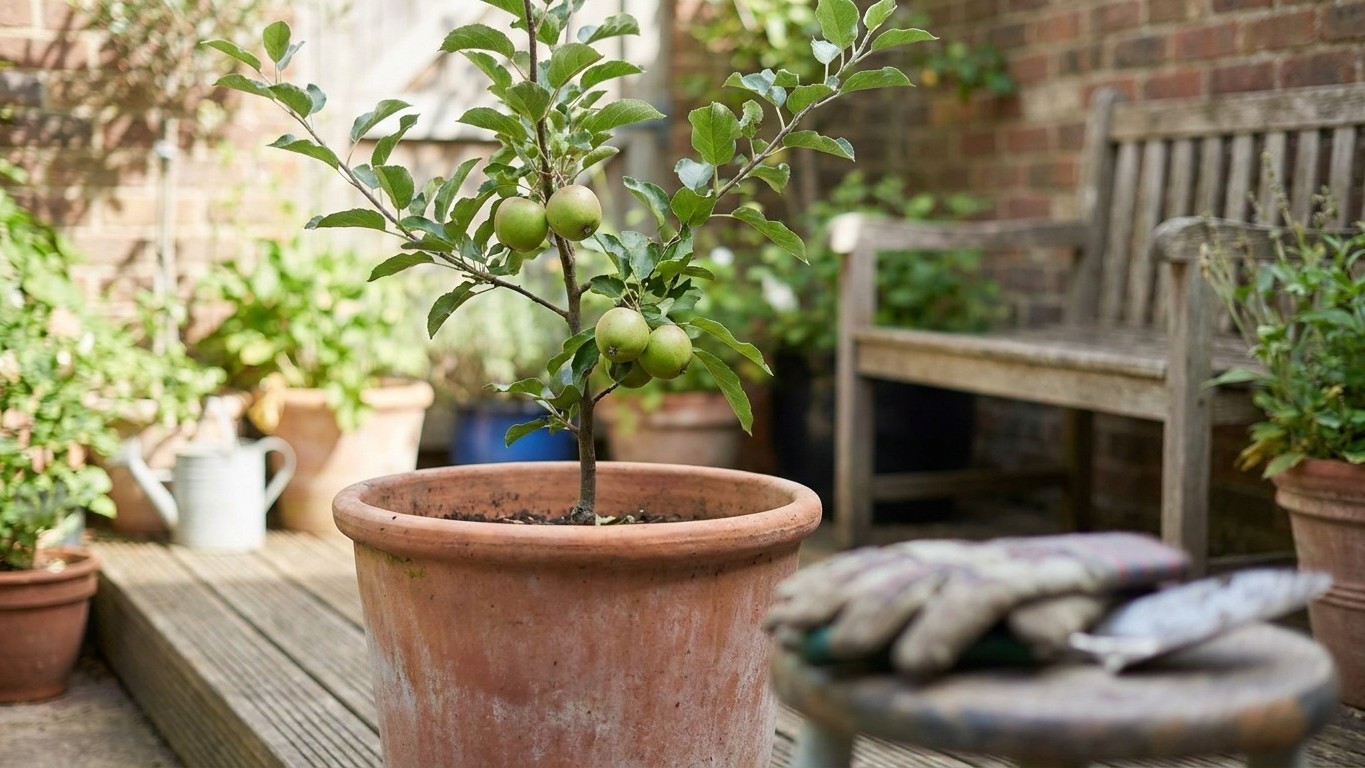

Yes, an apple tree can live its whole life in a pot, but only if you start with the right rootstock — that one choice decides whether it ever fits your patio or fights the container for years. Before you pick a variety, ask the nursery one question: what rootstock is this grafted onto. M.9 keeps a tree at 8 to 12 feet, small enough for a large pot for good. Anything bigger, and no amount of pruning will save it later.
Why it matters
The rootstock sets the ceiling
The rootstock, not the variety grafted onto it, decides whether an apple tree will ever fit on a patio. A ‘Honeycrisp’ or a ‘Fuji’ grafted onto MM.111 reaches 30 to 35 feet according to USU Extension, and no amount of pruning in a pot changes that ceiling in any useful way. The same variety on M.9 stays at 8 to 12 feet, and on M.26 or G.11 at 12 to 15 feet, per the same USU figures. Choose the rootstock before you choose the variety: ask which rootstock a tree is grafted onto, not just what apple it grows.
Get the rootstock wrong and the tree spends years fighting its container. Roots circle rather than spread, growth stalls, and fruiting slows or stops. That choice is made once, at planting, and cannot be corrected later without starting over with a new tree.
Stages that matter
This decision plays out at two stages in the tree’s year. The first is dormancy, when you plant or repot and the roots you disturb have months to recover before growth resumes. The second is bloom, when a container tree grown as a lone specimen depends on a compatible pollinator being within reach of bees, since there’s no orchard block around it to fall back on. Skipping either stage costs a season, not just a task.
Grow apples in the ground and a rootstock mismatch is a slow inconvenience you can prune around for years. In a container, the mismatch shows within three to five years, once roots fill the pot and have nowhere left to go. If you already have an in-ground planting and are adding a potted tree alongside it, the groundwork in Growing Apples still applies. The container just adds a second set of limits on top.
When to do it
Dormancy governs planting and repotting
Plant a bare-root or containerized apple tree while it is fully dormant, with no green showing on the buds. Dormancy gives the roots weeks to settle into new soil before the tree has leaves to support, which matters more in a container than in the ground because a pot holds a fraction of the soil volume and dries out and warms faster. Wait past green tip and the tree stalls, spending energy on leaves before the roots have taken hold.
Repotting an established container tree follows the same rule: do it in dormancy, every two to three years, before buds swell. Root disturbance after green tip happens just as the tree is drawing hardest on stored energy for the season’s new growth, and it never fully catches up.
What moves the dormancy window is climate, not the calendar. Dormancy starts and ends on a different date in a mild coastal climate than it does somewhere with a hard winter, so reading the tree’s own buds, rather than a date on a page, is what actually tells you it’s time.
Bloom governs pollination
Bloom is the other stage that governs container growing, because most apple varieties need a second variety blooming at the same time to set fruit at all. Clemson Cooperative Extension’s HGIC 1350 groups varieties by relative bloom time rather than by date, since the order holds across climates even though the actual dates shift: group A includes Anna and Dorsett Golden; group B includes Fuji, Gala, Ginger Gold, Granny Smith, Jerseymac, Mollie’s Delicious, Mutsu, Red Delicious and Yates; group C includes Arkansas Black, Golden Delicious, Jonagold, Ozark Gold, Priscilla, Rome Beauty and Stayman. Pairing two varieties from the same group, or from adjacent groups, puts a pollinator’s bloom inside your tree’s own bloom window. Pairing group A with group C is the pairing most likely to miss each other entirely.
How to do it

Pick the rootstock and the pot together
Start from the rootstock, since it fixes how large the tree can ever get. USU Extension’s mature-height figures below are the range to work from when matching a rootstock to a life spent in a container.
| Rootstock | Mature height (USU Extension) | Fit for a container |
|---|---|---|
| M.9 | 8-12 feet | Best fit, stays manageable in a large pot for its life |
| M.26 | 12-15 feet | Workable, needs a larger pot and more frequent repotting |
| G.11 | 12-15 feet | Workable, similar demands to M.26 |
| G.30 | 18-20 feet | Outgrows most containers within a few years |
| M.7 | 18-20 feet | Outgrows most containers within a few years |
| M.106 | 25-30 feet | Not suited to a container |
| MM.111 | 30-35 feet | Not suited to a container |
| Seedling | 35-40 feet | Not suited to a container |
Once you know the rootstock, size the container to match. Choose a pot large enough to give the roots several years of room before they fill it, since moving up to a bigger container as the tree grows is easier on the roots than crowding them early. Half whiskey barrels and large nursery pots are common choices, as long as the pot has real drainage holes rather than a single hole or none at all. Fill it with a well-draining potting mix rather than garden soil, which compacts and drains poorly once confined.
Keep the graft union, the visible knob near the base of the trunk, above the soil line, a couple of inches clear of the mix. Bury it and the scion variety can root on its own, which cancels out the dwarfing effect you chose the rootstock for in the first place. Stake the trunk for the first year or two, since a container tree has less root anchorage in a confined volume of mix than the same tree would have in open ground. Water enough to keep the mix evenly moist through the growing season. A pot dries out faster than garden soil and has no surrounding reserve to draw on if you miss a few days in hot weather.
Match pollination before you commit to one tree
Decide on a pollination plan before you plant, not after the first bloom with no fruit to show for it. Some varieties are self-fertile enough to set a partial crop alone, but most need pollen from a second variety blooming at an overlapping time, which for a solitary container tree usually means a second potted tree nearby or a neighboring tree within bee range. Avoid pairing two varieties that both carry sterile pollen, such as Jonagold, Mutsu, Stayman and Winesap: each of these needs pollen from a different variety and cannot supply pollen to another, so a container garden holding only two of them sets no fruit at all, per Clemson HGIC 1350, UGA Circular 740 and USU Extension. Feeding a container tree correctly once it’s cropping is its own topic, covered in Feeding an Apple Tree: When It Helps and When It Hurts, since a pot’s limited soil volume changes how and when nutrients need replacing.
What goes wrong
Roots that never had anywhere to go
A container tree left in the same pot for years shows stunted new growth and leaves that yellow early, the signs of roots that have circled the inside of the pot until they choke each other. By the time you see it above ground, the roots have often already grown into a tight ring, which no amount of feeding fixes. The fix is to slip the tree out at the next dormant season, cut through the worst of the circling roots, and move up to a larger pot.
Overwatering is the more common mistake, and it doesn’t look like too much water. It looks like a tree that wilts despite moist soil, because roots sitting in waterlogged mix have suffocated and can no longer take up water at all. A pot without real drainage holes, or one standing in a saucer that never empties, sets this up regardless of how carefully you water afterward.
Winter is harder on a potted tree than on one in the ground, because roots in a container have far less insulating soil around them and take on outside air temperature much faster than roots buried in open garden soil. A tree that would come through a hard freeze unhurt in the ground can lose roots to the same freeze in a pot. Move containers against a wall, into an unheated garage, or bank them with mulch for winter, and check with your state extension service for the cold-hardiness limits of your particular rootstock and variety combination, since that threshold is specific to your climate.
Fruit that never sets despite healthy bloom usually traces back to pollination, not the weather. Two varieties from bloom groups far apart, per Clemson HGIC 1350’s grouping, miss each other’s flowering window. Two sterile-pollen varieties planted together, such as Jonagold, Mutsu, Stayman or Winesap paired with each other, set no fruit at all because neither can pollinate the other, though either can be pollinated by a third, pollen-fertile variety.
Leaves with olive-green or dark spots, or shoots that blacken and curl as if scorched, point to scab or fire blight rather than to a container problem, and the timing of any spray response is read off the tree’s own stage, not the date on the bag. See The Spray Schedule Read Off the Tree, Not the Calendar for that timing.
What changes where you are
Everything about apple tree timing is relative, not absolute. Dormancy, green tip, pink, bloom, and petal fall happen everywhere apple trees grow, but the calendar dates attached to those stages shift by weeks depending on where you garden. Someone gardening in a mild coastal climate may see green tip on a container tree while someone in a colder interior climate is still weeks from it, even for the same rootstock and variety.
The bloom-group order published by Clemson HGIC 1350 holds regardless of climate: a group A variety like Anna still blooms ahead of a group C variety like Golden Delicious wherever both are grown. What changes is how many days apart they end up, and how much that gap matters for pollination, since a wide climate swing can stretch a gap that’s harmless in one place into a missed pollination window in another.
Winter exposure and rootstock hardiness
How much winter protection a container tree needs depends on both the rootstock and the climate zone, and none of USU, Clemson, or UGA publish a single hardiness figure that applies everywhere. Some rootstocks tolerate root exposure to cold better than others, and a rootstock that overwinters fine in a container in one region may need to be moved into shelter in another. Ask your state extension service which rootstocks it recommends as cold-hardy for containers in your specific area, since that recommendation is one of the few pieces of this decision that genuinely is local.
Chill hours, the accumulated cold a tree needs during dormancy before it can break bud normally, also vary by region and affect which varieties fruit reliably in a pot.
Common questions
Will pruning keep a full-size apple tree small in a pot?
Not reliably. Pruning shapes a tree and slows growth at the margins, but a rootstock like MM.111 or a seedling rootstock is aiming for 30 feet and beyond according to USU Extension, and a container won’t stop those roots from trying to get there. The tree fights the pot for years rather than settling into it. Starting with a dwarfing rootstock such as M.9 or M.26 avoids that fight entirely.
Do I need two apple trees to get fruit from a potted tree?
Usually, yes, unless you’ve confirmed the variety is self-fertile. Most apples need pollen from a second variety that blooms at an overlapping time, and Clemson HGIC 1350’s bloom grouping is the way to check whether two varieties overlap closely enough. If you only have room for one pot, a tree in a neighbor’s yard can serve as the pollinator as long as bees can reach both.
How long will a potted apple tree keep producing?
That depends more on how consistently you repot and manage the roots than on any fixed number of years. A tree moved into fresh mix every two to three years and never allowed to go fully root-bound can keep fruiting for a long stretch of its life. One left in the same pot until roots fill it solid declines regardless of feeding.
Can I bring my potted apple tree indoors for the winter?
Don’t move it somewhere heated. Apple trees need a cold dormant period to break bud normally the following spring, and a warm house skips that requirement rather than protecting the tree from it. An unheated garage, an enclosed porch, or a sheltered spot against an outdoor wall protects the roots from the worst cold without cutting dormancy short.