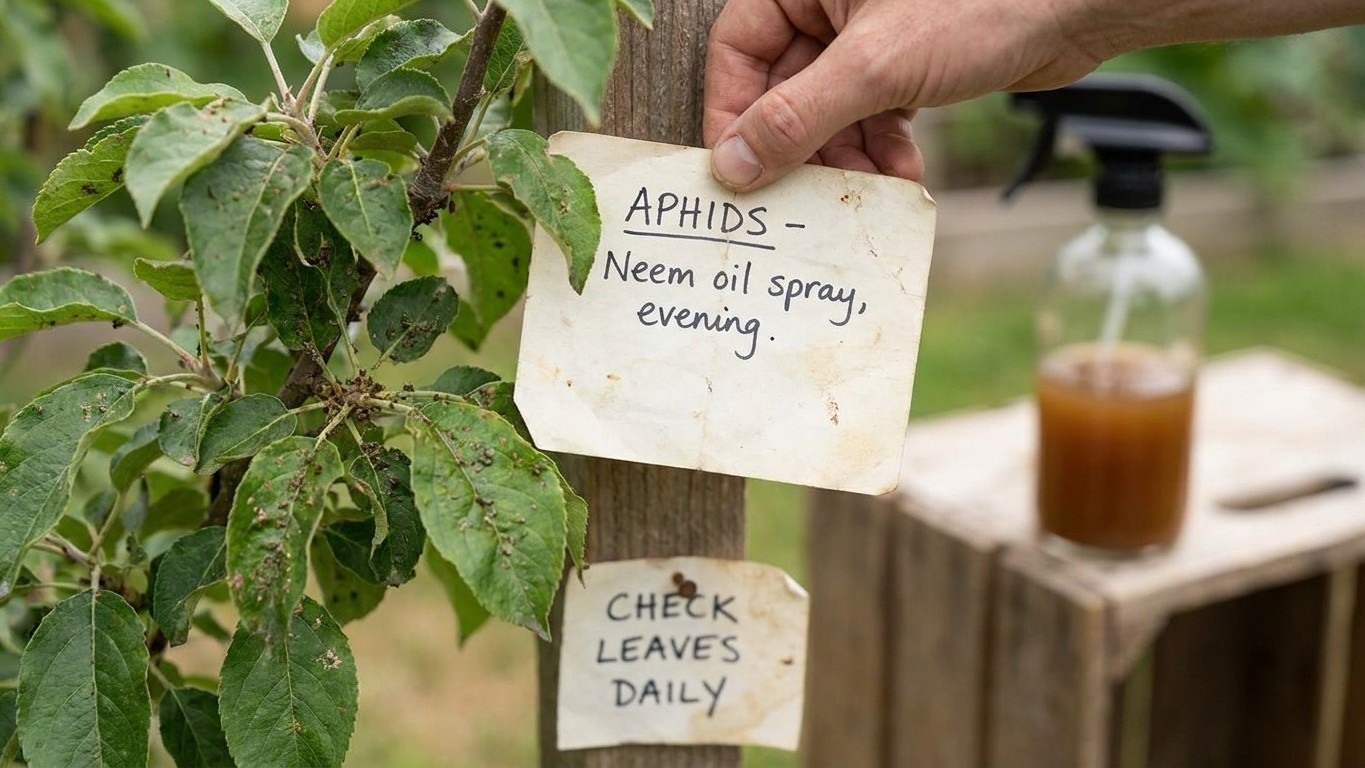

The right time to spray an apple tree is whatever stage the buds are showing that week, not a date circled on a calendar. An orchard two counties over can reach pink a week or two ahead of yours in the same spring, because bud stage tracks accumulated warmth, not the flip of a page. Walk out to the tree once a week starting in late winter, look closely at the terminal buds on last year’s wood, and match what you see to the stage descriptions below before you load the sprayer.
Why it matters
Spray a tree at the wrong stage and you either waste the trip or do real harm. A dormant oil applied while the tree is still fully asleep smothers Overwintering mites and scale on the bark with almost no risk to the tree. The same oil applied after green tip, once soft new tissue is exposed, can scorch it. The gain from reading the tree correctly is not abstract: it is the difference between catching a scab infection before the leaves ever show a lesion and spraying a tree that has already been infected for two weeks.
Five checkpoints, not one calendar date
Every apple tree, regardless of variety, moves through the same five visible checkpoints each spring: dormancy, green tip, pink, bloom, and petal fall. The stage decides the spray, not the week of the year. Dormancy is bare wood with tight brown or gray buds and no green anywhere. Green tip is the first sliver of green pushing through the bud scale. Pink is the flower bud swelling and coloring before the petals separate. Bloom is full open flowers with pollinators working them. Petal fall is the petals dropping while a small green fruitlet starts to swell where the flower was.
If you are just starting an orchard, the groundwork for reading a tree this closely gets easier once you understand what growing apples actually involves season to season, rather than treating each spray as an isolated chore.
When to do it
What moves a tree from one stage to the next is temperature, specifically how much warmth has accumulated since the coldest part of winter passed. That is a site-specific number your own state extension service tracks for your area. What is fixed, and true everywhere, is the order the stages arrive in and, if you grow more than one variety, the order those varieties bloom relative to each other.
Not every variety moves at the same pace
Clemson Cooperative Extension’s HGIC 1350 fact sheet on apples groups varieties by bloom timing. Group A, Anna and Dorsett Golden, blooms earliest. Group B, which includes Fuji, Gala, Ginger Gold, Granny Smith, Jerseymac, Mollie’s Delicious, Mutsu, Red Delicious, and Yates, follows next. Group C, including Arkansas Black, Golden Delicious, Jonagold, Ozark Gold, Priscilla, Rome Beauty, and Stayman, blooms last. That order holds regardless of climate, even though the actual dates shift from one region to another. If your yard mixes varieties from different groups, you will be reading pink and bloom off two or three trees at slightly different times, not off one calendar entry for the whole orchard.
Bloom stage carries an extra rule that has nothing to do with disease control: whatever you spray during bloom must not harm the pollinators the flowers depend on. This matters even more in an orchard holding a variety with sterile pollen. Jonagold, Mutsu, Stayman, and Winesap all produce pollen that cannot fertilize another tree, a fact carried by Clemson HGIC, the University of Georgia’s Circular 740, and Utah State University Extension alike. Such a tree still needs pollinator visits to set fruit from a different variety’s pollen, so a bloom-stage spray that drives off bees costs you the crop twice over. The pairing decisions that avoid this problem start well before bloom, at the point covered in Buying an Apple Tree: What the Label Does Not Tell You.
How to do it

Start the weekly bud walk in late winter, while the tree is still fully dormant, and keep at it through petal fall. Bring a hand lens if you have one. Look at spur buds on two-year and three-year wood, not just the tips of new shoots, since spurs are what carry most of the flower buds on a mature tree.
Match the gesture to the stage
- Dormancy: this is the window for a dormant oil, applied while the wood is bare and no green shows anywhere on the buds.
- Green tip through pink: this stretch is when most fungicide programs for scab begin, timed to rain and wetting events rather than to a fixed number of days.
- Bloom: hold off on anything that could harm pollinators. If a spray is unavoidable during bloom, it should target disease only, and only a material your local extension service has confirmed is safe to use while flowers are open.
- Petal fall: this is typically when the first insecticide pass for fruit-stinging pests goes on, once the petals have dropped and the tiny green fruitlet is visible.
Coverage depends on the size of the tree you are spraying, and that size is fixed by rootstock, not by variety. USU Extension’s rootstock figures make the practical difference clear:
| Rootstock | Mature height (USU Extension) | Realistic spray equipment |
|---|---|---|
| M.9 | 8-12 feet | Backpack or hand-pump sprayer reaches the whole canopy |
| M.26 | 12-15 feet | Backpack sprayer with an extension wand for the top |
| G.11 | 12-15 feet | Backpack sprayer with an extension wand for the top |
| G.30 | 18-20 feet | Higher-pressure or tow-behind sprayer for full coverage |
| M.7 | 18-20 feet | Higher-pressure or tow-behind sprayer for full coverage |
| M.106 | 25-30 feet | Airblast sprayer or a hired spray service |
| MM.111 | 30-35 feet | Airblast sprayer recommended |
| Seedling | 35-40 feet | Airblast sprayer or professional service |
A tree left unpruned makes every one of those problems worse, because a dense canopy blocks material from reaching the inner branches no matter what sprayer you own. The structural work that keeps a canopy open enough to spray properly is laid out in Pruning an Apple Tree in Winter: Where to Cut, and it pays off every spring after.
What goes wrong
The most common mistake is spraying by the date rather than the bud. A calendar reminder that says “apply fungicide” on a fixed day will sometimes land during a rain-soaked infection window and other times miss it by a week, and the tree cannot tell you which happened until the leaves show lesions weeks later.
Errors that show up too late to fix
Spraying an insecticide during bloom is the error with the highest cost, because it kills the pollinators the flowers need at the exact moment they are working the blossoms. The damage does not show as a dead bee at your feet. It shows up in early summer as a tree that bloomed heavily but set almost no fruit, and by then there is nothing left to do for that season.
Skipping the petal fall spray is the second common gap. Fruit-stinging insects are active in the days right after petals drop, and a missed window here often does not show damage until the fruit has sized up and the stings become visible dimples or scars on the skin, long after the insect that caused them is gone.
On a tall tree, uneven coverage causes a subtler failure. A hand sprayer that reaches the lower third of an MM.111 or seedling tree at 30 to 40 feet leaves the upper canopy essentially untreated, and disease or insect pressure concentrates exactly there, out of easy sight from the ground. Finally, a heavy rain within a day or two of any spray can wash material off the leaves before it has done its job, and the fix is a repeat application, not a shrug.
What changes where you are
The order of stages, the bloom groups, and the sterile-pollen varieties hold true in every state. What shifts by region is the calendar date each stage actually falls on, because that depends on winter chill accumulation and spring warm-up, both of which your own state’s climate sets and a national fact sheet cannot.
Pest and disease pressure also varies by region. Some areas deal with cedar apple rust pressure that others barely see, and the fungicide materials legally registered for home use differ from state to state. Check with your state’s cooperative extension service for the specific pest calendar, chill-hour tracking, and approved materials for your area before you build out a full spray program. That local guidance, layered on top of the stage-by-stage reading described here, is what turns this into a schedule you can actually follow rather than one you are guessing at.
Common questions
My tree bloomed early this year, does that mean it’s diseased?
No, early bloom on its own is not a disease symptom. It usually just means your winter and early spring ran warmer than average, which shifts every stage earlier without changing the order they arrive in.
Do I need to spray a small backyard tree the same as a commercial orchard would?
Not necessarily. A single dwarf tree on M.9 or M.26 rootstock carries a much lighter pest load than a solid block of trees, and many home growers get by with fewer passes, timed carefully around the stages that matter most, rather than a full commercial program.
Can I skip the dormant oil spray if I didn’t see any pest problems last year?
You can, but a clean year does not mean no pests are present, only that pressure was low enough to miss. Skipping it is a reasonable risk on a healthy young tree, less so on an older tree with rough or flaking bark where pests overwinter more easily.
What if it rains right after I spray?
Check how long the specific product’s label says it needs to dry before it is considered rainfast. If rain falls before that window passes, plan on reapplying once conditions allow, since a washed-off spray gave the tree no real protection at all.