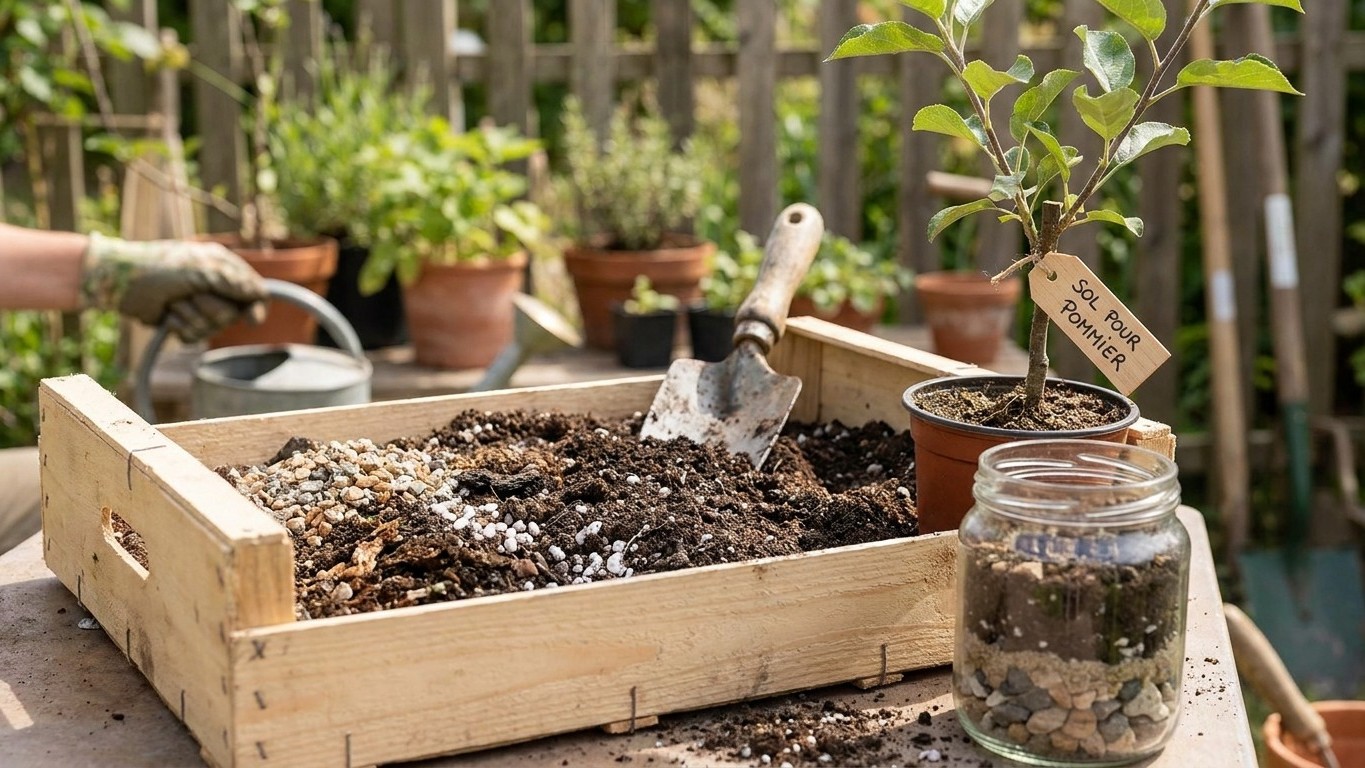

Apple trees need soil that drains within a matter of hours after a hard rain, not soil that is rich or perfectly balanced in pH. Roots that sit in water for a day or more start to suffocate, and once the fine feeder roots die back, no amount of fertilizer brings the tree back. Before you plant, or before you try to diagnose a struggling tree, dig a hole about a foot deep, fill it with water, and time how long it takes to drain.
Why it matters
Apple roots need oxygen almost as much as they need water, and soil that stays saturated pushes the air out of the pore spaces the roots depend on. Within a couple of days the fine feeder roots start to die, and the tree responds by shedding leaves or wilting even though the ground underneath is soaked, not dry. Once a mature root system has rotted back, no amendment fixes it; the fastest recovery is often to start over on a better site.
This matters most at one stage: before the tree ever goes in the ground. Drainage is a site condition, not a maintenance task, and it is far easier to test and correct a bare planting hole than to rescue a tree that has been struggling through its first two or three growing seasons on waterlogged ground.
Rootstock size changes how forgiving a site can be. A tree on M.9 rootstock tops out at 8 to 12 feet at maturity, and on G.11 at 12 to 15 feet, according to USU Extension’s variety guide for the home garden. Both keep the bulk of their roots in the top foot or two of soil, right where waterlogging does the most damage. A tree on a seedling rootstock, by the same USU figures, reaches 35 to 40 feet at maturity, and its root system typically pushes deeper, giving it more soil layers to draw on if the topsoil turns soggy for a stretch. Choosing a dwarfing rootstock for a site with marginal drainage stacks the odds against the tree before it ever leafs out.
When to do it
Drainage gets fixed, if it needs fixing, during dormancy, before the tree goes into the ground and before any root growth has started. This is also the stage to run a percolation test on a site you are still deciding on, because a dry, frozen, or waterlogged root zone at planting time behaves the same way for the rest of the tree’s life unless you change the ground itself.
What moves this timing is the weather leading up to planting, not the calendar. A stretch of heavy rain, a high water table from snowmelt, or ground still saturated from winter all change what the same patch of soil tells you on different days. Test after a normal rain, not right after a downpour and not during a drought, or the result will exaggerate the problem in one direction or the other.
The next checkpoint is at green tip, when the buds start to swell and show color, because spring rains often saturate soil at exactly the moment the roots wake up and need oxygen the most. A site that drained fine in dormancy can still flood at the roots during a wet spring, so a second look at green tip catches problems the first test missed.
How large an area needs correcting depends on the rootstock again. A tree on G.30 or M.7 reaches 18 to 20 feet at maturity, per USU Extension, and its root system spreads well beyond the planting hole within a few years. Amending or draining only the hole itself buys a season or two before those wider roots reach the same wet clay you were trying to avoid in the first place.
How to do it

Run the percolation test
Start with a percolation test on the actual spot the tree will occupy, not a few feet away where the ground looks similar. Dig a hole about a foot wide and a foot deep, fill it with water, let it drain once to saturate the surrounding soil, then fill it a second time and time the drop.
- Under about four hours to drain fully: the site is fine as it is
- Four to twelve hours: workable, but plan to plant on a raised mound and mix organic matter well beyond the hole
- Over twelve hours, or standing water the next day: treat the site as a drainage problem to solve before you plant, not after
Fix a slow site, don’t just dig deeper
If the ground drains slowly, the fix is rarely to dig the hole deeper. A hole dug into clay often ends up with smooth, compacted walls that hold water like a bowl, sometimes called a bathtub effect, and a deeper hole just makes a deeper bathtub. Breaking up the walls and floor with a fork before backfilling helps roots push through, but it does not solve a site where the whole area sits wet.
For a site that drains slowly across a wide area, build a raised planting mound a foot or so high and several feet across, wider than the tree’s eventual root spread, using topsoil mixed with compost rather than pure amendment dumped into a narrow hole. On a slope, position the tree so surface water runs past it rather than pooling against the trunk. Where a hardpan layer or a genuinely high water table is the cause, a French drain or perforated tile leading away to a lower point on the property does more than any amount of soil amendment, though installing one is worth planning before, not after, you’ve bought the tree.
Match the rootstock to what the site can actually offer. On ground you have improved but still distrust a little, a rootstock with a shallower root system, such as M.26 or G.11, both reaching 12 to 15 feet at maturity by USU’s figures, keeps most of the root system in the layer you have amended. On genuinely difficult ground, a more vigorous rootstock such as MM.111, reaching 30 to 35 feet at maturity, or a seedling rootstock at 35 to 40 feet, sends roots deep enough to find better soil below a shallow wet layer, though neither substitutes for fixing the drainage you can control.
What goes wrong
The most common mistake is amending only the planting hole in heavy clay, filling it with compost and loose topsoil while the surrounding ground stays dense and unbroken. The amended hole then acts like a sponge, pulling in water from the clay around it faster than it can drain out the bottom, and the tree ends up standing in a pot-shaped puddle a foot underground. This shows up as a tree that looks fine for a season, then declines steadily through its second and third year for no obvious reason.
What root rot from waterlogging looks like
Root rot from waterlogging is easy to mistake for something else at first. Look for leaves that are smaller than they should be and pale rather than the usual green, wilting in the heat of the day even though the soil underneath is wet, not dry. At the base of the trunk, at or just below the soil line, healthy bark is firm and tight. Rotted bark there turns dark, sometimes sunken or cracked, and the wood underneath is discolored rather than the pale, clean tissue of a healthy tree. By the time the canopy shows obvious dieback, the root loss has usually been underway for a full season or more.
The opposite mistake, planting on ground that drains too fast, gets far less attention but costs just as many trees. Pure sand or heavily disturbed fill soil can drain within minutes, and a tree there dries out between waterings even when watered on a normal schedule, because the soil cannot hold enough moisture in reserve. The fix runs the other direction: more organic matter worked through a wide area, and a watering routine matched to the soil rather than to a fixed calendar, a balance covered in more detail in Watering a Young Apple Tree: How Much and How Often.
A third error is testing drainage once, in a wet spring, and assuming the verdict holds all year. Soil that drains acceptably after a dry summer can seal up and hold water through a wet fall and winter, particularly on clay. One test tells you about one set of conditions, not the site’s full range.
What changes where you are
How much of this article applies to you depends on soil texture and rainfall pattern more than on climate zone alone. Heavy clay is common in some regions and nearly absent in others, and a rainfall pattern that delivers steady, moderate rain all year behaves very differently at the root zone than the same annual total delivered in a few intense storms. Neither the mature heights by rootstock nor the bloom timing groups used elsewhere in apple growing change the answer to a drainage question. Only your own ground does.
The most useful next step for your specific site is a soil test through your state’s extension service or a local soil-testing lab, which can tell you the texture, drainage class, and any hardpan or high water table specific to your property, none of which a national article can responsibly guess at. Your state extension service is also the right source for local rainfall averages and any regional guidance on raised beds or tile drainage that fits your area’s soil types.
If your ground fails every test you throw at it and a French drain or raised mound is not practical, growing the tree in a container sidesteps the drainage question almost entirely, since you control the growing medium from the start. That approach comes with its own tradeoffs around root space and winter protection, covered in Growing an Apple Tree in a Container. For the broader groundwork a drainage decision fits into, from site selection through rootstock choice, see Growing Apples.
Common questions
Can I improve drainage after the tree is already planted?
Only to a limited degree. You can improve surface drainage around an established tree with a French drain or by regrading the surrounding ground, but you cannot dig up and amend the soil directly under an established root system without damaging it. Correcting drainage works best before planting, which is why the percolation test matters most at that stage.
Does apple tree soil need a specific pH?
A soil test through your state extension service or a local lab will tell you your actual pH and whether it needs adjusting, which is more reliable than a generic number applied to every garden.
What does root rot look like early on, before the tree dies?
Look for leaves that are smaller and paler than normal, wilting during the heat of the day even in wet soil, and reduced shoot growth compared to a healthy tree of the same age. Bark discoloration at the soil line, described above, usually shows up later than the leaf symptoms.
Is raised-bed planting always better for apple trees?
No, only where drainage is the limiting factor. On ground that already drains well, a raised mound just makes the root zone dry out faster and adds an unnecessary watering burden, so match the fix to the actual percolation test result rather than applying it everywhere by default.