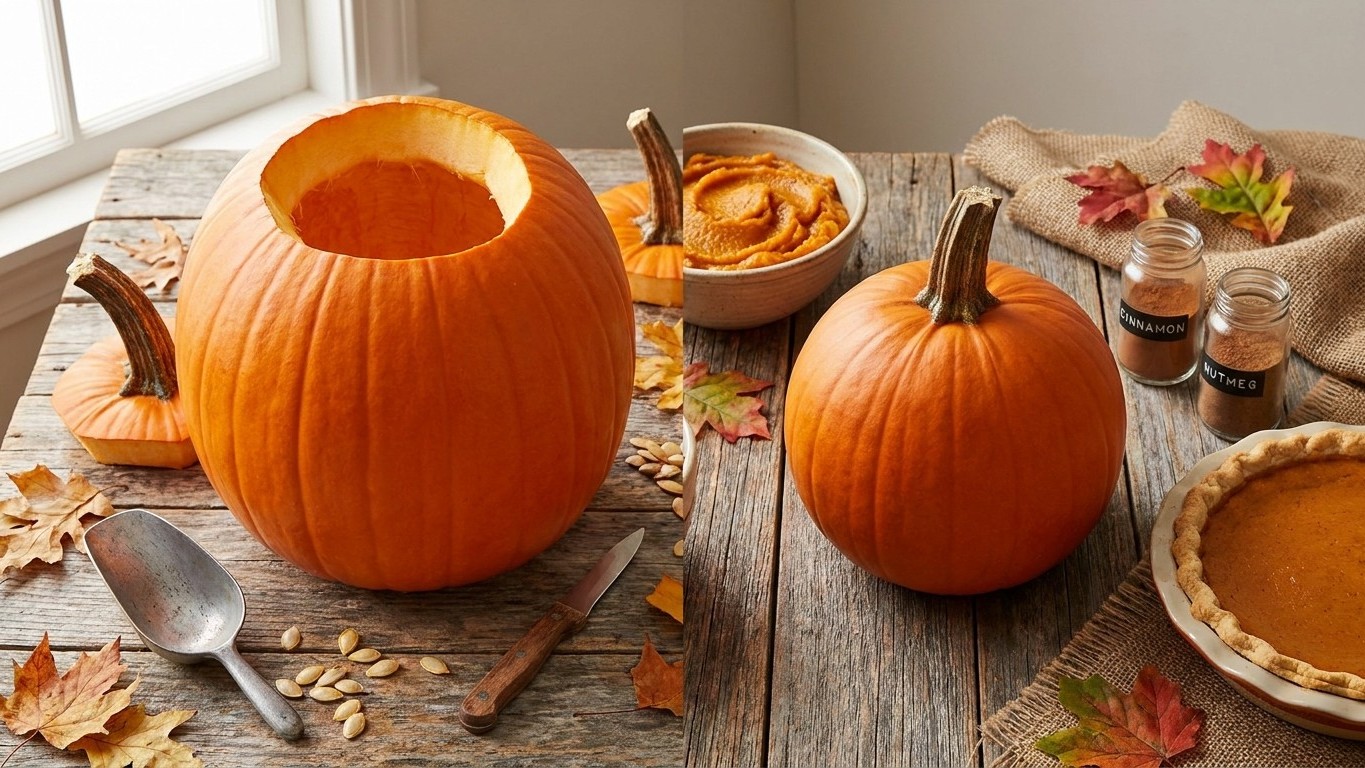

Carving pumpkins and pie pumpkins are not interchangeable, and University of Illinois Extension spells out why: carving types are “great for decorating and carving” with bright orange, smooth skin, while pie or “processing” pumpkins carry higher sugar content and less watery flesh built for the oven. Grab the wrong one and your jack-o’-lantern flops, or your pie turns stringy and bland.
The short answer

University of Illinois Extension draws a clean line between the two. Carving pumpkins “generally have bright orange smooth skin, can be very large, and have a stem,” bred for a knife and a candle, not a mixing bowl. Pie pumpkins, sometimes labeled “sweet” pumpkins in the same Extension guidance, are “more desirable for baking or cooking” because they carry higher sugar content, more flavor, less water, and flesh with a smoother texture once cooked down.
Size gives away the intent behind the breeding. For cooking, University of Illinois Extension recommends picking smaller pumpkins, ideally between 4-8 pounds. That’s a fraction of what a carving variety can reach, and the difference isn’t cosmetic. A carving pumpkin’s genetics push toward big, hollow-walled fruit with thin flesh, easy to hollow out with a scoop and a steady hand. A pie pumpkin’s genetics push the other way, toward dense, sugary flesh packed into a compact shell.
Utah State University Extension names specific varieties that fall on each side of that line. Autumn Gold, Connecticut Field, Spirit Hybrid, Big Max, and Big Moon lean toward carving and display work, the kind of pumpkins that show up on porches around October 31. Jack Be Little, Wee-B-Little, and Baby Bear run small and sweet, closer to what a baker wants. Lumina, the white-skinned variety, gets grown mostly for looks. Utah State University Extension notes some varieties “can be used for pies and carving,” so a handful of dual-purpose types exist, but they’re the exception, not the rule.
So if you’re shopping for a Halloween centerpiece, size and a sturdy stem matter more than flavor. If you’re shopping for a pie filling, weight and variety name matter more than how photogenic the pumpkin looks sitting on a hay bale. Read the sign at the farm stand, or ask which patch a pumpkin came from, because visually two orange globes can look nearly identical while cooking up completely different.
What actually decides it
Sugar content and flesh texture
The core mechanism is what University of Illinois Extension describes directly: pie pumpkins carry higher sugar content and smoother-textured flesh, while carving types don’t get bred for either trait. A carving pumpkin’s flesh tends to be thinner-walled, stringier, and wetter, which is exactly what you want when you’re scooping out a cavity for a candle but exactly what ruins a pie filling. Water content matters because excess moisture in a puree means a soggy, loose filling that never sets right in a crust.
Breeding purpose, not random variation
These aren’t just individual pumpkins that happened to turn out different. Utah State University Extension lists distinct named varieties bred for one purpose or the other: Connecticut Field, Big Max, and Big Moon for size and display, Jack Be Little, Wee-B-Little, and Baby Bear for eating. Growers select seed stock generation after generation for the trait they want, whether that’s a hollow shell that carves clean or dense flesh that bakes sweet. The pumpkin aisle isn’t sorting random genetics. It’s sorting decades of targeted plant breeding.
Size and moisture ratio
Weight is the practical clue a shopper can use without a variety tag. University of Illinois Extension’s cooking recommendation, 4-8 pounds, reflects a smaller fruit with a higher ratio of dense flesh to hollow cavity. Big carving pumpkins grow that size by developing more open interior space and thinner walls, useful for a knife, useless for a recipe that needs pounds of solid flesh per pumpkin. A 20-pound carving pumpkin might yield surprisingly little usable puree once you scrape out the stringy interior and seeds.
How to do it
- Decide the purpose first. Are you carving a display piece or cooking a filling? That answer determines every choice that follows.
- For carving, look for the traits University of Illinois Extension names: bright orange, smooth skin, a firm stem, and size proportional to your design plans.
- For cooking, target a smaller pumpkin in the 4-8 pound range that University of Illinois Extension recommends, and ask if it’s a named pie or sweet variety such as those Utah State University Extension lists for eating.
- Check the whole fruit for soft spots, cuts, or mold before buying. A pumpkin with broken skin won’t hold up whether it’s headed for a knife or an oven.
- Carry the pumpkin by cradling the base, never by the stem. The stem can snap under weight, and a broken stem speeds up rot on a carved pumpkin.
- Store the pumpkin whole in a cool, dry spot until you’re ready to use it. Don’t cut or hollow it out days ahead of when you need it.
- Carve close to the day you plan to display it. No university extension publishes a fixed shelf life for a carved pumpkin, so the practical move is choosing a firm, undamaged fruit and cutting it as close to showtime as your schedule allows.
- For cooking, wash the exterior, cut, remove seeds and strings, and roast or steam the flesh according to your recipe’s method rather than the pumpkin’s appearance.
What goes wrong
- Buying a carving pumpkin for pie filling. The flesh runs watery and stringy, exactly the traits University of Illinois Extension attributes to carving types rather than pie types. The remedy: check for a named pie or sweet variety, or stick to the 4-8 pound range before you buy.
- Buying a small pie pumpkin expecting a big jack-o’-lantern. Pie varieties like Jack Be Little or Baby Bear, named by Utah State University Extension, stay compact by design and won’t give you the large carving surface a display piece needs. Pick a carving-type variety instead if size is the goal.
- Carrying the pumpkin by the stem. The stem isn’t a handle. It can snap off under the fruit’s weight, and a pumpkin missing its stem tends to soften and spoil faster whether it’s carved or whole. Always support the pumpkin from underneath.
- Expecting a published “shelf life” for a carved pumpkin. No extension source lists a specific number of days a jack-o’-lantern lasts, and no research-backed preservation dip or coating protocol exists in that guidance either. Don’t chase a magic fix. Instead, choose a firm, undamaged fruit and carve near the date you plan to display it.
- Carving weeks ahead of the event. Even a well-chosen pumpkin declines once it’s opened up and exposed to air. Timing the carving close to when you’ll actually show it off does more for appearance than any treatment applied to a pumpkin cut too early.
- Ignoring soft spots at the store. A bruise or soft patch on a pumpkin, carving or pie type, usually signals internal damage that spreads fast once the fruit is cut. Inspect the whole surface, including the bottom, before you commit to one.
Common questions
Can you cook with a carving pumpkin if that’s all you have?
You can, but University of Illinois Extension’s guidance points toward pie or sweet varieties for baking because of their higher sugar content and less watery flesh. A carving pumpkin will cook, but expect a thinner, less flavorful result compared to a purpose-grown pie pumpkin in the 4-8 pound range.
Are Jack Be Little and Wee-B-Little only decorative?
Utah State University Extension lists these small varieties among pumpkins used for eating, alongside Baby Bear, though their tiny size also makes them popular for tabletop decorating. Some pumpkins do double duty, but the majority of named varieties lean toward one purpose or the other.
Does a bigger pumpkin always mean it’s a carving type?
Not automatically, but size is a useful clue. Utah State University Extension names Big Max and Big Moon as large carving and display varieties, while pie types stay smaller by design. If a pumpkin is well above the 4-8 pound cooking range University of Illinois Extension recommends, it’s more likely bred for carving or display than for a pie filling.
Is there a trick to make a carved pumpkin last longer?
No extension source publishes a preservation method or a specific number of days a carved pumpkin holds up. The practical approach is choosing a firm pumpkin with smooth, undamaged skin, keeping it whole until you’re ready, and carving it close to the day you plan to display it rather than weeks in advance.