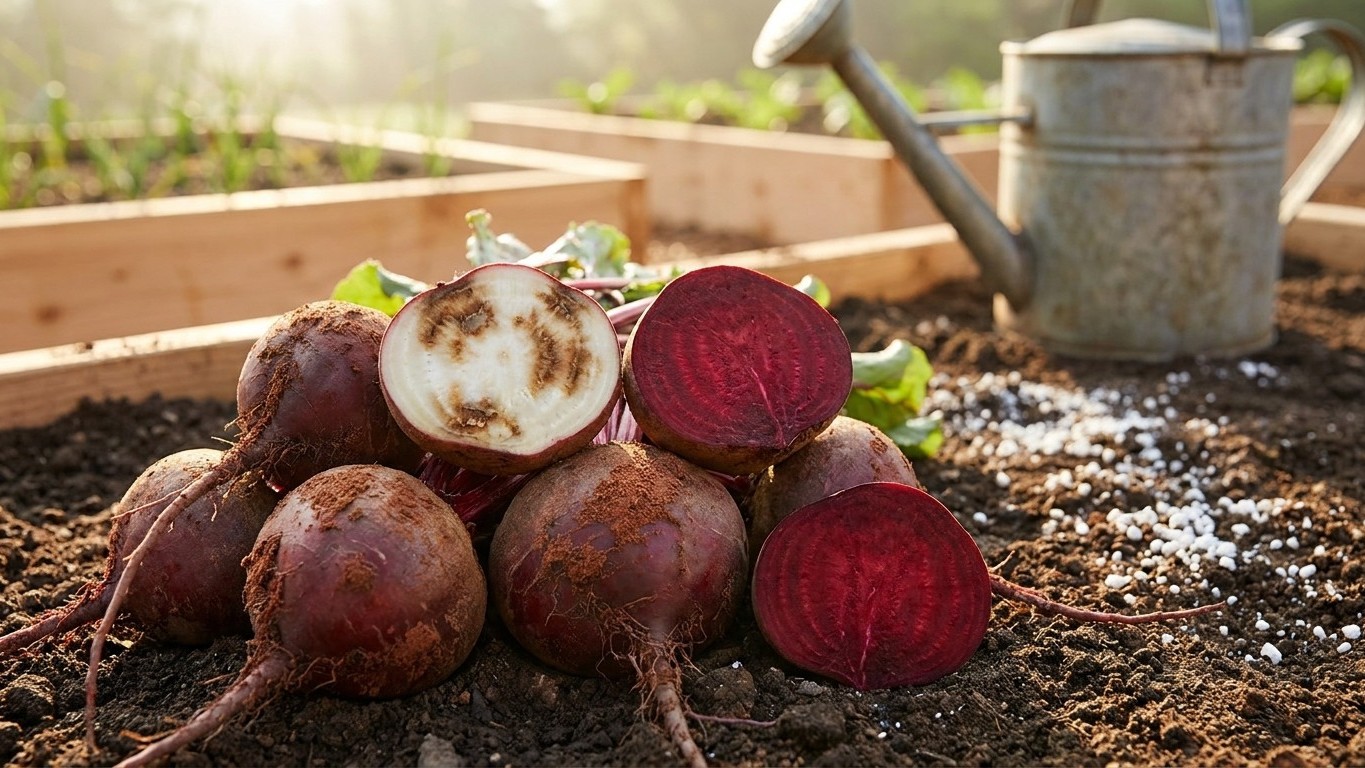

In Nova Scotia, three things take most of a beet crop, and none of them has legs. The first is thirst in the first six weeks, which sends young plants to flower. The second is warm weather above 85 F combined with thirst, which turns roots woody. The third is a storage room that is too cold, which invites black spot and rot. Insects and leaf diseases are not covered by the verified data behind this page, so they are left out rather than guessed at.
The short answer
Start with the ground. Canada has no official provincial soil the way a US state does, so there is no single series name to cite. What the soil survey does give is the dominant profile: across 472 mapped surface horizons in Nova Scotia, the commonest soil order is Podzol, covering 53 percent of the mapped surface, with Gleysolic soils next. A Podzol is the acid, leached soil that forms under conifers, where rain has washed the bases out of the top layer. The median surface is 52 percent sand, 10 percent clay and 38 percent silt, a loam to silt texture. Organic matter sits around 2.1 percent, median pH is about 5.2 (strongly acid), and the drainage class is imperfect. The source is Agriculture and Agri-Food Canada’s Canadian Soil Information Service.
Treat that as a starting point, not a diagnosis. The province spans hundreds of soils, the survey covers agricultural districts only, and your garden may look nothing like the median. River bottoms, boggy ground and any lot a builder has scraped or filled will behave differently. The pH of 5.2 is the median of the survey, never your pH. A soil test gives you your own number.
Set that profile against what beets want. Utah State University Extension describes deep, sandy, well-drained soil rich in organic matter, amended with no more than 1 inch of composted organic matter per 100 sq ft. The sand share (over half) is on the right side of that description. The 10 percent clay is low enough that a heavy, sticky seedbed is not the typical problem. The mismatches are the modest organic matter and the imperfect drainage, which means water lingers after a wet spell. The Extension guidance gives no pH target, so the acidity question goes to your soil test, not to a rule of thumb from this page. For the root’s-eye view of this ground, see Beet Soil in Nova Scotia: What the Root Will Meet.
Then there is heat. The same Extension source says that heat above 85 F with water stress makes the root woody. How many days a year Halifax, the reference city for this page, passes 90 F is not published in the verified data here, and I won’t guess at it. Use the 85 F figure instead: it is the lower and more useful trigger, and your own thermometer will tell you how often your garden crosses it. Woodiness is a mid-season problem of the swelling root. It has nothing to do with the early flowering problem described next, and the two need different handling. The broader picture is in Growing Beets in Nova Scotia.
The six weeks that decide it here
The Extension source is blunt: water stress in the first 6 weeks causes premature flowering. That is bolting, and it is decided early, which makes the timing of sowing the main lever you have.
The average last spring frost at Halifax Stanfield, from Environment and Climate Change Canada’s climate normals, is May 7. It is a mean, not a safe date. In one year out of two the last frost falls later than that, so read it as the midpoint of a window. It also comes from one airport station. Northern and upland districts of the province run weeks behind it, and the Canadian normals use an older 30-year period than the US figures used elsewhere on this site.
Sowing beets 2 to 3 weeks before the last frost, counted from that Halifax mean, points to roughly April 16 through April 23. The first six weeks then run to somewhere between late May and early June. That stretch is the part of the calendar this page cares about. For the full sowing logic, see When to Sow Beets in Nova Scotia.
What does that stretch usually do? Nova Scotia’s spring is shaped by the Atlantic: slow to warm, often damp, and given to swings between raw wet weeks and a few dry, bright ones. No verified figure here quantifies it, so take it as a general pattern. It puts the bolting risk in the dry spells, not in the wet ones. A damp May leaves imperfectly drained ground holding water, so seedlings rarely go thirsty. A dry fortnight in late May is different. A sandy-leaning loam sheds water faster than a clay would, and seedlings with shallow roots feel it within days. That is when a missed watering costs you, because the damage shows weeks later as a flower stalk.
Beets are sown in place, not transplanted, so the 60 to 80 days to harvest run from seeding. From an April 16 to April 23 sowing, that puts the earliest roots in mid-June and the latest in mid-July. Roots swelling through the first half of July are exactly the ones exposed to warm spells above 85 F. So there are two separate windows. The bolting window closes at about six weeks, and the woodiness window opens after it and runs while the root bulks up. Watering through a dry May does nothing to prevent woodiness in July, and heavy July watering cannot undo a bolt that started in May.
What goes wrong here
Each failure below comes from this soil, this spring or this storage routine, and each has a fix you can start on this season.
- Bolting after a dry spell. Thirst in the first six weeks sends plants to flower. Remedy: water seedlings deeply through any dry stretch from sowing to about six weeks, and check the soil a few inches down instead of trusting the surface.
- Woody roots in warm weather. Heat above 85 F with water stress is the trigger. Remedy: keep moisture even once roots start swelling, and do not blame early watering for this one. It is a separate problem with a later clock.
- Waterlogged ground in a wet spring. Imperfect drainage, and the Gleysolic soils that rank second, mean water can linger. Remedy: sow on raised rows or beds so the root has air, and skip any planting spot where water pools after rain.
- Too much compost. The Extension limit is no more than 1 inch of composted organic matter per 100 sq ft. With organic matter near 2.1 percent, it is tempting to pile it on. Remedy: stay under the limit and let a soil test show what is missing.
- Unknown acidity. The median surface pH is about 5.2, but yours may differ widely. Remedy: test your own bed before adding anything, and amend according to that result.
- Sowing against an unreliable frost date. May 7 is a mean for Halifax, and half of years run later. Remedy: look up the frost record nearest your garden, and treat the early end of the sowing window with caution.
- Roots that shrivel or rot in storage. The USDA’s Handbook 66 says topped beets keep best at 33 to 36 F and 98% relative humidity, and that storage at 32 to 34 F brings more black spot and rot. Colder is not better here. Remedy: top the roots first, because bunched beets with leaves last only 10 to 14 days. Keep the large roots for storage, since small ones lose water and shrivel faster, and eat the small ones first. In a pit or cellar, stay between 31 and 41 F.
Common questions
Is bolting the same as woody roots?
No. Bolting is early flowering caused by water stress in the first six weeks after sowing. Woodiness is a tough, fibrous root caused by heat above 85 F combined with water stress later on. They happen at different stages, so a garden can suffer one and escape the other.
Can I use the Halifax frost date for my own garden?
Use it as a rough anchor and nothing more. May 7 is the average last frost at one airport station, and in one year out of two the last frost comes later. Northern and upland parts of Nova Scotia run weeks behind it, so a record from a station near you is the better guide.
What temperature should I store beets at?
For topped roots, 33 to 36 F with 98% relative humidity. Going down to 32 to 34 F produces more black spot and rot, which surprises gardeners used to colder storage for other root crops. Pits and cellars should stay between 31 and 41 F.
Do I transplant beets, and how long until harvest?
Beets are sown directly where they will grow. The 60 to 80 days to harvest count from seeding, not from setting out a plant. Keep the large roots for storage and pull the small ones first, since the small ones shrivel faster once they are out of the ground.