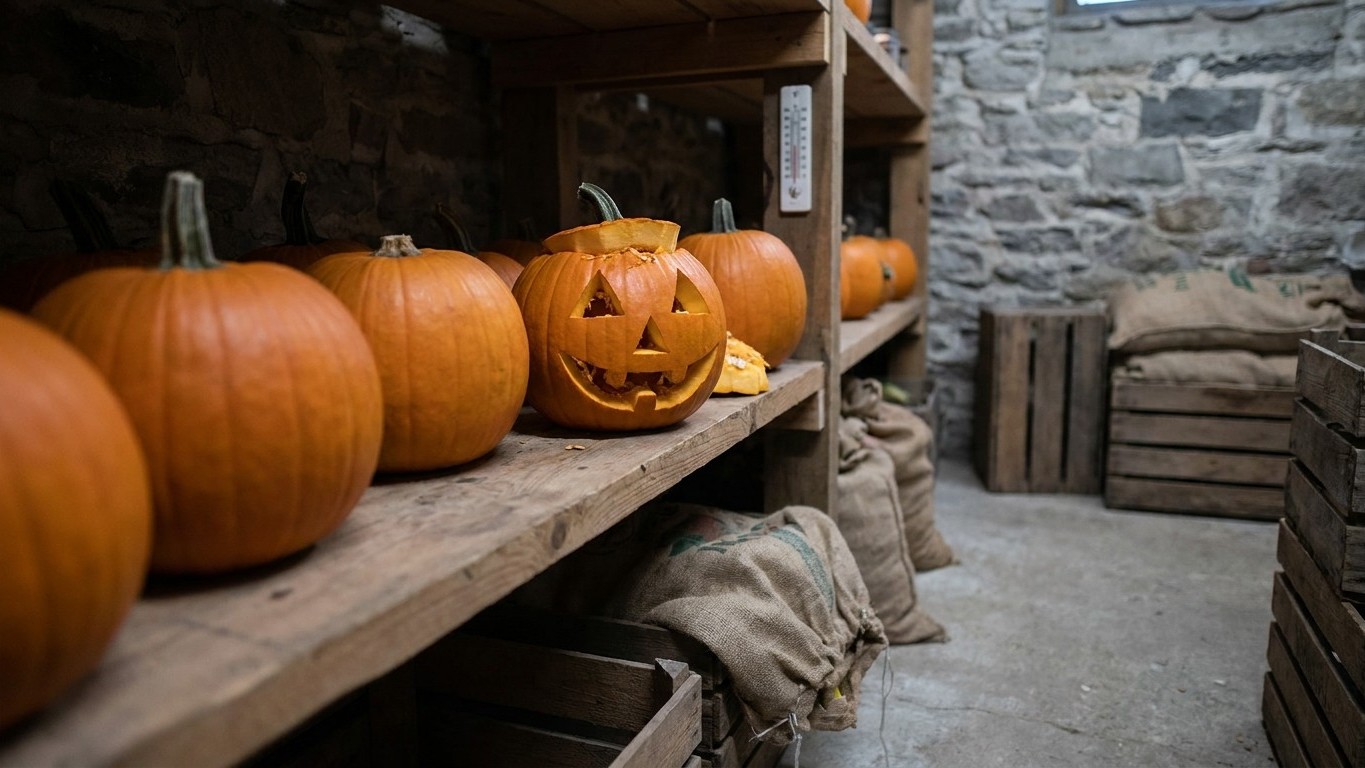

Neither University of Illinois Extension nor Utah State University Extension publishes a shelf life for a carved pumpkin. That’s the honest answer. What is published, and what actually matters, is how you choose and store the pumpkin before you ever pick up a knife.
The short answer

Search “how long does a carved pumpkin last” and you’ll find dozens of confident numbers. None of them trace back to a university extension service. University of Illinois Extension, one of the few research institutions that publishes detailed pumpkin-care guidance, addresses the whole, uncarved pumpkin. It states plainly that “you can keep pumpkins for three to six months” when stored in a cool, dark location “between 45-50 F.” That figure applies to a pumpkin with its skin intact, sitting away from ripening produce. It says nothing about a jack-o’-lantern with its top removed and its flesh exposed to air.
Utah State University Extension, the other authority worth citing here, focuses on variety selection rather than storage duration. It distinguishes carving pumpkins from pie pumpkins, noting they are not the same fruit, and names specific cultivars in The Pumpkin Varieties the Extension Actually Names, but it does not offer a countdown for how many days a carved face will hold up on a porch.
So where does “three to five days” come from, or the bleach-dip and petroleum-jelly tricks you’ve probably seen? Content farms, not research. No extension service has tested or published those methods, and repeating them here would mean inventing a fact that doesn’t exist. The honest position is this: once you cut into a pumpkin, you’ve stepped outside what the research covers.
What extension research does give you is control over the variables that happen before the cut. University of Illinois Extension is specific about what to look for: a pumpkin with “1 to 2 inches of stem left,” no blemishes, no soft spots, and one that feels heavy for its size. Shape, it notes, “is unimportant.” Get those three things right (stem, surface, weight) and you’ve stacked the odds in your favor before carving ever enters the picture, as detailed in Picking Your Own: Three Signs It Is Ready to Cut. The research answer to “how long will it last” isn’t a number. It’s a set of conditions you control upstream.
What actually decides it
The stem as a seal
The stem isn’t a decoration and it isn’t a handle. It functions as a seal over the pumpkin’s interior. University of Illinois Extension explains the mechanism directly: “once the stem breaks off, that section of the pumpkin becomes exposed, increasing the chance of the pumpkin spoiling prematurely.” Break the stem, and you’ve opened a doorway for decay organisms right at the top of the fruit, weeks before you even reach for a carving knife. This is why Keeping a Pumpkin Whole Until You Carve It matters so much for extending its usable life. This is precisely why, as detailed in Choosing a Pumpkin to Carve: the Stem Decides, the stem’s condition should be the first thing you check before buying.
Surface integrity
A soft spot or blemish on the skin is rarely cosmetic. It’s usually a sign that the pumpkin’s outer barrier has already been compromised somewhere on the rind, whether from a bruise, insect damage, or early rot underneath. That’s why the extension guidance to avoid “blemishes and soft spots” isn’t about appearance. A pumpkin that looks perfect on the outside but feels light for its size may already have started breaking down internally, which is why weight, not shape, is the more reliable indicator.
Temperature and neighboring produce
Cool, dark storage between 45-50 F slows the biological processes that lead to softening. Heat and light speed them up. Equally important is what sits nearby: University of Illinois Extension advises keeping pumpkins “away from any ripening fruit or vegetables such as apples, potatoes, or tomatoes.” Ripening produce releases ethylene gas, which accelerates the ripening and eventual breakdown of nearby pumpkins. A pumpkin stored next to a bowl of apples is working against itself.
Carving removes the barrier entirely
All of the above (stem, surface, temperature) governs a whole pumpkin. Carving changes the equation completely: it strips away the rind’s protective barrier over a large surface area and exposes moist interior flesh directly to open air, temperature swings, and airborne organisms. That’s the mechanical reason no extension service publishes a post-carving timeline. The variables multiply the moment you make the first cut, and a controlled figure becomes far less meaningful.
How to do it
- Choose a true carving variety. University of Illinois Extension notes carving pumpkins “generally have bright orange smooth skin, can be very large, and have a stem,” which makes them easier to cut cleanly than a dense, thick-walled cooking pumpkin.
- Inspect the stem before buying. Look for 1 to 2 inches remaining, intact and firmly attached. A short, broken, or missing stem means the seal is already gone.
- Check the skin for blemishes and soft spots, and lift the pumpkin (from the base, never the stem) to judge its weight. A heavy pumpkin for its size is doing better than a light one, regardless of shape.
- Store the whole, uncarved pumpkin in a cool, dark spot between 45-50 F, away from apples, potatoes, tomatoes, or any other ripening produce, until you’re ready to carve.
- Carve as close as possible to the day you plan to display it. Since no research publishes how long a carved pumpkin holds up, minimizing the time between cutting and display is the only evidence-based way to reduce exposure.
- Handle the finished jack-o’-lantern by its base or by cradling the bottom, never by the stem. The stem is a seal, not a lifting point, and treating it as one is a fast way to break it and expose the interior.
- Once carved, keep it out of direct sun and extreme heat. That’s a straightforward extension of the same cool, dark logic that governs whole-pumpkin storage, even though no formal carved-pumpkin protocol exists.
What goes wrong
- Lifting the pumpkin by the stem. The stem snaps, the seal breaks, and the fresh wound at the top becomes an entry point for spoilage organisms weeks before carving even happens. Always lift from the base.
- Storing it next to apples, potatoes, or tomatoes. These release ethylene gas that speeds up ripening and softening in nearby pumpkins. Move the pumpkin to a separate cool, dark spot away from any ripening produce.
- Buying one with soft spots or blemishes because the price looked good. Those marks usually indicate the rind’s barrier is already compromised. Choose a pumpkin that’s heavy for its size and free of blemishes instead; shape doesn’t matter.
- Using a carving pumpkin for pie filling. Carving varieties are bred for smooth skin and large size, not flavor. Utah State University Extension recommends processing or “pie” pumpkins instead, which have “high sugar content, are more flavorful, less watery, and have smooth-textured flesh,” and suggests picking smaller ones, ideally 4-8 pounds, for cooking.
- Carving weeks before display and expecting extension-backed guidance on how long it’ll hold up. That figure doesn’t exist in the research. The only evidence-based countermeasure is to shorten the gap between carving and display, not to rely on a published timeline that was never studied.
Common questions
How long does a carved pumpkin actually last?
No extension service publishes that number, so any specific figure you’ve seen didn’t come from research. What is documented is whole-pumpkin storage: three to six months at 45-50 F in a cool, dark spot, away from ripening produce. That guidance stops applying the moment the pumpkin is cut open.
Can I bake a pie with a regular carving pumpkin?
You can, but Utah State University Extension points out that processing or “pie” pumpkins are “more desirable for baking or cooking” because of their higher sugar content and smoother, less watery flesh. Carving pumpkins are bred for size and skin quality, not flavor.
Are there varieties good for both carving and pie?
Utah State University Extension lists several pumpkin varieties, including Autumn Gold, Connecticut Field, Spirit Hybrid, Jack Be Little, Wee-B-Little, Baby Bear, Lumina, Big Max, and Big Moon, noting that some of these “can be used for pies and carving.” Checking a variety’s intended use before buying saves disappointment either way.
When should I buy my pumpkin relative to the first fall frost?
The mean first fall frost is a regional average, not a guaranteed date, and it varies by hardiness zone and by year. Rather than timing a purchase around a specific date, the more reliable approach based on the research above is to choose a pumpkin with an intact stem and no soft spots, store it properly, and carve it close to when you plan to display it.