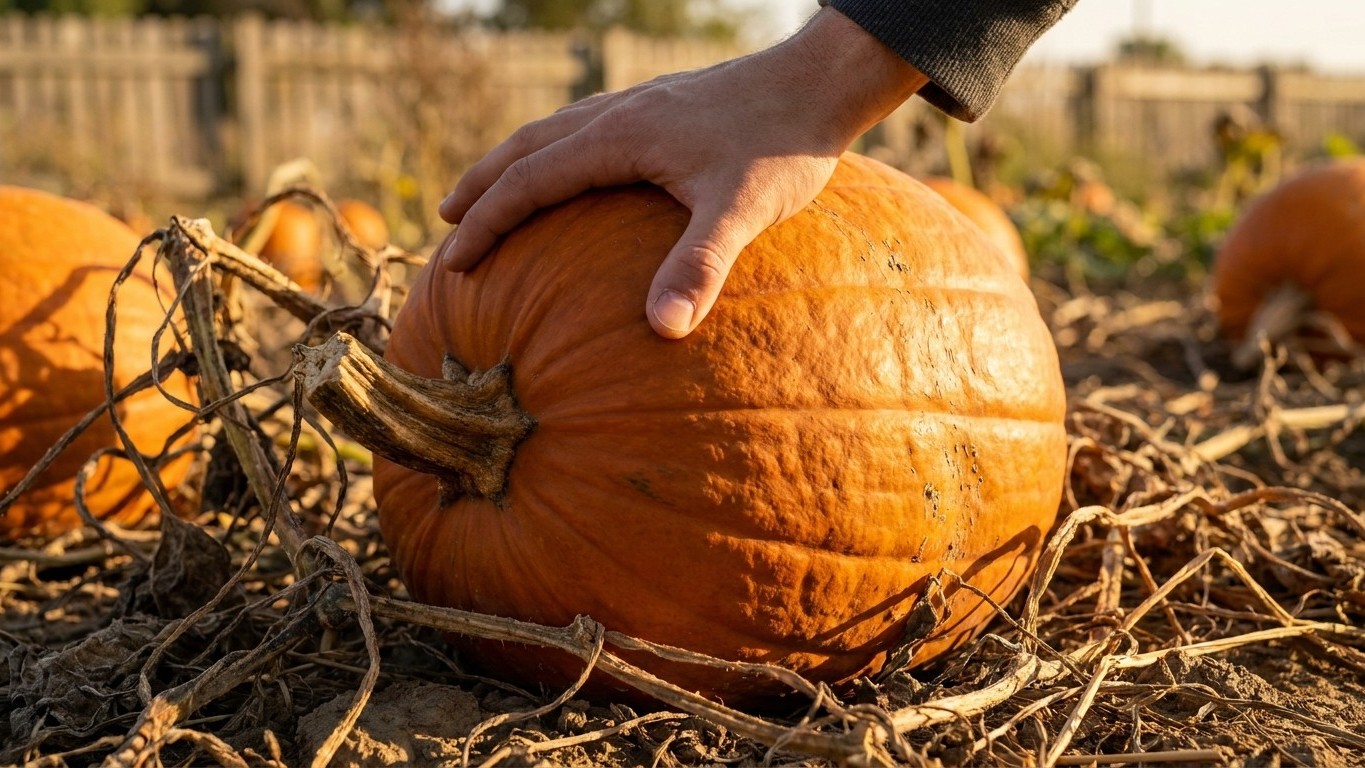

Three signs tell you a pumpkin is ready to cut: full color with the vine dying back, a rind too hard for a fingernail to scratch, and a stem intact with 1 to 2 inches left on top, according to University of Illinois Extension. Skip any one of these and you’re gambling on a pumpkin that looks orange but isn’t actually done.
The short answer

University of Illinois Extension puts a number on the one sign most people overlook: stem length. Its guidance for choosing a pumpkin is to look for one with 1 to 2 inches of stem left attached. That’s not a cosmetic preference. The stem functions as a seal over the fruit’s interior, and once it breaks off, that exposed section becomes a direct entry point for rot and decay to set in faster than it would otherwise.
Utah State University Extension fills in the other two signs, both tied to how the pumpkin developed on the vine rather than how it looks sitting in a patch or on a stand. A pumpkin is mature, in their language, when it’s fully colored, when the vine that fed it has started to die back, and when the rind has hardened enough that a fingernail can’t scratch through it. That third test is the most reliable one you can do on the spot, standing in a field with nothing but your hand. Press a thumbnail into the rind near the base. If it slides in or leaves a mark, the pumpkin needs more time. If it just skates across hardened skin, that’s a fruit that’s finished growing.
Color alone fools people constantly. A pumpkin can turn deep orange while the flesh underneath is still soft and the rind still gives under pressure, especially in a warm stretch late in the season. That’s why extension guidance stacks three checks instead of relying on one. Vine die-back matters because a living vine is still pulling water and sugars into the fruit; once it starts browning and collapsing, the pumpkin has stopped changing and won’t improve by staying attached longer.
Weight matters too, though it’s a supporting sign rather than a maturity test. Utah State University Extension notes that harvested fruits should come off the vine with the stem attached and go somewhere they won’t freeze, and University of Illinois Extension adds that a pumpkin worth taking home should feel heavy for its size, free of blemishes and soft spots. Shape doesn’t matter at all. A lopsided pumpkin that’s heavy, hard-shelled, and carries its full stem is a better choice than a picture-perfect one that’s light and soft.
What actually decides it
The three signs aren’t arbitrary checkpoints. Each one reflects something specific happening inside the fruit as it finishes developing, and understanding the mechanism helps explain why skipping a step causes problems later.
Why the rind hardens
A pumpkin’s shell starts soft and green because the plant is still investing energy in growth. As the fruit approaches maturity, the outer wall lignifies, meaning it builds up rigid structural material the way a young tree trunk does. That hardened rind is what keeps moisture in and organisms out. A fingernail test works because soft, immature rind hasn’t built up that barrier yet. Once it has, the rind resists not just your nail but the fungal spores and bacteria that would otherwise find easy entry through a still-thin skin.
Why the vine’s condition matters
A pumpkin plant behaves like a supply line. While the vine is green and active, it’s still moving water and sugars toward the fruit, and an immature pumpkin cut too early won’t finish ripening off the plant the way a tomato might. Once Utah State University Extension’s marker of vine die-back shows up, the transfer has effectively stopped. Cutting at that point doesn’t rob the fruit of anything it still needed.
Why the stem is a seal, not a handle
The stem is the plug over the point where the fruit once connected to the vine. University of Illinois Extension is specific that once it breaks off, that exposed section becomes a weak point where decay gets started prematurely. That’s a structural fact, not just a rule of thumb, which is why a pumpkin should never be lifted or carried by the stem. Grip it there and the stem can crack loose under the fruit’s weight, and now you’re holding a pumpkin with an open wound instead of a sealed one.
How to do it
- Check the vine and color first. Look for a fruit that’s fully colored with a vine nearby that’s browning and dying back rather than green and actively growing.
- Run the fingernail test. Press a thumbnail against the rind near the base. If it doesn’t scratch or dent, the rind has hardened enough for harvest.
- Inspect the stem. Confirm there’s roughly 1 to 2 inches of stem attached, per University of Illinois Extension. A short, broken, or missing stem means the seal is already compromised.
- Cut, don’t pull. Use a knife or pruners to cut the vine a few inches from the fruit rather than twisting or snapping it off, which protects the stem from cracking at the base.
- Lift by the body, never the stem. Carry the pumpkin with both hands under its weight. The stem is a seal, not a handle, and it can snap under load.
- Check overall condition. Set it down and scan for blemishes or soft spots. University of Illinois Extension notes it should feel heavy for its size; shape doesn’t matter.
- Store where it won’t freeze. Utah State University Extension is specific that mature fruits should be kept somewhere protected from freezing temperatures once harvested.
What goes wrong
- Harvesting by color alone. A pumpkin can look fully orange while the rind is still soft underneath. Fix: always run the fingernail test before cutting, regardless of how deep the color looks.
- Snapping the stem off instead of cutting the vine. A twisted or yanked stem often cracks at the base, breaking the seal before the pumpkin even leaves the field. Fix: cut the vine a few inches away with a blade so the stem stays intact and attached.
- Carrying the pumpkin by its stem. The stem isn’t rated to hold the fruit’s weight, and it can snap off in your hand. Fix: carry with two hands supporting the body from underneath.
- Ignoring soft spots and light weight. A pumpkin that feels light for its size or shows soft patches is already breaking down internally, even if the outside looks fine. Fix: set aside any fruit with blemishes or a hollow, light feel and choose one that’s heavy and unmarked instead.
- Storing it somewhere that freezes. Freezing temperatures damage the rind and flesh, accelerating collapse. Fix: keep harvested pumpkins in a spot that stays above freezing until you’re ready to use them.
- Expecting a published number for how long a carved pumpkin lasts. No extension service publishes a preservation protocol or a countdown of days for carved jack-o’-lanterns, and none recommends dips, coatings, or treatments for extending carved life. What’s actually documented is upstream of carving: choose a mature, hard-rinded, heavy pumpkin with an intact stem, keep it whole and unblemished, and carve close to the day you plan to display it.
Common questions
Does the stem need to be a certain color to be ready?
Neither extension service ties stem color to maturity. The measurable marker is length, roughly 1 to 2 inches per University of Illinois Extension, along with the stem being firmly attached rather than loose or cracked.
Can a pumpkin keep ripening after it’s cut from the vine?
The guidance from both extension services centers on cutting once vine die-back and rind hardness show up, which suggests the fruit has already finished the growth phase that depends on the live vine. Neither publishes information about post-harvest ripening.
Is it safe to pick before the first frost?
The mean first fall frost date is only an average for a given area, not a guaranteed event, and it’s separate from a hard freeze. The three signs, color, vine die-back, and rind hardness, are the actual markers to use rather than timing a harvest around a frost estimate.
Does a pumpkin’s shape indicate whether it’s ripe?
No. University of Illinois Extension states plainly that shape is unimportant. Weight, firmness of the rind, absence of soft spots, and an intact stem are the relevant checks, not how symmetrical or classic the pumpkin looks.